Yearning for Success: The Job Challenges Faced by Freshers #CampusTo Corporate

Freshers often face unique challenges when entering the job market. Lack of experience, uncertainty about industry norms, and fierce competition can all make the transition daunting. Let me share a scenario of one my student to make you understand the challenges that exists.

Radhika’s academic prowess was undeniable; she consistently topped her class and received accolades for her achievements. However, her success in academics did not translate seamlessly into securing a campus placement due to her struggle with communication skills. Despite her excellent grades, Radhika found it challenging to effectively express herself during interviews and interact confidently with potential employers.

Despite these challenges, Radhika’s luck turned when a company recognized her potential and decided to offer her a job. They were impressed by her academic record and believed that her eagerness to learn could compensate for her current limitations in communication. Radhika was thrilled to receive the job offer and eagerly accepted the opportunity.

However, once Radhika started working at the company, she encountered difficulties adapting to the office culture. She found herself struggling to navigate the unwritten rules, social dynamics, and expectations of the workplace. Radhika’s lack of familiarity with office norms, such as professional etiquette, collaboration dynamics, and time management practices, hindered her integration into the team.

As a result, Radhika faced challenges in building relationships with colleagues, understanding the company’s processes, and meeting performance expectations. She felt overwhelmed and out of place in the new environment, which affected her confidence and job satisfaction.

To overcome these challenges, Radhika realized the importance of proactively seeking support and guidance. She reached out to her manager and colleagues for advice, clarification, and feedback on her performance. She also took initiative to observe and learn from more experienced coworkers, asking questions and seeking opportunities to improve her understanding of office culture and expectations.

Over time, with patience, perseverance, and a willingness to adapt, Radhika gradually acclimated to the office culture. She became more comfortable in her role, developed stronger relationships with her colleagues, and gained confidence in her abilities. Radhika’s journey underscores the importance of resilience, adaptability, and continuous learning in navigating the challenges of transitioning from academia to the corporate world.

  1. Lack of Experience: One of the primary challenges is the lack of professional experience. Without a track record in the industry, freshers may struggle to demonstrate their capabilities and compete with more experienced candidates.
  2. Limited Network: Freshers typically have a smaller professional network compared to seasoned professionals. Building connections within the industry can be challenging, making it harder to find job opportunities and access valuable mentorship.
  3. Unfamiliarity with Corporate Culture: Adjusting to the corporate environment and understanding its norms, hierarchies, and dynamics can be overwhelming for freshers who are new to the workforce.
  4. Skill Gap: Despite possessing academic qualifications, freshers may lack certain practical skills that are highly valued in the corporate world. This gap between academic learning and real-world application can hinder their performance and career progression.
  5. Job Search Challenges: Finding entry-level positions that match their skills and interests can be difficult for freshers. Additionally, navigating the job application process, writing resumes, and preparing for interviews can be daunting without prior experience.
  6. Pressure to Perform: Freshers often feel pressure to prove themselves and meet high expectations in their new roles. This pressure can lead to stress and anxiety, especially if they are given significant responsibilities early on.
  7. Limited Career Guidance: Without experienced mentors or career advisors, freshers may struggle to chart their career paths and make informed decisions about their professional development.
  8. Work-Life Balance: Balancing work responsibilities with personal life can be challenging, especially for freshers who are still adjusting to the demands of the corporate world. Long hours, tight deadlines, and workplace pressure can impact their overall well-being.
  9. Recognition and Validation: Freshers may feel undervalued or overlooked in the workplace, particularly if their contributions are not recognized or appreciated by their colleagues or superiors.
  10. Adapting to Change: The corporate world is dynamic and constantly evolving. Freshers must adapt quickly to changes in technology, industry trends, and organizational priorities to stay relevant and competitive.

Despite these challenges, freshers can overcome them by leveraging their strengths, seeking mentorship, continuously learning, and staying resilient in the face of adversity.

  1. Focus on Transferable Skills – While freshers may lack direct job experience, they often possess transferable skills gained through education, internships, volunteer work, or extracurricular activities. Highlighting these skills on resumes and during interviews can demonstrate to employers your ability to adapt and learn quickly.
  2. Networking: Building a professional network can open doors to opportunities that may not be advertised. Attend industry events, connect with alumni, and engage with professionals on platforms like LinkedIn. Networking can provide insights, mentorship, and potential job referrals.
  3. Tailored Resumes and Cover Letters: Customize your resume and cover letter for each job application to emphasize how your skills and experiences align with the role. Use keywords from the job description and highlight achievements that demonstrate your capabilities.
  4. Interview Readiness: Prepare thoroughly for interviews by researching the company, understanding the role, undergoing interview skills training and practicing common interview questions. Showcase your enthusiasm, communication skills, and problem-solving abilities during the interview process.
  5. Continuous Learning: Stay updated on industry trends, technologies, and best practices. Pursue online courses, certifications, or workshops to enhance your skills and make yourself more marketable to employers.
  6. Seek Feedback: Request feedback from mentors, peers, or interviewers to identify areas for improvement. Constructive feedback can help you refine your approach and become a stronger candidate in future job applications.
  7. Stay Persistent and Resilient: Rejection is a common part of the job search process, especially for freshers. Stay resilient, remain positive, and continue applying for opportunities that align with your career goals. Persistence often pays off in the end.
  8. Problem-Solving Skills: Adaptable freshers are adept at problem-solving and finding creative solutions to challenges they encounter. They approach obstacles with a positive mindset, viewing them as opportunities for growth and innovation rather than setbacks. This mindset enables them to overcome hurdles more effectively and contribute positively to their teams and organizations.
  9. Flexibility in Roles: Freshers may not always land their dream job right away. Being adaptable allows them to be open to different opportunities and roles within their field. They can leverage their transferable skills and willingness to learn to excel in diverse job functions, even if they initially envisioned a different career path.
  10. Navigating Change: The corporate world is dynamic, with constant changes in technology, processes, and market trends. Freshers who are adaptable can quickly adjust to these changes without feeling overwhelmed. Whether it’s learning new software, adapting to a different work environment, or embracing new strategies, adaptable freshers can easily pivot and thrive in evolving circumstances.

Four Types of Employee Training Programs #CampusToCorporate

When a company invest in employees training programs, they are actually investing in their own success. We all are living in an era where technology advances are common and to survive in this ever-changing world every employee demands their companies to facilitate them with continuous training programs to keep them abreast with the latest technologies, trends and different industrial processes. Now these training methods are designed not just to enhance employees skills but help in improving their performance and productivity, develop efficiency in their job, and avoid violations of laws and regulations and prepare them for the future.

Benefits of training programs

These ongoing training programs brings out positive culture and environment that facilitates employees in becoming

  • More adaptive: An employee who is more adaptive in nature will never fear a change. They would challenge themselves by being more innovative. Adaptability increases their chances of succeeding, as they will find themself trying out different job.
  • More productive: As every employee will be familiar with their roles and responsibilities it will help them to give their 100% and be more productive and efficient.
  • Improve morale: Employee training sharpens the skills and knowledge of employees, which results in a boost of their morale and adds a sense of job satisfaction as well as security. A satisfied and motivated employee is a great asset for organizational success.
  • Improve retention: Every company want an efficient employee and every employee want an opportunity to grow. A company with a culture of continuous learning and development leads to  higher retention rates. This is why prioritizing training inspires top talent to stick around for a long time.
  • Reduce error: Workplace training makes employees more proficient and reduces the chances of them committing errors on the job. It strengthens the functioning and abilities of the employees.
  • Identifying weaknesses: Employee training program will make organization aware about their weaknesses and allows to strengthen the skills that each employee needs to improve.

Four different types of training programs

Orientation Training

Orientation training program is generally conducted by the HR department of any company to train and make them aware about their roles and company policies. The orientation program benefits both employee and employer as both get to learn about each other which is must for their success.

Onboarding training

Onboarding training helps new employees to speed up their understanding of their responsibilities and organizational culture in becoming productive team members quickly. Onboarding is responsible for truly integrating an employee within an organization. This training includes functional training where in employee has been given overview of the company and their roles and goals.

Compliance Training

This is one of the mandatory training that every organization needs to provide. It educates employees on the laws and regulations applicable to their job function or industry. Some of the examples of compliance trainings are anti-harassment, diversity, cybersecurity and business ethics. Undergoing this training will help in minimizing the risks and provide better and safe workplace environment for employees.

Soft Skills Training

Soft skills training is very crucial for every organization as employees trained in soft skills will help organization in maintaining good customer relationships, gaining new clients and building stronger team dynamics. Soft skills training includes communication skills, negotiation skills, conflict management skills, leadership skills, sales and customer service ready and team building. These skills are not only necessary for their individual career growth but for the overall development of the organization.

Things to remember

Identifying and implementing right training program for your organization enables you to create rich learning opportunities that can truly empower your employees to grow with the organization.

Make sure that these training programs are interactive. Interactive training engages each individual and connects them personally and focuses on learner’s engagement which leads to higher productivity and performance.

Every training program should have a purpose and a goal as it puts them in the right direction for creating and setting realistic employee training goals and objectives. Your organization’s training goals should be SMART so that they know what is expected to achieve by the end of a training program. 

‘This blog post is part of the blog challenge ‘Blogaberry Dazzle’ hosted by Cindy D’Silva and Noor Anand Chawla.’

6 Most Innovative Future Jobs #CampusToCorporateSeries

Embracing Unknown Future will reduce the anxiety. And if I say so I may not be wrong. Tomorrow’s graduates will be entering into the professional unknown as they will be taking up jobs which doesn’t exist now. But there is nothing to fear as it’s rightly said “Change is the only constant thing” and fearing that change will only cause you stress, so if one wants to increase their probability of success, accept the change, be the change and be proactive in the approach.

The fourth Industrial revolution is here and has brought opportunities that unfolds many stages of development. We all are standing at the edge of technological revolutions that will change the way we live, work and relate with one another. The transformation and scale of this revolution will be such that humankind have not experienced it before. As I said we don’t know how it will unfold, but it is surely going to be integrated and comprehensive as there will be fusion of technologies which will fade away the line between physical, digital and biological spheres and wherein public sector, private sectors, academia and civil society all will be part of it.

The 21stcentury has witnessed rapid change and many new jobs are the result of experimentation and complementary rather than replacing existing jobs. Lets see how and what future jobs are going to look like.

Wearable Technology Personalized Therapist

Wearable technology is something that you can wear, be it smart watches, fitness trackers which are mostly personalized. Today people are not just going through physical health issues but emotional health concerns too which has increased the demand for personalized therapist. These therapists will use AI and research to monitor the emotional health of their patients and give personalized therapies. The required skills would be High EQ and SQ, creative thinking , technical aptitude and analytical skills.

Memory Creators

Recreating spaces for people who want to relive beautiful memories of past. Here a creator needs to do historical research and combine it with interior design skills to recreate the space which are the reflection of their favorite time of life. Basically they will develop virtual reality experience to help them to cherish those memories which will bring happiness and love in their lives.

Robot Police

As in real life , technology also comes with lot of ethical problems that emerges with the design, operation or use of robots in real life. For example using drones are still not legal in many countries, so to keep a track of their movements and tasks we require a profession that requires strong analytical and risk assessment skills in order to proactively assess the danger these machines can bring and how to control them by using specific action.

Best Out of Waste Creators

As we know India generates 62 million tonnes of waste each year. About 43 million tonnes (70%) are collected of which about 12 million tonnes are treated and 31 million tonnes are dumped in landfill sites. Now Best out of waste creators will help in creating ways to reuse these waste by helping individual toat individual level. They will be responsible for creating new ideas and sharing it with general public, so that waste can be reused at the source itself and this can help in reduction in the volume of waste generation. This future job would help us to live in a more environment friendly way. The creator should have creative skills, engineering skills and good interpersonal skills so that they not just create innovative ideas but letting those ideas be acceptable by the people too.

Criminal Psychology Tapper

The crime rate in India is increasing year after year. No law or rule could create fear in these criminal minds. These criminal psychology tappers will not just have neurological understanding but emotional and analytical skills which will help them to understand how criminal mind works. Research conducted by Dustin Pardini, PhD, of the University of Pittsburgh, 26-year-old men with lower amygdala volumes are three times more likely to be aggressive, violent and to show psychopathic traits than the same age men with normal-sized amygdala, independent of factors including history of violence and social background. With the help of AI and neurological research, criminal psychology tapper will ensure to balance amygdala volume to balance the emotions and this may help in reduction in crime rate.

Farming Big Data Analyst

We know that a farmer is a person who works as an agriculturist and produces a wide variety of food products and to get better yield he also manipulates the environment by using, pesticides, fertilizers, crop rotation etc. Similarly farming big data analyst grows data from computer models and manipulates it , this can help them predict new trends for developing new and innovative products and services, regulate commerce and environment strategies. They do this with the help of simulation model where they work on algorithm and estimate things by assuming variables for their advantage.

As I said earlier, future jobs are going to be an unknown territory, nobody knows how it is going to be but one thing we are sure that technologies like Al, big data, block chain will be integrated with traditional way or working to give absolutely new and innovative working style. So prepare yourself working in diffuse mode of brain where-in you have to think out of the box. Most of these futuristic jobs are going to be fusion of different skills but the foundation will remain techno innovation with Al.

“Innovation is taking two things that already exist and putting them together in a new way” – Tom Freston

This blog post is part of the blog challenge ‘Blogaberry Dazzle’ hosted by Cindy D’Silva andNoor Anand Chawla in collaboration with RRE Studios and ShowCase Events.

What is Skill Mapping and Ways To Develop Skill Matrix?#CampusToCorporateSeries

In my previous post I have talked about How to develop job oriented skillset. In order to develop any skill it is imperative to understand the skills one needs to develop and for that very purpose we need to do skill mapping.

Skill mapping is similar to competency mapping the only difference is competency mapping is more in depth which includes things beyond skills, like behaviour. Skill mapping is a visual representation of the skills needed to perform well in any given role and comparing that with the existing skills. This comparison will allow to identify the gaps. Skills maps can provide a view of the entire team by showing the contributions and skills of each individual in the teams.

Need of Skill Mapping

Skill mapping will not only show the strength and weakness of a team but will benefit the company as a whole. Organizations and companies do this in order to get better clarity and insight about their employee’s skillset.

  • Skills mapping identifies which tasks and skills are crucial to the organization as only few employees can actually perform a certain task to a required level.
  • It helps in recommending what kind of training employee needs.
  • It can find the substitute candidate in case of emergency.
  • It allows tracking the progress of each team and individual.

Skill mapping benefits the team as the organization would know the skills required by the team before a project begins. It benefits the employee as they could identify their strengths and weaknesses and accordingly can train themselves. It benefits the company, as they know what skill sets they require and accordingly hire people. While doing skills mapping they could clearly see available skills and missing skills and empower their employees with required skills or hire people with skills which are needed to reach company’s goal. A team that is aware about their strengths and weaknesses can work on upgrading their skills and in turn company gets the benefits so the company benefits mean good news to the clients.

Skill Matrix

Skill mapping provides immense benefits and the best way to visualize proficiency level is by using the tool called Skill Matrix. A skill matrix is a snapshot of all the employees skills laid out in matrix form.

How to make Skill Matrix?

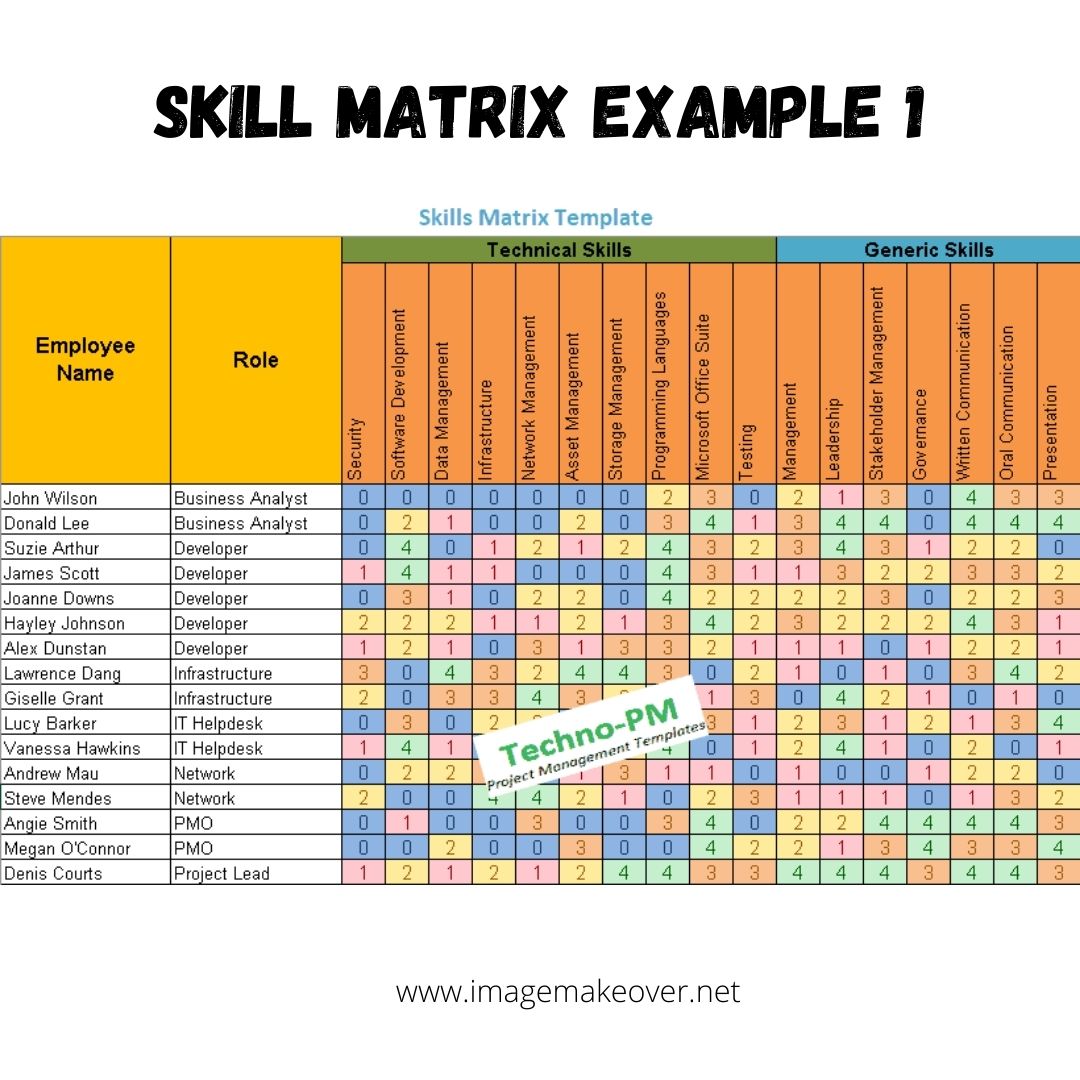
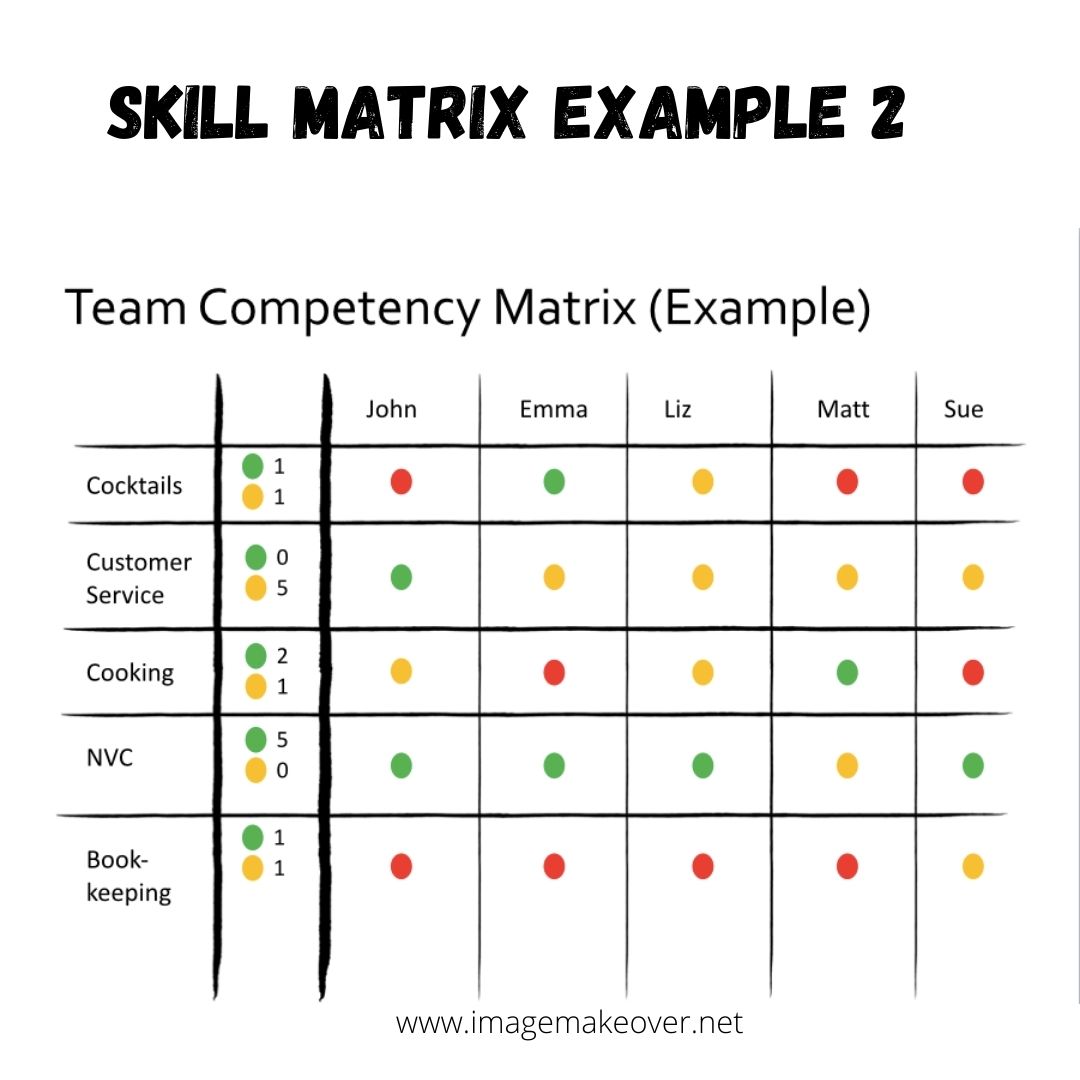
Create one skill matrix for each department or a team. List down names of all the employees and their role down the left hand column and all their skills across the top row. Then enter the proficiency levels for each employee for each skill until the matrix is filled. Measuring proficiency varies from organization to organization.

Firstly, it is important to determine what kind of skills are required for a particular project. This input will list down the competencies that you’ll assess the team members on.

Secondly, assess the team member on their current skill level.

Some organizations divides their capabilities in 4 group

  • No capability
  • Basic level of capability
  • Intermediate level of capability
  • Advanced level of capability

Some organization uses 5 point scale, to determine knowledge and experience of their employees

  1. No experience or knowledge
  2. Little experience or knowledge
  3. Reasonable experience or knowledge
  4. Considerable experience or knowledge
  5. Expert experience or knowledge

Thirdly, the skills matrix may show that you have someone competent at a crucial task – but if the person is unwilling to perform the task, you will still hit a dead end. For each person, you’d want to know whether they have:

  1. No interest in applying this skill or knowledge
  2. Interested in applying this skill or knowledge

Lastly, incorporate all the information in the matrix and analyze.

You can find different types of skill matrix, so use what suits you the best or create one which works for you. Please find some of the examples below

For any project to be a successful it is important to make sure you have the right people and the right skills to start quickly and finish the job successfully. In such scenario the skills matrix, or competency matrix, is your best friend.

@ Swati Mathur

‘This blog post is part of the blog challenge ‘Blogaberry Dazzle’ hosted by Cindy D’Silva andNoor Anand Chawla.’

10 ways to Boost Confidence at a Job Interview- Campus To Corporate

The one thing that held people pursuing their dream is fear of failure and to overcome that, one needs to have self-confidence. If we do anything with the mindset of having nothing to lose than no uncertainties can ever stop us achieving what we ever dream of.

Being interviewed for a job can make you nervous, sacred and doubtful about your own abilities. And to add to these feelings you need to come across as cool, clam and confident during the interview. The question is How to build self-confidence? Do you believe in yourself? If the answer is yes then why to worry, but if the answer is No , then why to worry, as I have the list of ways that can help you overcome this fear and make you a confident interviewee.

Continue reading “10 ways to Boost Confidence at a Job Interview- Campus To Corporate”

Ace Your Interview Skills – Campus To Corporate

This is my Fourth post on the theme Campus to Corporate. Hiring manager decides to call for an interview based on your impressive Resume and after you clear your other rounds like, technical, aptitude and group discussion.Therefore personal Interview is one of the most crucial in the process of recruitment as this is the final round which decides whether you are in or out.

Job interviews are of utmost importance for you as a job aspirants, especially if you are taking your first step in this regards. Hiring manager calls for an interview only if you pass through Group discussion especially if they are going for mass hiring. A good interview can make or break the confidence of a job seeker. In this world of employment it is more important than ever to have good interviewing skills due to increasing competition and the main reason for this is that graduation rates are increasing and students will leave college with more competition. If you fail to create a good impression it could cost you an opportunity.

This shows that having good grades and appropriate working experience is not enough to get your dream job, you need to have strong interviewing skills.

Planning and preparation before the interview

  • Collect as much as information as you can about the organization you will be going for an interview.
  • Go through the job description and requirement in detail as you will know what is expected from you.
  • Resume and Interview call letter should be carried along when you are called for an interview.
  • It is important that you confirm the date and venue before you head for the interview.
  • Groom properly and look your professional (Dressing) best.
  • Conduct mock interview with your friends and family members.
  • Be prepared with the expected questions you expect, read and reread and edit them to make them concise and practice these polished answers out loud, repeatedly.
  • Try to be positive and do not worry about outcome.
Continue reading “Ace Your Interview Skills – Campus To Corporate”