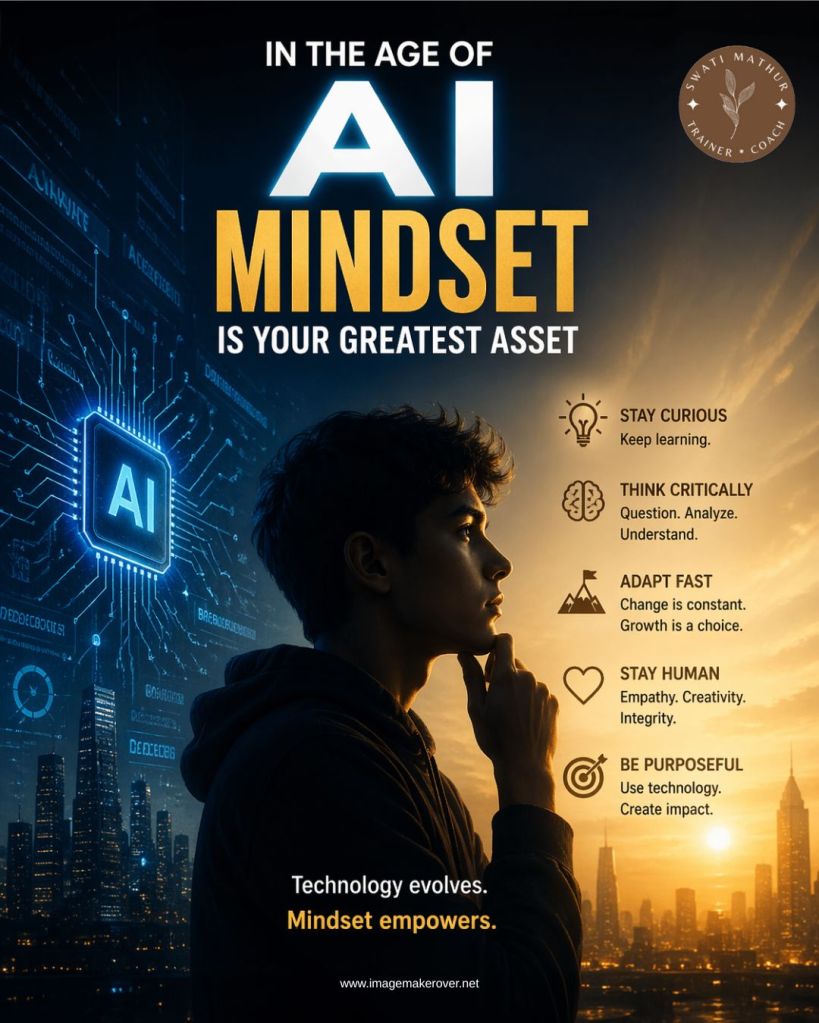
In a world shaped by Artificial Intelligence, tools are evolving rapidly but the real differentiator is not the tool you use, it is the mindset you bring to it. AI can enhance your abilities, automate your work, and expand your possibilities. But whether it becomes your advantage or your limitation depends entirely on how you think.
As Henry Ford once said:
“Whether you think you can, or you think you can’t—you’re right.”
And in the age of AI, this statement holds deeper meaning than ever before. Why Mindset Matters More Than Skill. Today, anyone can access AI tools, skills can be learned and knowledge can be acquired. But mindset determines whether you even choose to learn, adapt, and grow.
Two people may have the same access to AI, one feels threatened and avoids it while the other feels curious and explores it. Over time, the second person moves ahead, not because of better tools, but because of a better mindset.
This highlights an important truth “Mindset drives action, and action drives results.” In the context of AI, mindset becomes even more visible. A fixed mindset says
“AI is too complex for me”
“Technology will replace me”
“I am not good at learning new things”
This leads to fear, resistance, and stagnation.
A growth mindset, on the other hand, says
“I can learn this step by step”
“AI is a tool I can use”
“Every challenge is an opportunity to improve”
This leads to curiosity, action, and continuous progress.
As Carol Dweck said: “Becoming is better than being.”
In the AI era, this belief is what keeps you relevant. Interestingly, AI often mirrors the mindset of the person using it. If your mindset is curious you ask better questions and explore deeply and if it is fearful you will avoid using it or use it superficially. If you become lazy you depend on it without thinking but if you have growth mindset you use it to learn, improve and create. The tool remains the same but the outcome changes completely.
Developing the right mindset is not about sudden transformation, it is about small, conscious shifts.
For example, Instead of saying “I don’t understand AI,” say “I am learning AI”, instead of avoiding new tools, explore them with curiosity and instead of fearing mistakes, treat them as learning steps. These small changes in thinking create powerful long-term results. AI can either make you dependent or make you capable.
If your mindset is passive, you will rely on AI for everything and stop thinking independently and even lose confidence over time but if your mindset is active then you will use AI as a support tool, strengthen your thinking and build confidence and clarity. Your mindset decides whether AI becomes a crutch or a catalyst.
AI will continue to evolve. Tools will keep changing. Skills will keep updating. But mindset is what allows you to adapt to all of it.
AI can open doors but one thing you should always remember that, your mindset will determines whether you walk through them.
This post is part of Blogchatter A2Z challenge 2026
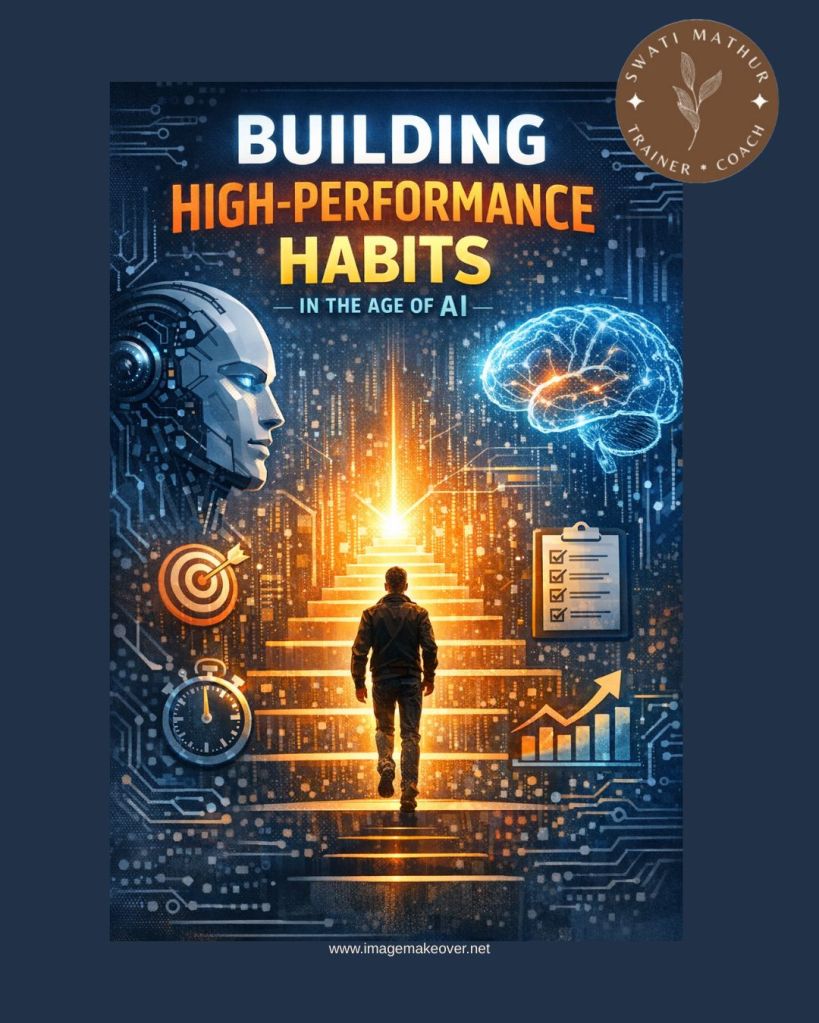
In the age of AI, your habits is not just your intelligence but it will define your success.
We often believe that intelligence, talent, or access to the right tools gives people an edge. But today, with Artificial Intelligence making knowledge accessible to everyone, the playing field has changed.
The real differentiator is no longer what you know, but what you repeatedly do. AI can not only give you answers in seconds or can simplify complex problems but it can even think alongside you. But there is one thing it cannot do and that is, it cannot build your habits. And that is exactly where your future is decide.
There was a time when information was limited. People who had knowledge had power but today, information is unlimited. Anyone with a smartphone can learn anything. So what matters now?
Consistency over intensity
Discipline over motivation
Execution over intention
You don’t need to know everything, but what you really need is the habit of learning continuously. Imagine two students, one who studies only before exams, using AI to quickly prepare. and another one studies a little every day, using AI to understand deeply. The difference is not intelligence. The difference is habit. We need to remember success is not a one-time event, it is a system. and habits are that system. They operate quietly in the background, shaping your skills, thinking patterns, your confidence and your Identity. You don’t wake up one day confident instead you become confident by repeatedly doing things that build confidence.
Similarly, in the AI era, you don’t become future-ready overnight instead you build it through daily habits of learning, adapting, and applying.
AI has made life faster, but it has also made distractions stronger and patience weaker. This creates two kinds of people:
1. The Reactive User
Uses AI for quick answers
Avoids effort
Seeks shortcuts
Feels productive but isn’t growing
2. The Intentional Learner
Uses AI to explore deeper
Asks better questions
Practices and reflects
Builds long-term capability
The difference lies in one thing: habitual behavior. We often underestimate small actions because they don’t show immediate results. But transformation is never instant, it is accumulated. Consider these simple but powerful habits:
Writing or journaling for 10 minutes daily
Learning one new concept every day using AI
Practicing speaking or communication regularly
Asking “why” and “how” instead of just accepting answers
Individually, these feel small but collectively, they create exponential growth.
One of the most powerful ideas that I have come across is that “You don’t rise to your goals. You fall to your habits.” how beautiful and true. Your habits are constantly answering on every important question and that is “Who am I becoming?” If you practice daily, you will become disciplined, ff you avoid effort, you will become dependent and if you think deeply, you will become insightful. In the AI age, identity matters more than ever because tools are common but mindsets are not.
AI is powerful but how you use it depends on your habits. Use AI to learn, and not just to finish any tasks. It is extremely imperative to cross-check and validate information also learn to apply what you learn in real situations and also build original thinking alongside AI. Apart from empowering us there are certain things that we need to be cautious about, like not blindly trusting AI outputs, not to copy-past without understanding, not making enough effort because AI makes things easy and also not to become mentally passive.
Remember, If you don’t control your habits, your habits will control your future. Habits don’t show results immediately which is why people quit early. But over time, they create a powerful effect. For example 1% improvement daily leads to massive growth in a year and 1% neglect daily leads to gradual decline. A student who practices communication for just 10 minutes daily may not see change in a week. But in 6 months, their confidence can completely transform. Similarly, someone who avoids effort daily may not fail immediately but slowly loses competence.
In the age of AI, tools are available to everyone but discipline is not. And discipline is built through habits.
This post is part of Blogchatter A2Z challenge 2026
Leaving anything on chance means relying solely on luck or external factors without taking proactive actions to influence the outcome. When it comes to achieving goals or navigating through challenges, relying completely on chance can lead to disappointment and missed opportunities.
Instead of passively waiting for things to happen it’s important that we take ownership of our circumstances and outcomes and recognize that we have the power to influence our destiny through your actions, choices, and mindset. By assuming responsibility for our life, we empower ourself to actively shape our future.
For that the first thing that we need to do is set clear goals. Define specific, achievable goals that align with our values and aspirations. And then break down our goals into actionable steps and create a plan to accomplish them. Setting clear goals will provide direction and purpose, guiding our actions and decisions toward desired outcomes.
Creating a detailed plan outlining the steps we need to take to achieve your goals helps us to eliminate potential obstacles and develop strategies to overcome them. Having a well-thought-out plan increases our chances of success by providing structure, guidance, and clarity on what needs to be done.
Next step is to execute our plan with intentionality and purpose and if it is done with consistency and strategically, these actions will move us closer to our goals. Be proactive in seeking opportunities and addressing challenges as and when they arise. When we take deliberate action, we exert control over our circumstances and create opportunities for success. Adopt an attitude of constant learning and development. Consider our past experiences, including our triumphs and setbacks, and draw insightful conclusions from them. Utilize input to improve our strategy and make any necessary changes to your tactics. Remember we become more resilient and effective when we are always changing and adjusting. Develop resilience to navigate setbacks and adversity. It is imperative that we understand that challenges are inevitable on the path to success so if we view them as opportunities for growth and learning nothing can stop us from being successful. Cultivate resilience by building coping skills, maintaining a positive outlook, and staying focused on your long-term goals.
Stay Committed and focused on our vision and remain dedicated to pursuing it, even in the face of obstacles or setbacks. We need to trust our abilities and persevere through challenges with resilience and resolve. Willingness to step out of your comfort zone and take calculated risks to advance toward your goals will definitely give rewards. Firstly we need to assess potential risks and rewards, and then make informed decisions based on careful consideration and analysis. Taking calculated risks allows you to seize opportunities for growth and innovation while minimizing potential negative outcomes.
By adopting a proactive approach and refusing to leave anything to chance, we are empowering ourself and creating the future we desire. Through intentional action, strategic planning, and a resilient mindset, we can overcome obstacles, achieve your goals, and fulfill our potential.
Making vows or promises to change is a common human behavior. However, without a solid plan and commitment, those promises often remain just words.
Imagine someone, who wants to lose weight, may say, “From now on, I’ll eat healthier and exercise regularly. I’ll lose 20 kgs!” She feels motivated at the moment, but without a concrete plan, she is solely relying on her good intentions. She doesn’t set specific goals, establish a workout routine, or plan her meals. As a result, a few weeks later, She finds herself falling back into old habits. She gets discouraged and concludes, “I knew nothing would change. I’ve blown it again.”
While on the other hand someone who also wants to lose weight, but here she understands the importance of planning. She sets SMART goals: Specific, Measurable, Achievable, Relevant, and Time-bound. Instead of just saying he’ll eat healthier, her plans to cook meals at home four times a week, incorporating more vegetables and lean protein. She schedules workouts three times a week, alternating between cardio and strength training and tracks her progress, celebrating small victories along the way. When she encounters setbacks, he adjusts her plan rather than giving up entirely.
In the second scenario her approach exemplifies starting with the end in mind, a concept popularized by Stephen Covey in “The 7 Habits of Highly Effective People.” By envisioning her desired outcome and working backward to create a roadmap, she sets herself up for success. Breaking down goals into manageable steps prevents overwhelm and increases likelihood of sticking with the plan.
In both scenarios, the desire for change exists, but only one individual takes deliberate action to turn that desire into reality. Making vows or setting intentions is only the first step; true transformation requires planning, commitment, and perseverance. By taking ownership of the process and proactively addressing challenges, one can bring about meaningful change in their lives.
Planning is essential for achieving any goal effectively. Here’s a step-by-step guide to do that
Identify Your Goal: Start by clearly defining what you want to achieve. Make sure your goal is specific, measurable, achievable, relevant, and time-bound (SMART). For example, instead of saying “I want to get fit,” specify “I want to lose 10 pounds in three months.”
Break it Down: Divide your goal into smaller, manageable tasks or milestones. Breaking down your goal makes it less overwhelming and allows you to track your progress more effectively. For instance, if your goal is to lose weight, your milestones could include creating a meal plan, starting an exercise routine, and tracking your calorie intake.
Set Deadlines: Give each of your milestones a date to establish accountability and a sense of urgency. Setting deadlines for yourself keeps you motivated and focused on achieving your objective. Establish deadlines for things like making a nutrition plan in a week and beginning an exercise regimen in two weeks.
Create a Plan of Action: Describe the actions you must take to reach each goal. Think about the resources you require—such as funds, time, or assistance—and how you plan to get them. If your goal is to start working out, for example, your action plan can include looking out gyms or training programs, buying athletic wear, and setting up particular times to work out.
Anticipate Challenges:Determine any potential roadblocks or difficulties that might occur and come up with solutions. This could involve unanticipated obstacles, time limits, or a lack of desire. Making backup preparations for unexpected events makes you more resilient when things go wrong.
Track Your Progress: Regularly assess your progress to determine how you’re performing in relation to your deadlines and milestones. This can entail keeping a journal, calendar, or goal-tracking software updated with your accomplishments and activities. You may stay on track and make any required plan revisions by routinely monitoring your progress.
Celebrate Achievements: No matter how tiny, acknowledge and celebrate your accomplishments to maintain motivation and reward good conduct. This could be giving yourself a tiny treat as a reward or setting aside some time to recognize your efforts and accomplishments. Honoring your accomplishments gives you more self-assurance and motivates you to keep working toward your objective.
Review and Adjust: Review your plan from time to time to evaluate if you’re progressing and if any changes need to be made. Consider what’s going well and what could be better, and be prepared to modify your plan as necessary. Since planning is a dynamic process, the secret to success is to be adaptable and willing to adjust.
You can more successfully organize your actions and raise your chances of reaching your objectives by adhering to these guidelines. Recall that planning is a continuous process, so maintain your commitment, your focus, and your willingness to make necessary revisions to your plan.
Now this is important, addressing failure is crucial; what strategies will you employ to navigate it effectively?
Acknowledge Your Feelings: It’s normal to feel disappointed, frustrated, or even upset when you experience failure. Allow yourself to acknowledge and process these emotions rather than suppressing them. Recognizing your feelings can help you move forward in a healthy way.
Gain Perspective: Put your failure into perspective by reminding yourself that setbacks are a natural part of life and an opportunity for growth. Reflect on what you’ve learned from the experience and how it can help you in the future. Viewing failure as a learning opportunity can help shift your mindset from defeat to growth.
Practice Self-Compassion: Be kind to yourself and practice self-compassion during times of failure. Avoid harsh self-criticism and negative self-talk, and instead, treat yourself with the same kindness and understanding that you would offer to a friend facing a similar situation. Remember that failure does not define your worth as a person.
Seek Support: Don’t hesitate to reach out to friends, family, or mentors for support during difficult times. Sharing your feelings and experiences with others can provide emotional validation and perspective. Surround yourself with people who uplift and encourage you, and lean on their support as you navigate through failure.
Focus on What You Can Control: While you may not be able to change the outcome of the failure, you can control how you respond to it. Redirect your energy towards aspects of the situation that are within your control, such as your attitude, efforts, and future actions. Channeling your energy into constructive activities can help you regain a sense of agency and empowerment.
Setbacks vs. Failures: Distinguish between setbacks and failures. Setbacks are temporary obstacles that can be overcome with perseverance and resilience, whereas failures are opportunities to learn and grow. Reframe your perception of failure as a setback on your journey rather than a permanent roadblock.
Adjust Your Goals: Use failure as an opportunity to reassess your goals and priorities. Consider whether your goals are realistic, achievable, and aligned with your values. Adjust your goals as needed based on the insights gained from your failure, and create a new plan of action to move forward.
Stay Persistent: Maintain a growth mindset and stay persistent in the face of failure. Understand that success often requires perseverance and resilience in the face of obstacles. Use failure as motivation to keep pushing forward and striving for your goals, knowing that each setback brings you one step closer to success.
By incorporating these strategies into your coping toolkit, you can navigate failure with resilience, self-compassion, and a renewed sense of purpose. Remember that failure is not the end of the road but rather a stepping stone on your journey toward growth and success.
“Every failure and disappointment teaches you something”. People say ‘why me,’ but I say ‘why not.’ You should think you are the chosen one who can have better learning, as each experience teaches you to be a better version of yourself.” Instead of viewing challenges as setbacks, seeing them as opportunities allows individuals to confront difficulties head-on. For instance, if someone faces rejection in a job interview, they could choose to see it as an opportunity to reflect on their skills and improve for future interviews. Each failure or disappointment can serve as a building block for resilience. When facing obstacles, individuals can choose to adapt and grow stronger rather than succumb to despair. Let’s say, a student who fails a test can use that experience to develop better study habits and resilience for future academic challenges. Every setback provides valuable lessons that contribute to personal development. Whether it’s a failed project at work or a broken relationship, there are insights to be gained from analyzing what went wrong and how to do better next time. Someone who experiences a business venture failure might learn valuable lessons about market research, financial management, or team dynamics. Instead of dwelling on self-pity or feeling like a victim of circumstances, adopting the mindset of “why not me?” can foster a sense of empowerment. This perspective shifts the focus from feeling singled out by adversity to believing in one’s ability to overcome it. An athlete who faces a career-threatening injury might use the experience to develop mental resilience and come back even stronger.
Recognizing that failure is not a final destination but rather a stepping stone toward growth enables individuals to embrace a continuous journey of self-improvement. Each setback becomes an opportunity to refine skills, broaden perspectives, and evolve into a better version of oneself. An entrepreneur whose startup fails can use that experience to refine their business model, identify areas for improvement, and ultimately achieve success in future endeavors. By reframing failures and disappointments as opportunities for growth and learning, individuals can harness their experiences to become more resilient, adaptable, and ultimately, better versions of themselves.
A growth mindset is a psychological concept developed by psychologist Carol Dweck, which describes the belief that abilities, intelligence, and talents can be developed through dedication and hard work. People with a growth mindset see challenges, setbacks, and criticism as opportunities for growth and learning, rather than as indicators of their fixed abilities.
Key aspects of a growth mindset:
Belief in Potential: Individuals with a growth mindset believe that their abilities and intelligence can be developed over time. They understand that with effort, perseverance, and effective strategies, they can improve and achieve their goals.
Embracing Challenges: Instead of avoiding challenges or giving up when faced with obstacles, those with a growth mindset see challenges as opportunities to learn and grow. They approach difficult tasks with enthusiasm and are willing to put in the effort to overcome them.
Persistence and Resilience: People with a growth mindset are resilient in the face of setbacks. They understand that failure is a natural part of the learning process and use setbacks as opportunities to gain valuable insights and adjust their approach.
Viewing Effort as Path to Mastery: A growth mindset values effort and hard work as essential components of success. Rather than relying solely on innate talent or intelligence, individuals with a growth mindset understand that consistent effort and practice are necessary to achieve mastery in any endeavor.
Learning from Feedback: Feedback, whether positive or negative, is seen as valuable information for growth and improvement. Instead of feeling threatened or discouraged by criticism, those with a growth mindset use feedback to identify areas for development and refine their skills.
Celebrating Others’ Success: Rather than feeling envious or threatened by others’ achievements, people with a growth mindset celebrate the success of others. They see others’ accomplishments as inspiration and evidence that with effort and dedication, they too can achieve their goals.
Continual Learning and Improvement: A growth mindset is characterized by a commitment to lifelong learning and development. Individuals with this mindset are always seeking new challenges, acquiring new skills, and expanding their knowledge base.
A growth mindset fosters a positive attitude towards learning and personal development. By embracing challenges, persisting in the face of setbacks, and valuing effort and learning, individuals with a growth mindset can unlock their full potential and achieve success in various aspects of life.
Transitioning from a fixed mindset to a growth mindset requires intentional effort and the implementation of strategies aimed at changing ingrained beliefs and behaviors.
Here are some strategies to help overcome a fixed mindset and cultivate a growth mindset:
Self-awareness: Recognize when you’re exhibiting fixed mindset beliefs or behaviors. Pay attention to your inner dialogue and the language you use when faced with challenges or setbacks. Are you attributing failures solely to lack of ability, or are you viewing them as opportunities for learning and growth?
Challenge fixed beliefs: Challenge the beliefs that contribute to a fixed mindset by questioning their validity. Ask yourself whether there is evidence to support the belief that abilities are fixed and cannot be changed. Consider alternative perspectives and examples of people who have achieved success through effort and perseverance.
Learn from failures: Instead of viewing failures as evidence of incompetence, see them as opportunities for growth and learning. Reflect on what went wrong, what you can learn from the experience, and how you can improve in the future. Embrace the idea that setbacks are a natural part of the learning process and provide valuable feedback for improvement.
Set learning goals: Shift your focus from performance goals to learning goals. Instead of solely focusing on achieving specific outcomes, prioritize acquiring new skills, expanding your knowledge, and developing expertise in areas of interest. Celebrate progress and effort, regardless of the outcome.
Embrace challenges: Seek out opportunities to challenge yourself and step outside of your comfort zone. Embrace challenges as opportunities for growth and development, rather than avoiding them out of fear of failure. Recognize that facing challenges head-on is essential for building resilience and developing new skills.
Cultivate a growth-oriented environment: Surround yourself with individuals who have a growth mindset and support your efforts to cultivate one as well. Engage in discussions about learning, development, and personal growth. Seek out mentors and role models who embody a growth mindset and can provide guidance and encouragement.
Practice self-compassion: Be kind to yourself and recognize that transitioning from a fixed mindset to a growth mindset is a gradual process that takes time and effort. Acknowledge and accept your limitations, but also believe in your capacity to learn and improve. Treat yourself with the same kindness and understanding that you would offer to a friend facing similar challenges.
Celebrate effort and progress: Acknowledge and celebrate your efforts and progress, regardless of the outcome. Recognize that growth and development are ongoing processes, and every step forward, no matter how small, is worth celebrating. Focus on the journey of self-improvement rather than solely on the destination.
By implementing these strategies consistently and intentionally, you can gradually shift your mindset from fixed to growth-oriented, unlocking your full potential and achieving greater success and fulfillment in various aspects of your life.
Let me explain you the concept of growth mindset with an inspiring stories of Ramya who have turned setbacks and obstacles into catalysts for growth and success through her resilient mindset.
“The Journey of Self-Discovery”
Born and raised in this close-knit community, Ramya grew up surrounded by the warmth of family and the simplicity of small-town life. Despite the comforts of her hometown, Ramya harbored dreams of a bigger world beyond the familiar streets —a world filled with opportunities, challenges, and endless possibilities.
With determination in her heart and a sparkle in her eyes, Ramya bid farewell to her hometown and embarked on a journey to the bustling metropolis of Metro City. Armed with nothing but her dreams and a resilient spirit, she set out to make her mark in this vast and bustling city, determined to turn her aspirations into reality.
At first, life in Metro City was a whirlwind of excitement and uncertainty for her. The towering skyscrapers, bustling streets, and fast-paced lifestyle were a far cry from the serene simplicity of her home town. But Ramya refused to be intimidated by the daunting challenges that lay ahead. Instead, she embraced the unfamiliarity of her new surroundings with open arms, viewing each obstacle as an opportunity for growth and learning.
With unwavering determination and a growth mindset guiding her path, she embarked on a journey of self-discovery and personal growth. She enrolled in night classes at a local community college, eager to expand her knowledge and skills in pursuit of her dreams. Despite the demands of her studies, she took on part-time jobs to support herself financially, demonstrating her relentless work ethic and resilience in the face of adversity.
As Ramya immersed herself in the vibrant culture and diversity of Metro City, she forged meaningful connections and friendships with people from all walks of life. She embraced the richness of her experiences, soaking in the sights, sounds, and opportunities that the city had to offer. And with each passing day, she felt herself growing stronger, more confident, and more determined than ever to carve out a place for herself in this bustling metropolis.
Driven by her passion and fueled by her unwavering belief in herself, Ramya pursued her dreams with unrelenting fervor. She seized every opportunity that came her way, whether it was a chance encounter with a mentor, a networking event, or a job interview. And with each success and setback alike, she remained steadfast in her commitment to growth and self-improvement, refusing to let anything stand in the way of her aspirations.
Years passed, and her hard work and perseverance began to pay off. She landed a coveted internship at a prestigious company, where her dedication and talent quickly caught the attention of her colleagues and superiors. With her innate curiosity, innovative thinking, and relentless drive, Ramya rose through the ranks, eventually securing a leadership position within the company.
But amidst her professional success, she never forgot her roots or the small town that had shaped her into the person she had become. She remained humble and grateful for the opportunities that had come her way, always mindful of the values of hard work, integrity, and community that had guided her journey from small-town dreams to big-city success.
As she looked out at the glittering skyline of Metro City, she couldn’t help but feel a sense of pride and accomplishment. She had defied the odds, overcome countless obstacles, and proven to herself—and the world—that with determination, perseverance, and a growth mindset, anything was possible.
And as she continued to chase her dreams and inspire others to do the same, Ramya knew that her journey was far from over. For in the vast and vibrant tapestry of life, there were always new adventures to be had, new challenges to conquer, and new dreams to pursue. And with her unwavering spirit and boundless determination, she was ready to embrace whatever the future had in store, knowing that the best was yet to come.
Therefore, with determination, perseverance, and a growth mindset, individuals can overcome obstacles, pursue their dreams, and achieve success in even the most daunting of circumstances. No matter where we come from or what challenges we may face, with dedication, resilience, and a positive mindset, we can overcome adversity and make our dreams a reality.