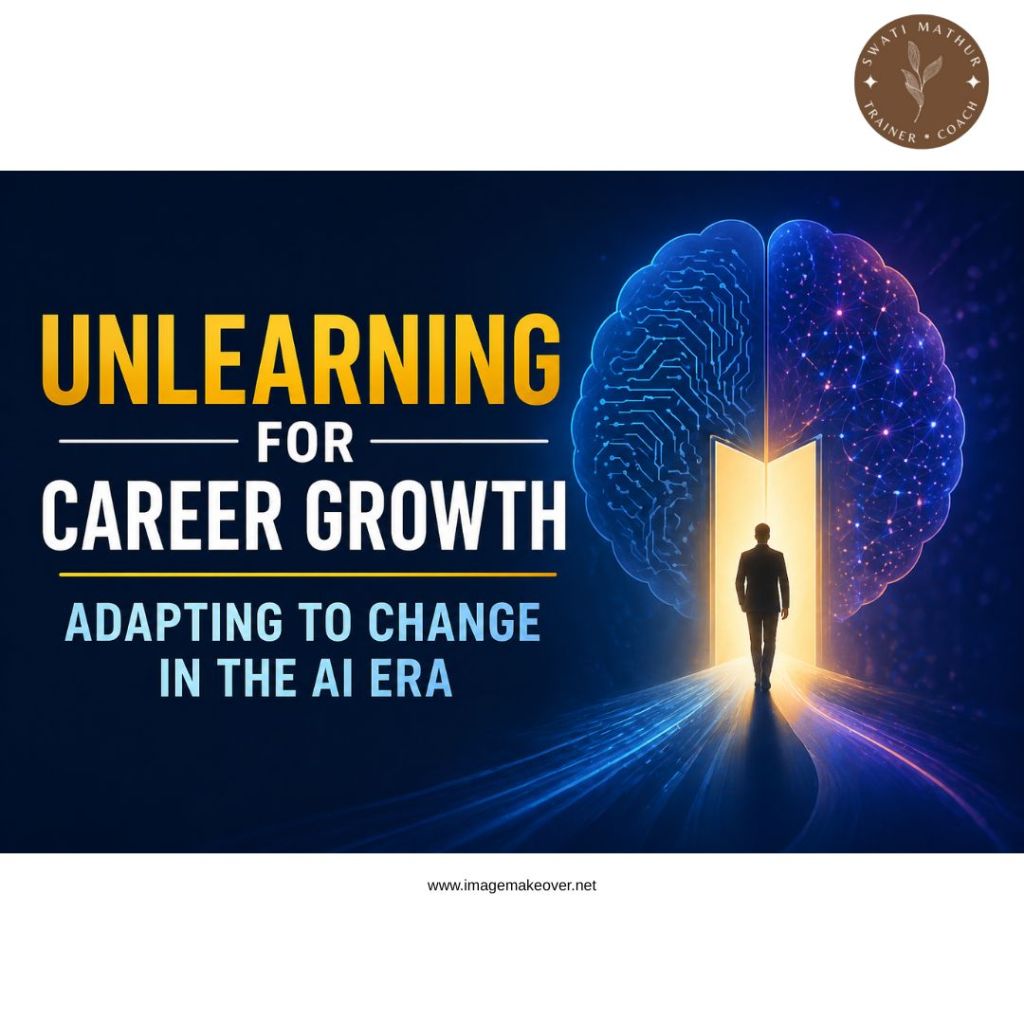
In a rapidly evolving world shaped by Artificial Intelligence, one of the most important skills is not just learning but unlearning. Unlearning means letting go of outdated beliefs, habits, and ways of thinking that no longer serve you. It requires humility, openness, and the courage to question what you once believed was right.
As futurist Alvin Toffler famously said:
“The illiterate of the 21st century will not be those who cannot read and write, but those who cannot learn, unlearn, and relearn.”
AI is changing industries, roles, and skill requirements faster than ever before. What worked yesterday may not work tomorrow.
The real challenge is not gaining new knowledge, it is releasing old mindsets that hold you back. For example: Moving from “I know this already” to “What more can I learn?” or shifting from fixed roles to flexible skill sets or even letting go of traditional ways of solving problems. Unlearning creates space for growth. Humans naturally resist change because familiarity feels safe. But in the AI era, comfort can quickly turn into stagnation.
Unlearning requires you to accept that you may be wrong or be open to new perspectives. It also embrace discomfort as part of growth. And that’s why It’s not easy but it is necessary.
Unlearning is hard because it challenges our identity.
What we know is often tied to:
Our experience
Our confidence
Our sense of expertise
Letting go of old knowledge can feel like losing control or admitting we were wrong. That’s why many people resist unlearning not because they can’t learn, but because they are too attached to what they already know.
As economist John Maynard Keynes said: “The difficulty lies not so much in developing new ideas as in escaping from old ones.”
Not unlearning has consequences like you become resistant to change, skills become outdated, struggle to adapt in new environments or you lose relevance in fast-changing industries. In the AI era, standing still is not safe in fact it is very risky. Because while you hold on to old ways, the world keeps moving forward.
Unlearning is deeply connected to having a growth mindset. A fixed mindset says, “This is how things are done.” But a growth mindset says: “This is how things were done, what’s possible now?” When you embrace unlearning you become more open to feedback and stop fearing mistakes. You also see change as an opportunity. Unlearning doesn’t always require big changes. Sometimes, small shifts can make a huge difference.
How to Practice Unlearning
Question your assumptions: Why do I believe this? Is it still relevant?
Stay curious: Explore new tools, ideas, and perspectives
Be open to feedback: Others often see what we don’t
Adopt a beginner’s mindset: Approach situations as a learner, not an expert
In the age of AI, your biggest strength is not what you know but how willing you are to evolve. Because sometimes, to move forward, you don’t need to learn more but you need to let go. In the age of AI, the winners will not be those who know the most, but those who can adapt the fastest. Because growth is not just about adding more sometimes, it’s about letting go of what no longer fits.
This post is part of Blogchatter A2Z challenge 2026
Soham and Siya shared a bond that transcended the ordinary. Their friendship burgeoned into a love so profound, it seemed to defy the limitations of time and circumstance. Siya’s beauty was not just skin deep; it radiated from within, captivating Soham’s heart with every glance. He found himself endlessly admiring her, not just for her physical allure, but for the myriad of talents and qualities that made her who she was. In a world where superficiality often overshadowed authenticity, Soham cherished Siya for her genuine self.
Likewise, Siya was drawn to Soham’s simplicity and his unwavering respect for others. His humility and kindness were like a beacon of light in her life, illuminating her path with warmth and comfort. From the moment they met through mutual friends, there was an undeniable connection between them—a connection that blossomed into a deep and abiding love.
As they sat on a weathered bench, Siya’s hand found its way into Soham’s, fingers intertwining effortlessly as they reveled in the simple joy of each other’s presence. With a soft smile playing on her lips, Siya leaned her head against Soham’s shoulder, feeling the warmth of his embrace enveloping her like a cozy blanket on a chilly day.
In that moment, time seemed to stand still as they basked in the warmth of their love, cocooned in their own little world of shared dreams and whispered promises. Soham brushed a stray lock of hair away from Siya’s face, his gaze filled with adoration as he traced the curve of her smile with his thumb.
Drawing her closer, Soham whispered words of love and devotion, his voice a tender melody that resonated deep within Siya’s heart. And in the soft cadence of his words, she found solace, knowing that in his arms, she was home. As the sun began its slow descent behind the horizon, casting a golden hue across the sky, Soham and Siya lingered in their haven of love, savoring each precious moment as if it were etched in the stars above.
Their journey together wasn’t without its challenges. One day, Soham found himself unable to contain his feelings any longer and confessed his love to Siya. Though initially taken aback, Siya soon realized that her own heart had been quietly leaning towards him all along. Their transition from friends to lovers was a natural progression, fueled by genuine affection and mutual understanding.
However, fate seemed determined to test their bond. When Siya learned that she had to relocate due to her father’s job transfer, their hearts were plunged into uncertainty. Despite the distance, they clung to their love, nurturing it with heartfelt conversations and cherished memories.
Yet, as time marched on, new obstacles emerged. Soham’s parents began pressuring him to marry, citing his advancing age. Siya, still grappling with the changes in her own life, needed time to navigate their future together. Tragically, their love story reached an impasse, and they were forced to part ways.
Years passed, and life took its toll on both Soham and Siya. They found themselves entangled in the complexities of marriage and family, yet their love for each other remained steadfast, a beacon of hope amidst the chaos.
Eventually, fate intervened once more, bringing Soham and Siya face to face once again. As they sat by the tranquil waters of a lake, tears streaming down their cheeks, no words were needed. In that moment, they knew that true love had found its way back to them—a love that had endured the tests of time and distance, stronger than ever before.
And so, they embraced each other, finding solace in the warmth of their reunion. For Soham and Siya, their love story was not just a tale of romance, but a testament to the enduring power of true love—a love that had weathered every storm and emerged victorious, against all odds.
The takeaway from Soham and Siya’s story is the enduring power of love and the importance of authenticity in relationships. Despite facing numerous challenges, including distance and societal pressures, Soham and Siya’s love for each other remained unwavering. Their bond was built on mutual respect, genuine admiration, and a deep connection that transcended time and circumstance.
True love can withstand the test of time and overcome any obstacle. Being true to oneself and valuing others for who they truly are, rather than superficial qualities. Ultimately, Soham and Siya’s journey reminds us that love, when nurtured with honesty, understanding, and patience, has the ability to find its way back to us, even in the most unexpected moments.
Radha and Mayak had been inseparable since childhood. They shared everything, from their deepest secrets to their wildest dreams. Their bond was so strong that everyone around them assumed they were destined to be together.
As they grew older, Radha and Mayak’s friendship blossomed into something more. They found comfort and solace in each other’s presence, and it wasn’t long before they realized they were in love. With their hearts full of hope and excitement, they decided to take their friendship to the next level and get married.
They had a happy and humorous first few years of marriage. Together, they traveled, followed their passions, and created an idyllic life on the outside. But as time went on, rifts in their relationship started to show.
Radha and Mayak realized that they had drifted apart. What was once an unbreakable bond now felt strained and distant. They struggled to communicate effectively, and conflicts arose more frequently than before. Despite their best efforts to reignite the spark, they found themselves caught in a cycle of misunderstandings and resentment.
Radha longed for the deep emotional connection they once shared, while Mayak felt suffocated by the weight of expectations and responsibilities. They both yearned for the simplicity and ease of their friendship but didn’t know how to bridge the growing divide between them.
As the struggles in their relationship mounted, Radha and Mayak found themselves at a crossroads. They had to confront the harsh reality that love alone couldn’t sustain their marriage. It required effort, compromise, and a willingness to confront their demons and work through their issues together.
With the help of therapy and open, honest communication, Radha and Mayak began to unravel the tangled knots that had formed between them. They learned to let go of past grievances and rediscover the qualities that had drawn them to each other in the first place.
They began to mend their relationship gradually but steadily. Once more, they sought comfort in each other’s arms and realized how deeply connected they were to one another. Radha and Mayak came to understand that genuine love involved being there for one another every day, especially in the face of adversity, rather than just making dramatic gestures or impassioned pronouncements.
Their journey wasn’t easy, but it was worth it. Through their struggles and triumphs, Radha and Mayak discovered the true meaning of love: a bond that could weather any storm, as long as they faced it together. And as they stood hand in hand, ready to face whatever the future held, they knew that their friendship-turned-love story would always be their greatest adventure.
The choice of a life partner is a decision that profoundly impacts every aspect of our lives .It underscores the importance of selecting a partner who not only shares our values and aspirations but also uplifts and supports us in our journey. A healthy and harmonious relationship can contribute positively to our mental health, emotional well-being, and overall happiness. Conversely, a toxic or incompatible partnership can have detrimental effects on our self-image, confidence, and life choices. Therefore, it’s essential to choose our partners wisely, prioritizing mutual respect, understanding, and compatibility, as they play a significant role in shaping our present and future experiences.
Certainly, selecting a partner can significantly impact various aspects of your life.
A supportive and understanding partner can contribute positively to your mental well-being, whereas a toxic or unsupportive relationship can lead to stress, anxiety, and depression. A harmonious relationship can provide a sense of security and tranquility, while conflicts and unresolved issues with a partner can disrupt your peace of mind. Loving partner can enhance your ability to give and receive love, fostering a positive self-image and self-worth. On the other hand, being in an unhealthy relationship may undermine your self-esteem and capacity to love yourself. Even your partner’s dietary preferences and lifestyle choices can influence your own eating habits, leading to healthier or unhealthier patterns depending on compatibility. A partner who is supportive can encourage and empower you to pursue your career goals, while a partner who undermines your ambitions or demands excessive attention may hinder your professional growth. Remember, a partner who believes in you and provides positive reinforcement can boost your confidence, whereas criticism or lack of support may erode your self-assurance, also partner’s values, opinions, and input can shape the decisions you make in various areas of your life, from finances to lifestyle choices. A loving and fulfilling relationship can bring joy and laughter into your life, but constant conflict or dissatisfaction can diminish your happiness. The dynamics of your relationship with your partner can significantly influence how you raise your children too, impacting their upbringing, values, and emotional well-being. While a loving and supportive relationship can encourage restful sleep, relationship stress or disruptions can impair your sleep quality and cause insomnia or irregular sleep patterns. Selecting a spouse has a significant impact on many areas of your life, including daily routines, long-term objectives, and emotional health. To promote happiness and personal development, relationships must be based on respect, understanding, and support for one another.
Ensuring happiness with your life partner involves careful consideration, communication, and ongoing effort. Here are some key steps to help you cultivate a fulfilling relationship:
Self-awareness: Before seeking a life partner, take the time to understand yourself, your values, and your needs. Reflect on what you truly desire in a relationship and what qualities are important to you in a partner.
Communication: Any effective partnership must include open and honest communication. Communicate your thoughts, feelings, and expectations to your spouse in an open and honest manner, and urge them to do the same. Stronger bonds, conflict resolution, and trust are all facilitated by effective communication.
Compatibility: Seek a partner who shares your core values, interests, and life goals. While differences can add depth to a relationship, fundamental compatibility forms the foundation for long-term happiness and compatibility.
Mutual Respect: Respect is the cornerstone of a healthy relationship. Treat your partner with kindness, empathy, and consideration, and expect the same in return. Respect each other’s boundaries, opinions, and autonomy.
Support and Encouragement: Be each other’s biggest cheerleaders. Support your partner’s dreams and aspirations, and encourage them to pursue their passions. Celebrate their achievements and provide comfort during challenging times.
Quality Time: Make time for meaningful interactions and shared experiences. Whether it’s going on dates, engaging in hobbies together, or simply having deep conversations, prioritize quality time to strengthen your connection.
Compromise and Flexibility: No relationship is perfect, and conflicts are inevitable. Learn to compromise, find common ground, and work through disagreements with understanding and empathy. Be willing to adapt and grow together as individuals and as a couple.
Maintain Independence: While it’s important to foster closeness and intimacy, it’s equally crucial to maintain your individual identities and interests. Allow each other space for personal growth, hobbies, and friendships outside of the relationship.
Emotional Intimacy: Cultivate emotional intimacy by being vulnerable and emotionally available with your partner. Share your fears, hopes, and dreams, and create a safe space for your partner to do the same. Emotional connection deepens the bond between partners and fosters greater understanding and empathy.
Continuous Effort: Lastly, remember that a happy relationship requires ongoing effort and commitment from both partners. Nurture your relationship with love, care, and dedication, and prioritize its well-being amidst life’s challenges and distractions.
By prioritizing these principles and actively investing in your relationship, you can increase the likelihood of finding happiness and fulfillment with your life partner.