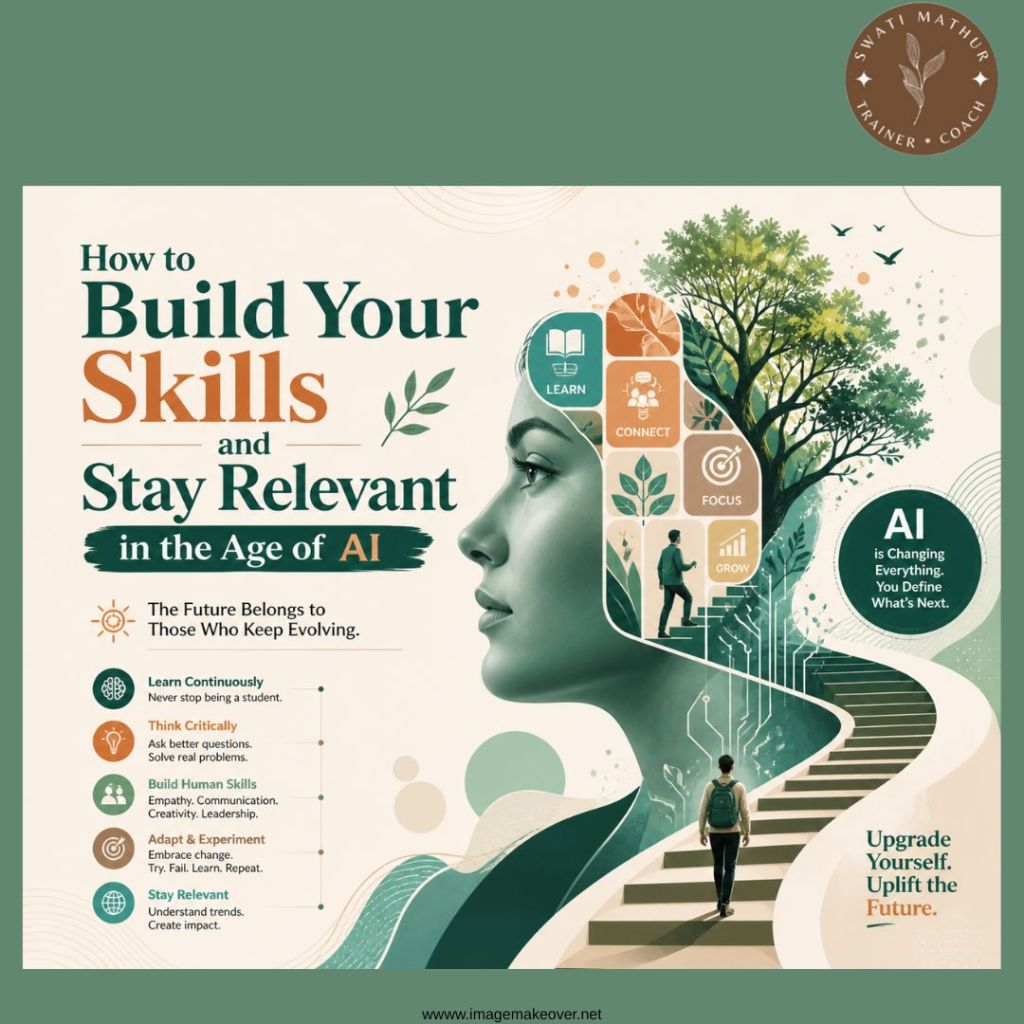
In a world increasingly powered by Artificial Intelligence, automation, and algorithms, it’s easy to focus on tools, technology, and trends. But here’s the truth. The most important factor is still you. Your mindset, your decisions, your values, your ability to connect these are things AI cannot replicate.
As Peter Drucker said: “The best way to predict the future is to create it.”And the one creating that future is not AI alone, it’s you, working with AI. AI can generate content, it can analyze data and also automate processes but it cannot define your purpose or make deeply human decisions. It cannot build authentic relationships and also take responsibility for outcomes. That’s why your role is not becoming less important it is becoming more intentional. Two people can use the same AI tools and get completely different results. And why do you think this happens? Well yes, it is because of mindset.
A fixed mindset says: “AI will replace me.”
A growth mindset says: “How can I use AI to grow?” Your thinking determines whether AI becomes a threat or an opportunity.
AI can suggest options but it cannot choose for you. Every day, you make decisions like what to learn, what to ignore, how to respond and where to invest your time and energy. These choices define your direction.
In a world of automated messages and AI-generated content, authenticity stands out. People trust real voices, honest opinions and genuine interactions. You don’t need to be perfect you just need to be real.
AI can assist you but accountability remains human. Whether it’s a decision at work, a leadership choice or a communication you send it’s you who will be responsible for the outcome.
Let’s understand how can youstrengthen yourself in the AI era,
Know your strengths: What makes you uniquely valuable?
Work on your mindset: Stay open, adaptable, and curious
Build emotional intelligence: Understand yourself and others
Take ownership: Don’t rely entirely on tools, use them wisely.
AI is a tool. Technology is an enabler but you are the driver. Because at the end of the day AI can support your journey but only you can define it.
This post is part of Blogchatter A2Z challenge 2026
In a world where Artificial Intelligence can generate answers instantly, suggest strategies, and even simulate outcomes, one critical question remains, Are you just consuming ideas or actually testing them?
This is where experimentation becomes a defining skill. Experimentation is the ability to take ideas and turn them into action, to test assumptions, learn from outcomes, and continuously improve. It is what transforms knowledge into capability. In the AI era, where access to information is no longer a barrier, the real advantage lies in what you do with that information.
As Peter Drucker wisely said:
“The best way to predict the future is to create it.”
And experimentation is how you begin creating. AI has democratized knowledge. You can learn almost anything in minutes be it concepts, tools, frameworks, strategies. But there is a gap between Knowing what to do and Actually doing it and making it work. Experimentation bridges that gap. It allows you to:
Validate ideas in real-world situations
Discover what works for you, not just in theory
Build confidence through hands-on experience
Develop adaptability in uncertain situations
In a fast-changing world, those who experiment don’t wait for certainty, they create clarity through action. One of the biggest reasons people don’t experiment is the desire to get things right the first time. But in reality perfection delays action and experimentation accelerates learning. Perfection says, “I will start when I am fully prepared.” On other hand experimentation says “I will start, learn, and improve as I go.”In the AI age, speed of learning matters more than initial accuracy. Let’s break down how experimentation shows up in real, everyday scenarios.
1. Trying New Tools Without Fear
AI tools are evolving at an incredible pace. New platforms, features, and capabilities are introduced constantly. A non-experimental mindset will say “I will use only what I already know.” But an experimental mindset will say “Let me explore this and see what it can do.” This means signing up for new tools and testing features, Trying different ways to solve the same problem and not being afraid of making mistakes while learning. Over time, this builds tool agility, the ability to adapt regardless of which tool you are using.
2. Learning Through Small Failures
Failure in experimentation is not an endpoint, it is feedback. Every failed attempt answers an important question: “What doesn’t work?” Instead of avoiding failure, experimenters analyze what went wrong, adjust their approach and try again with better understanding. This mindset reduces fear and increases resilience.
3. Iterating and Improving Continuously
Experimentation is not about trying once but it is about refining continuously.It follows a simple loop, Try, Observe, Learn, Improve and Repeat. For example writing prompts for AI and refining them for better output or delivering a training session and improving it based on feedback to testing different approaches in communication or problem-solving. Each iteration brings you closer to effectiveness.
4. Taking Initiative Instead of Waiting
Experimentation requires ownership. Instead of waiting for instructions, experimental thinkers, take the first step then test ideas independently and then learn proactively. This builds confidence and positions you as someone who acts and not just thinks. In modern workplaces, this is a highly valued trait.
AI has made experimentation faster, cheaper, and more accessible than ever before. You can test multiple ideas in minutes also generate variations instantly and receive feedback and refine quickly. But here’s the key insight AI accelerates experimentation but it does not replace it. AI can suggest possibilities. but only you can test, evaluate, and apply them meaningfully.
Let’s understand how to build an Experimentation Mindset.
1. Start Small, Start Now – You don’t need big projects to experiment. Try one new tool, test one new idea or make one small change. Small experiments reduce fear and build momentum.
2. Remove Fear of Judgment – Not every experiment needs to be perfect or public. Give yourself space to try without pressure, fail without embarrassment and learn without comparison. Growth happens when you allow yourself to explore freely.
3. Focus on Learning, Not Just Results – The goal of experimentation is not immediate success, it is insight. You should ask yourself what did I learn from this? or what can I do better next time? This mindset ensures continuous improvement.
4. Stay Curious – Curiosity fuels experimentation. When you ask what if I try this differently? or Is there a better way? You naturally move toward action and discovery.\
In the AI-driven world, information is everywhere, ideas are unlimited and possibilities are endless. But clarity does not come from thinking alone it comes from doing. Because thinking creates ideas, learning builds knowledge but experimentation creates real growth.
This post is part of Blogchatter A2Z challenge 2026
In the past, success was often defined by specialization being known for one skill, one role, one domain. But in today’s AI-driven world, that definition is shifting. Success now depends on versatility that is your ability to adapt, learn, and contribute across different roles, tools, and situations. Versatility is not just a skill. It is a mindset of flexibility, agility, and openness to change.
Artificial Intelligence is not replacing humans entirely, it is reshaping the nature of work. Tasks are being automated, workflows are evolving, and job roles are becoming more fluid.
Earlier, roles were clearly defined:
A marketer did marketing
A developer wrote code
A trainer delivered sessions
Today, boundaries are blurring. A marketer uses AI tools and analytics, a developer collaborates with design and product teams and a trainer integrates technology, storytelling, and data insights. This is why rigid roles are fading, and dynamic skill sets are risingWhat Versatility Looks Like in Practice, let’s break down the expectations of modern professionals.
1. Learning New Tools Quickly
In the AI era, tools are constantly evolving. What you learned last year may already be outdated. Versatility means you are not attached to one tool, you focus on understanding how tools work, not just how to use one tool and you can quickly adapt when a new platform or technology is introduced. For example, someone versatile doesn’t struggle when switching from one AI tool to another but they adapt because they understand the logic behind them.
2. Shifting Between Tasks and Responsibilities
Earlier, people stayed within fixed job descriptions. Today, professionals are expected to wear multiple hats. Here versatility helps in moving from execution to strategy when needed, handle both individual tasks and team responsibilities and take ownership beyond your defined role. Instead of saying, “This is not my job,” a versatile person asks, “How can I contribute here?”
3. Collaborating Across Domains
Work today is highly interconnected. You rarely work in isolation. In this scenario versatility enables you to understand perspectives from different functions, communicate effectively with diverse teams and also bridge gaps between departments. For instance, when a technical person understands basic business needs, or a non-technical person understands technology, collaboration becomes smoother and more impactful.
4. Thinking Both Technically and Creatively
AI handles logic, data, and speed but humans bring creativity, intuition, and context. Versatility is the ability to balance analytical thinking with creative problem-solving also use data to inform ideas, but not limit imagination and combine structure with innovation. This blend is what makes professionals truly valuable in modern workplaces.
One common misconception is that versatility means being average at everything. That’s not true. Versatility is not about losing depth, it’s about expanding your range without losing your core strength. Think of it as a “T-shaped professional”:
The vertical line (|) represents your deep expertise in one area
The horizontal line (—) represents your ability to understand and work across multiple areas
For example a trainer may specialize in soft skills (depth) but also understand AI tools, content creation, and facilitation techniques (breadth). This combination makes you adaptable and valuable across situations.
Versatility is not something you are born with but it is something you consciously develop.
1. Keep Learning Continuously
The half-life of skills is shrinking. What you know today may not be enough tomorrow. Continuous learning means staying curious, exploring new tools, ideas, and trends and not waiting for change— instead anticipating it. Learning is no longer a phase now it is a lifelong habit.
2. Step Out of Your Comfort Zone
Growth never happens in familiar spaces. When you take on new roles, try unfamiliar tasks or accept challenging projects, you expand your capabilities and confidence. Discomfort is not a sign of failure but it is a sign of growth in progress.
3. Collaborate Across Teams
Exposure creates adaptability. Working with different people expands your thinking and improves your communication too. It also helps you understand different approaches to the same problem. The more diverse your experiences is the more versatile you become.
4. Be Open to Change
Resistance to change is the biggest barrier to versatility. Instead of asking, “Why is this changing?” Start asking, “What can I learn from this change?” When you shift your mindset change stops feeling like a threat and it starts becoming an opportunity. In an unpredictable, AI-driven world, job roles will change, tools will evolve, and industries will transform. The question is not whether change will happen the question is how ready you are for it. Because the safest skill today is not specialization , it is adaptability through versatility.
When you are versatile you don’t fear change, you don’t resist new roles and you don’t even get stuck in one identity. Instead, you grow, evolve, and stay relevant. Because in the end, it’s not what you know that secures your future but it’s how well you can adapt when what you know changes.
As Charles Darwin is often paraphrased:
“It is not the strongest or the most intelligent who survive, but the one most adaptable to change.”
This post is part of Blogchatter A2Z challenge 2026
Networking today is no longer a transactional activity where people simply exchange business cards, LinkedIn requests, or contact details. In the age of Artificial Intelligence, networking has evolved into something far deeper. It is the ability to build meaningful, value-driven, and trust-based human relationships.
AI can automate almost everything around networking like suggesting connections, drafting messages, analyzing profiles, even predicting compatibility between professionals. But what it cannot replicate is the essence of human connection that is trust, empathy, emotional intelligence, and authenticity.
As Reid Hoffman, co-founder of LinkedIn, famously said:
“No matter how brilliant your mind or strategy, if you’re playing a solo game, you’ll always lose to a team.”
This becomes even more relevant in the AI era, where tools amplify speed but relationships still determine depth and long-term success. In the past, networking was often seen as “who you know.” Today, it has shifted toward “how well you know them, and how meaningfully you connect with them.”
AI can help you identify the right people faster than ever:
Suggest recruiters, mentors, or industry experts
Analyze mutual interests and shared backgrounds
Even generate personalized outreach messages
But here is the limitation, AI can initiate contact, but it cannot build trust.
As Maya Angelou wisely said:
“People will forget what you said, but they will never forget how you made them feel.” That emotional imprint is something only humans can create. In a world where communication is automated and attention spans are shrinking, genuine human connection becomes a rare and powerful asset. Strong networking today is built on three core human principles:
Listening More Than Speaking
Most people network with the intent to impress. But effective networkers focus on understanding first.
Listening allows you to understand real challenges of others, to identify hidden opportunities and to build deeper emotional connection. In networking, the ones who listen deeply often stand out the most.
Offering Value Before Asking for Help
In the AI era, where everyone is trying to optimize gain, value-first networking creates long-term trust.
Value can be sharing useful insights or resources or making introductions between people and also offering feedback or support without expectation. Networking is not a “what can I get?” space—it is a “what can I contribute?” ecosystem.
Staying Genuinely Interested in Others
Authenticity cannot be faked, not even by AI. People can sense genuine curiosity vs scripted interaction and Real interest vs opportunistic behavior. When you are genuinely interested in others, conversations stop being transactional and start becoming meaningful. This is where networking transforms into relationship-building.
AI is not the enemy of networking in fact it is an enhancer. It helps you:
Find relevant people faster
Personalize outreach at scale
Track professional interactions
But the human layer still decides success:
Do people trust you?
Do they feel heard?
Do they want to stay connected with you beyond one interaction?
AI opens the door, but you still have to build the relationship inside the room. The famous saying, “Your network is your net worth,” has never been more relevant but it needs an important upgrade in the AI era. Your network is not valuable because it is large. It is valuable because it is real, trusted, and mutually meaningful. In a world powered by algorithms, automation, and artificial intelligence, your greatest advantage remains deeply human.
This post is part of Blogchatter A2Z challenge 202
In today’s world, where technology is advancing rapidly and workplaces are becoming increasingly interconnected and diverse, soft skills are more relevant than ever. They complement technical skills and enable individuals to navigate complex social and professional landscapes with confidence and effectiveness.
Soft skills are not tangible or technical in nature like “hard skills,” which are specific, measurable abilities related to a particular job or field. The term “soft skills” originated as a way to distinguish between these two types of skills based on their characteristics.
Compared to hard abilities, soft skills are less measurable and more challenging to quantify. Soft skills are more arbitrary and are frequently evaluated based on conduct, communication style, and interpersonal interactions, whereas hard skills are easily measurable and assessed through exams or certifications. Soft talents are transferable to other occupations, sectors, and environments. They are transferable talents that can be used in a variety of contexts rather than being limited to specialized technical knowledge or experience. Communication, cooperation, problem-solving, and leadership abilities are a few examples. They are intrinsically linked to interpersonal relationships and feelings. They entail developing relationships, listening skillfully, empathy, and self- and other-awareness. These abilities are essential for handling social situations, resolving disputes, and working in groups. Because they are adaptive and malleable, soft skills are frequently referred to as “soft”. With practice, feedback, and experience, they can be honed and improved over time. In contrast to hard talents, which could become outmoded as industry and technology change, soft skills are still useful in a variety of settings.
Generally speaking, the phrase “soft skills” refers to the more qualitative, adaptable, and human-centered character of these abilities as opposed to the more quantitative, specialized, and technical character of hard skills. In spite of the term “soft,” these abilities are vital for both professional and personal success. They support technical proficiency and foster effective leadership, teamwork, and communication.
Enhanced Communication
Soft skills training is incredibly important in today’s world for several reasons: Soft skills training helps individuals communicate effectively, both verbally and non-verbally. They enable individuals to connect with others, understand their perspectives, and work together towards common goals. Soft skills training provides individuals with the tools and techniques to develop these skills, enhancing their interpersonal effectiveness and contributing to their success and well-being. This includes skills such as active listening, empathy, and clarity in expression, which are essential for building relationships and collaborating with others.
Improved Leadership
Soft skills like leadership, teamwork, and conflict resolution are vital for anyone in a management or supervisory role. By demonstrating strong leadership, fostering teamwork, and managing conflicts skillfully, managers can create a positive and productive work environment conducive to achieving organizational goals and fostering employee growth and development. Effective leaders inspire and motivate their teams, resolve conflicts, and foster a positive work environment.
Adaptability and Resilience
In today’s rapidly changing world, adaptability and resilience are crucial. Soft skills training helps individuals become more flexible in dealing with change, more resilient in the face of challenges, and better able to cope with uncertainty. It helps individuals develop a growth mindset, which is essential for embracing change and seeing it as an opportunity for growth and learning rather than a threat. Soft skills training equips individuals with the flexibility to adjust their plans, priorities, and strategies in response to changing circumstances. It help in building up resilience by cultivating coping mechanisms, stress management techniques, and self-care practices. Soft skills training enhances individuals’ problem-solving abilities, enabling them to approach challenges with confidence and resourcefulness.
Career Advancement
Soft skills are often what set candidates apart in the job market. Employers increasingly value skills such as problem-solving, creativity, and emotional intelligence alongside technical expertise, are highly valued by employers for their ability to drive innovation, foster collaboration, and drive organizational success. Employees who possess strong soft skills are more likely to advance in their careers, succeed in leadership roles, and make meaningful contributions to their organizations.
Customer Satisfaction
Many soft skills, such as empathy and customer service orientation, are essential for providing exceptional customer experiences. Businesses that prioritize soft skills training for their employees are more likely to build loyal customer relationships and enhance their reputation.
Effective Collaboration
Soft skills like teamwork, collaboration, and conflict resolution are essential for working effectively in diverse teams. Individuals who possess these skills can contribute positively to team dynamics, foster a culture of collaboration, and achieve better results collectively.
Personal Development
Soft skills training not only benefits individuals professionally but also personally. It helps individuals develop self-awareness, emotional intelligence, and interpersonal skills that contribute to their overall well-being and success in various aspects of life.
There are various types of soft skills training available to cater to different needs and preferences. Here are some common types:
Communication Skills Training: This type of training focuses on improving verbal and non-verbal communication skills, including listening, speaking, writing, and body language.
Leadership Development Programs: These programs aim to cultivate leadership qualities such as decision-making, strategic thinking, delegation, and team management.
Emotional Intelligence Workshops: Emotional intelligence training helps individuals understand and manage their own emotions effectively, as well as recognize and empathize with the emotions of others.
Team Building Activities: Team building exercises and workshops are designed to enhance collaboration, trust, and cohesion among team members.
Conflict Resolution Training: Conflict resolution training equips individuals with techniques and strategies to manage conflicts constructively and find mutually beneficial solutions.
Time Management and Organization Skills Training: This type of training helps individuals prioritize tasks, manage their time efficiently, and stay organized to improve productivity and reduce stress.
Stress Management Workshops: Stress management training teaches techniques for coping with stress, building resilience, and maintaining overall well-being.
Creativity and Innovation Workshops: These workshops focus on fostering creativity, encouraging innovative thinking, and problem-solving skills.
Customer Service Training: Customer service training is essential for employees who interact directly with customers. It covers skills such as active listening, empathy, handling complaints, and building rapport.
Networking Skills Workshops: Networking skills training helps individuals develop the ability to build and maintain professional relationships, effectively communicate their value proposition, and leverage networking opportunities.
Diversity and Inclusion Training: Diversity and inclusion training promotes awareness, understanding, and appreciation of differences among individuals, fostering a more inclusive and respectful work environment.
Presentation Skills Workshops: Presentation skills training focuses on developing effective presentation techniques, including public speaking, storytelling, visual aids, and handling Q&A sessions.
Organizations may decide to offer specialized training programs or obtain training from outside providers, online courses, workshops, seminars, or coaching sessions, depending on the needs of each individual.
Individuals in a variety of positions and levels within a company, as well as those outside of official work environments, might gain from soft skills training. The following categories of individuals could gain from receiving training in soft skills:
Regardless of their position or department, all employees can benefit from soft skills training. This includes front-line staff, managers, executives, and support personnel. Soft skills are essential for effective communication, teamwork, problem-solving, and leadership at all levels of an organization.
Managers and leaders play a crucial role in setting the tone for organizational culture and fostering a positive work environment. Soft skills training can help them improve their leadership, communication, and people management skills, leading to better team performance and employee engagement.
Job Seekers and Career Changers: Job seekers can enhance their employability and stand out in the competitive job market by developing strong soft skills. Soft skills are often considered as important, if not more important, than technical skills by employers. Career changers can also benefit from soft skills training as they transition into new roles or industries.
Entrepreneurs and business owners need strong soft skills to build and grow successful businesses. Effective communication, leadership, negotiation, and networking skills are essential for attracting customers, building partnerships, and leading a team.
Soft skills training can complement academic education and prepare students and graduates for success in their future careers. Skills such as communication, teamwork, problem-solving, and time management are valuable in both academic and professional settings.
Professionals who interact directly with clients or customers, such as sales representatives, customer service agents, and client managers, can benefit from soft skills training to enhance their interpersonal skills, build rapport, and deliver exceptional customer experiences.
In today’s interconnected world, individuals working in cross-cultural or global settings can benefit from soft skills training that promotes cultural awareness, sensitivity, and effective communication across diverse backgrounds and perspectives.
Soft skills training is not limited to professional contexts. Anyone interested in personal development and self-improvement can benefit from developing skills such as emotional intelligence, resilience, assertiveness, and stress management.
In conclusion, a broad spectrum of people can benefit from soft skills training, including managers and staff members, job seekers, entrepreneurs, students, and anybody else interested in personal or professional growth. It builds leadership qualities, strengthens interpersonal relationships, facilitates communication, and adds to general success and fulfillment in a variety of spheres of life.
Some people may still not completely comprehend the value of soft skills, despite the fact that their importance is becoming more widely acknowledged for a variety of reasons.
There may be a misperception that technical or hard talents are more valuable than soft skills. This misunderstanding could result from a failure to recognize the role soft skills play in both career and personal success.
Development of soft skills may be neglected in some professions or industries where technical proficiency or hard skills are valued more highly. People and organizations tend to place more value on technical competence than soft skills, despite the fact that soft skills are essential for leadership, teamwork, and successful communication.
In contrast to hard talents, which are easier to measure and quantify through exams or certificates, soft skills are frequently harder to evaluate objectively. Some people can find it more difficult to prioritize the development of soft skills or to acknowledge their significance due to the absence of concrete measures.
People who haven’t spent a lot of time in settings that stress developing soft skills—like some educational programs or jobs—might not realize how important they are. It can be difficult for some people to understand the value of soft skills if they haven’t personally experienced their advantages.
Some people can erroneously think that soft skills are inherent qualities that people are either born with or without, as opposed to abilities that can be honed and improved over time with practice and instruction. This false belief could result in a lack of effort or financial commitment to the development of soft skills.
It can be challenging to make changes, and some people or organizations can be unwilling to add soft skills training to their current routines or organizational structures. Fear of the unknown, lethargy, or an unwillingness to leave comfort zones can all be reasons for resistance to change.
Soft skill development may be given less priority in settings where there is a heavy focus on immediate results or short-term results in favor of more pressing aims or objectives. Nonetheless, spending money on soft skills can pay off in the long run in terms of increased productivity, contented workers, and successful businesses.
Education, raising awareness, and a societal shift toward an appreciation of the value of soft skills in both professional and personal development are all necessary to address these issues. The necessity of soft skills in today’s society can be better understood and appreciated by people and organizations through emphasizing the advantages of soft skills, offering chances for training and development, and cultivating a culture that prioritizes interpersonal skills.
Making soft skills training more interesting and engaging can greatly enhance participants’ learning experience and maximize the effectiveness of the training. Here are some strategies to achieve this:
Interactive Workshops: Design workshops that actively involve participants through interactive exercises, group discussions, role-playing activities, and case studies. Encourage hands-on participation to promote engagement and facilitate experiential learning.
Gamification: Incorporate elements of gamification, such as quizzes, challenges, simulations, and leaderboard competitions, to make the training more interactive and enjoyable. Gamification can increase motivation, encourage participation, and reinforce learning objectives.
Real-Life Scenarios: Use real-life scenarios and examples relevant to participants’ experiences and contexts to demonstrate the practical application of soft skills concepts. Encourage participants to share their own experiences and insights, fostering a sense of relevance and authenticity.
Storytelling: Utilize storytelling techniques to illustrate key concepts and principles in a compelling and memorable way. Share anecdotes, case studies, or success stories that resonate with participants and convey the importance of soft skills in real-world situations.
Multimedia Resources: Incorporate multimedia resources, such as videos, animations, podcasts, and interactive presentations, to diversify the training content and cater to different learning preferences. Visual and auditory stimuli can enhance engagement and retention of information.
Role-Playing and Simulations: Provide opportunities for participants to practice and apply soft skills in simulated scenarios or role-playing exercises. This allows participants to experiment with different strategies, receive feedback, and develop confidence in their abilities.
Peer Learning: Foster a collaborative learning environment where participants can learn from each other through peer feedback, group projects, and collaborative problem-solving activities. Encourage peer coaching and mentoring to promote mutual support and learning.
Continuous Feedback: Offer timely and constructive feedback throughout the training to guide participants’ progress and reinforce learning outcomes. Encourage self-reflection and self-assessment to help participants identify areas for improvement and track their development.
Customization and Personalization: Tailor the training content and activities to the specific needs, interests, and skill levels of the participants. Allow flexibility for participants to choose topics or activities that are most relevant and engaging to them, promoting ownership and autonomy in the learning process.
Follow-Up and Application: Provide opportunities for participants to apply and reinforce their learning beyond the training session. Offer follow-up resources, tools, and support to help participants integrate soft skills into their daily routines and work practices.
By incorporating these strategies into soft skills training programs, facilitators can create a dynamic and engaging learning experience that captivates participants’ interest, fosters active participation, and maximizes the impact of the training on their personal and professional development.
While the just-in-time concept is commonly associated with the manufacturing industry, its application extends far beyond, particularly in the realm of education.
The “just-in-time” (JIT) concept is a management philosophy that aims to optimize processes by delivering the right quantity of goods or services at the right place and time, exactly when they are needed. This approach emphasizes minimizing waste, reducing inventory costs, and maximizing efficiency throughout the production or service delivery process.
Just-in-time (JIT) manufacturing eschews vast stocks of completed items or raw materials in favor of producing commodities only as needed during the production process. This minimizes surplus inventory, lowers storage costs, and simplifies production procedures.
JIT in the service sector might mean providing resources or services right when needed, cutting down on surplus capacity or needless waiting periods. The JIT approach aims to maximize value and minimize waste by synchronizing production or service delivery with demand, which will increase efficiency, lower costs, and improve customer satisfaction.
As I mentioned earlier, Yes, the just-in-time (JIT) concept can be applied across various fields beyond manufacturing and services. Here are some examples:
Supply Chain Management: JIT principles can be applied throughout the supply chain, from raw material sourcing to final product delivery. By synchronizing inventory levels with demand, companies can minimize holding costs and reduce the risk of obsolete inventory.
Healthcare: In healthcare, JIT can optimize inventory management of medical supplies and pharmaceuticals, ensuring that hospitals and clinics have the right supplies on hand when needed while minimizing waste and reducing costs.
Retail: Retailers can implement JIT principles to manage inventory levels in stores and warehouses. By closely monitoring sales data and adjusting orders accordingly, retailers can minimize stockouts, reduce excess inventory, and improve overall efficiency.
Construction: In construction projects, JIT principles can be used to manage the delivery of materials and equipment to the job site precisely when they are needed. This helps to minimize storage space requirements and reduces the risk of theft or damage to materials.
Education: JIT can be applied in education to tailor learning experiences to the individual needs of students. By providing resources and support exactly when students need them, educators can optimize learning outcomes and improve student engagement.
Software Development: In software development, JIT principles can be used to prioritize and deliver features or updates based on customer feedback and market demand. This iterative approach, often referred to as “agile” or “lean” development, helps teams to respond quickly to changing requirements and deliver value more efficiently.
Overall, the JIT concept can be adapted and applied to various industries and processes to improve efficiency, reduce waste, and enhance customer satisfaction.
Let’s now discuss the specific use of the JIT concept in the realm of education. In order to implement just-in-time (JIT) concepts in education, learning resources, support, and interventions must be provided to students at the exact moment they require them, as opposed to on a set timetable. By better catering to the requirements and preferences of each individual student, this method can assist maximize learning results and increase student engagement. Here are some examples of how JIT might be used in the classroom:
Personalized Learning Paths: Students in a traditional classroom setting often work at the same speed on a defined curriculum. But with Just-In-Time (JIT), teachers may tailor each student’s learning path according to their aptitudes, interests, and learning preferences. For instance, extra practice problems or specialized tutoring sessions could be provided to a student who is having difficulty with a certain arithmetic idea at the exact moment they need them.
On-Demand Resources: Teachers can provide resources to pupils as they move through the curriculum, rather than giving them all at once. For example, an online learning environment may provide additional texts, videos, or interactive exercises on particular subjects, which students can access if they run into difficulties or wish to learn more about a particular topic.
Immediate Feedback and Support: JIT helps students by providing them with timely feedback and assistance, so they may correct misunderstandings or challenges immediately. Interactive learning systems, for example, can give students immediate feedback on tests or assignments, enabling them to see where they need to make improvements and get help when they need it.
Adaptive Learning Technologies: Algorithms are used by adaptive learning technology to assess student performance and modify the learning process. For instance, based on a student’s answers, an adaptive math software application could change the level of practice questions, giving more difficult problems to students who perform well and remedial exercises to those who struggle.
Just-in-Time Teaching Strategies: Teachers can also incorporate JIT ideas into their lesson plans by modifying their lessons in response to performance data and student input. For instance, a teacher may use formative evaluations to determine how well a lesson is understood by the class and modify their approach, offering more exercises or explanations where necessary to clear up any areas of uncertainty.
Scaffolding and Support Structures: Providing scaffolding and other support systems can be a part of JIT in order to assist students in progressively developing their abilities. To help students with various parts of the writing process, such brainstorming, drafting, and revising, a writing teacher could, for example, provide on-demand writing workshops or tutoring sessions.
Overall, implementing JIT in education requires a flexible and responsive approach to teaching and learning, where resources and support are provided precisely when students need them to optimize learning outcomes and foster engagement.
Implementing just-in-time (JIT) principles in education offers several advantages, but it also presents some challenges. Let’s explore the advantages and disadvantages:
Advantages:
Personalized Learning: JIT allows educators to tailor learning experiences to individual student needs, preferences, and learning styles. This personalized approach can lead to greater student engagement and improved learning outcomes.
Optimized Resource Allocation: Just-in-time (JIT) delivery of resources and support helps maximize the distribution of educational resources by providing them precisely when students need them. This may lead to lower expenses and more effective use of resources, including time.
Immediate Feedback: With the use of just-in-time (JIT) feedback and assessment, students can address misconceptions or challenges immediately. This quick feedback loop encourages greater comprehension and quicker learning.
Flexibility and Adaptability: JIT promotes adaptability in education by enabling teachers to modify their lesson plans and available materials in response to input from students and performance information. This flexibility guarantees that training is current and sensitive to the requirements of the students.
Enhanced Engagement: JIT encourages students to actively participate in their education and pursue self-directed learning by offering tools and assistance when needed. Empowerment has the potential to boost motivation and cultivate a feeling of control over the learning process.
Disadvantages:
Infrastructure and Technology Requirements: JIT implementation in the classroom frequently calls on dependable internet connectivity, as well as access to digital resources and technology. Lack of these resources may provide challenges for schools or students hoping to get the most out of JIT strategies.
Equity and Access Issues: JIT depends on providing equal access to educational materials and assistance for all students. On the other hand, differences in educational opportunity, internet connectivity, and technology accessibility might worsen already-existing educational gaps.
Teacher Workload: Teachers’ workloads may grow as a result of customizing lessons and materials to fit JIT principles. This is especially true when it comes to creating personalized learning experiences, giving prompt feedback, and overseeing individualized support.
Standardization vs. Customization:Personalized learning experiences that are adapted to each student’s needs are emphasized by JIT. Finding the right balance between curricular requirements that are standardized and customization can be difficult, particularly in educational systems that have strict standards and assessment procedures.
Overreliance on Technology:JIT frequently uses digital tools and technological platforms to provide resources and support. Even though technology can improve education, a dependence on digital solutions too much could disadvantage pupils who need or prefer other forms of instruction.
Overall, while JIT offers significant potential benefits for enhancing teaching and learning in education, careful consideration of the associated challenges is essential to ensure equitable access, effective implementation, and sustainable outcomes.
In the quaint town, nestled amidst rolling hills and whispering forests, there lived a man named Rajveer . He was not born into wealth or prestige, nor did he possess extraordinary talents or abilities. Yet, there was something about him, a quiet strength, a gentle wisdom—that drew people to him like moths to a flame.
From a young age, Rajveer understood the importance of respect. He believed that respect was not something to be demanded but earned through actions and deeds. And so, he set out to prove himself worthy of the admiration and trust of those around him.
Rajveer was not the loudest voice in the room, nor was he the most charismatic or assertive. Instead, he led by example, demonstrating unwavering integrity, compassion, and empathy in everything he did. Whether it was lending a helping hand to a neighbor in need or standing up for the voiceless, he never wavered in his commitment to doing what was right.
As he grew older, he found himself becoming a pillar of the community, someone whom others looked up to for guidance and support. He served as a mentor to the youth, imparting valuable life lessons and instilling in them a sense of responsibility towards their fellow human beings.
But perhaps his greatest quality was his ability to listen; to truly hear and understand the concerns and grievances of others. He didn’t dismiss people’s opinions or belittle their feelings; instead, he treated each person with dignity and respect, regardless of their station in life.
One day, a crisis struck his town—a fierce storm ravaged, leaving destruction and devastation in its wake. Homes were destroyed, livelihoods shattered, and the people were left reeling in despair.
In the aftermath of the storm, Rajveer emerged as a beacon of hope, a steady hand guiding his fellow townsfolk through the darkness. He organized relief efforts, rallied volunteers, and worked tirelessly to rebuild what had been lost.
But it was not just his actions that earned him the respect of the community; it was his unwavering commitment to standing by his principles, even in the face of adversity. He never sought recognition or praise for his deeds; instead, he remained humble and grounded, always putting the needs of others before his own.
As the town slowly began to heal and rebuild, his reputation as a respected leader only grew stronger. People looked to him for guidance, not because of any title or position he held, but because they believed in him—his integrity, his compassion, his unwavering dedication to making the world a better place. Amidst the trials and tribulations of everyday life, he taught a valuable lesson—that true respect is not bestowed upon us by others but earned through our words, our actions, and, most importantly, our character.
I feel a true leadership is not defined by titles or authority but by the qualities of character and actions that inspire respect and admiration from others. Rajveer embodied integrity, compassion, humility, and resilience, showing that leadership is about serving others, listening to their needs, and leading by example. Remember earning respect requires consistent dedication to principles, genuine care for others, and a willingness to stand up for what is right, even in the face of adversity. Ultimately, it reminds us that the most impactful leaders are those who strive to make a positive difference in the lives of those around them and leave a lasting legacy of integrity, compassion, and service.
As a trainer, it’s essential to ensure that I concludes with valuable tips or suggestions to leave a lasting impact….hahahah. I am helpless. Several key factors and qualities that contribute to becoming a respected leader and here I am with my suggestions:
Integrity: Rajveer demonstrated unwavering integrity in all his actions. Integrity involves honesty, consistency, and a strong moral compass. A leader with integrity earns the trust and respect of others because they know they can rely on them to do what is right, even when it’s difficult.
Compassion and Empathy: He showed compassion and empathy towards others, especially during times of need. Understanding and caring for the emotions and struggles of those around you build strong connections and foster a sense of community.
Humility: Despite his contributions and leadership role, my character remained humble. Humility involves recognizing one’s strengths and weaknesses without arrogance or false modesty. A humble leader is approachable, open to feedback, and willing to learn from others.
Active Listening: Rajveer’s ability to listen actively and empathetically to the concerns of others was crucial in earning their respect. Leaders who listen sincerely build trust and create an environment where everyone’s voice is valued.
Leading by Example: He led by example, demonstrating the values and principles he espoused through his own actions. Leaders who practice what they preach inspire others to follow suit and emulate their behavior.
Servant Leadership: He exemplified servant leadership by prioritizing the needs of others above his own. Servant leaders focus on serving the greater good and empowering those around them rather than seeking personal gain or recognition.
Resilience and Determination: In the face of adversity, Rajveer remained resilient and determined, never wavering in his commitment to his community. Leaders who persevere through challenges inspire confidence and motivate others to overcome obstacles.
Vision and Purpose: Rajveeer had a clear vision for the betterment of his community and worked tirelessly towards that purpose. Leaders who articulate a compelling vision and inspire others to work towards shared goals foster unity and drive progress.
Effective Communication: He effectively communicated his ideas, plans, and values, fostering understanding and alignment among his followers. Leaders who communicate clearly and authentically build rapport and create a sense of direction.
Empowerment: Rajveer empowered others by providing opportunities for growth, development, and meaningful contribution. Leaders who empower their team members foster a sense of ownership and commitment, leading to increased engagement and performance.
These qualities, when cultivated and practiced consistently, enable individuals to become respected leaders who make a positive impact on their communities and the world around them.