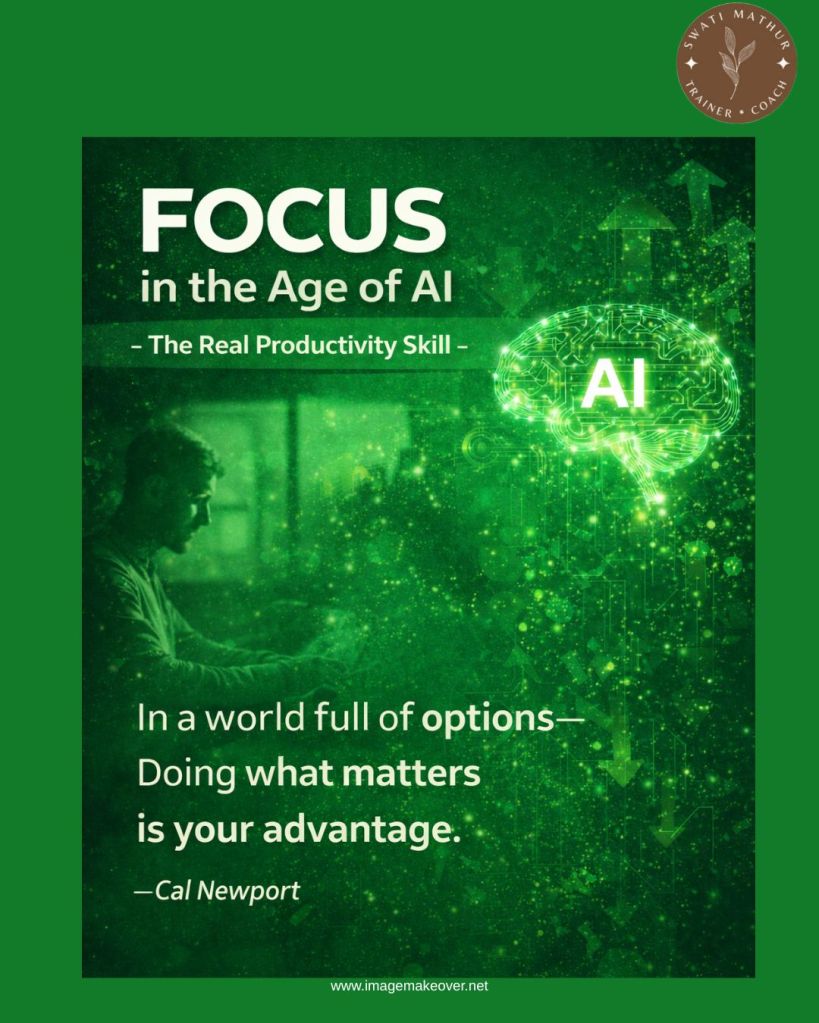
Focus in the Age of AI-The Real Productivity Skill #FocusMatters

In a world full of notifications, tools, and endless information, the real challenge is no longer access actually it is focus. We are surrounded by possibilities, powered by Artificial Intelligence that can generate ideas, automate tasks, and provide instant solutions. Yet, despite having more resources than ever before, many of us struggle to complete meaningful work. The reason is simple, AI gives us options, but focus helps us choose what truly matters.

As the author Cal Newport wisely said,

There is an interesting paradox that comes with the rise of AI. While it offers countless tools for writing, designing, coding, and learning, it also creates an environment of constant distraction. What begins as a productive intention often turns into scattered activity. For instance, you may start using one AI tool to write an article, then switch to another for better phrasing, explore a third for visuals, and eventually end up watching tutorials on the “best AI tools available.” Hours pass, yet the actual task remains incomplete. This is not productivity, it is attention being pulled in multiple directions. Psychologists describe this as decision fatigue, where too many choices reduce our ability to act effectively. In fact, research suggests that professionals spend a significant portion of their time switching between tasks rather than completing them, which reduces both efficiency and quality of work.

At its core, focus is not merely about avoiding distractions but it is about directing your energy with intention. It means doing one thing at a time and doing it well. Although multitasking is often celebrated, studies have shown that it can reduce productivity and increase errors. When you try to write, check messages, and use AI tools simultaneously, your thinking becomes fragmented. On the other hand, when you dedicate uninterrupted time to a single task, your work gains clarity and depth. Focus also requires giving your full attention to what you are doing. AI can generate output quickly, but it cannot replace your judgment, creativity, or understanding. For example, you may generate content in seconds using AI, but without thoughtful review and refinement, it may remain generic and uninspiring. It is your attention that transforms that output into something meaningful.

Another essential aspect of focus is the ability to complete what you start. One of the biggest productivity challenges today is the habit of leaving tasks unfinished. Constant notifications, easy access to multiple tools, and the temptation to switch tasks create mental clutter. You might begin working on a report, get distracted by a message, check an AI suggestion, and return later with reduced clarity. This cycle not only delays completion but also drains mental energy. In contrast, completing a task before moving on creates a sense of progress and builds momentum.

As Steve Jobs once said,

Using AI effectively requires a focused approach. Instead of jumping between multiple tools, it is far more beneficial to understand and master one or two tools deeply. Mastery brings efficiency, confidence, and better results, whereas constant switching leads to surface-level knowledge. Similarly, having a clear goal before using AI makes a significant difference. Without clarity, AI becomes a source of random exploration rather than purposeful action. A focused approach to AI can be as simple as,

  • Using one or two tools consistently instead of experimenting endlessly
  • Setting a clear intention before starting a task
  • Allocating separate time for learning and exploration
  • Asking clear, structured questions instead of multiple vague ones

These small shifts can dramatically improve both productivity and quality of work.

The quality of your interaction with AI also depends on the clarity of your thinking. Asking multiple vague questions often leads to scattered answers, while asking one well-structured question produces precise and meaningful results. This reflects an important truth: AI responds to the quality of human input. A focused mind naturally asks better questions and therefore receives better answers.

If you reflect on your daily routine, you may notice how often your attention shifts—between apps, tasks, and ideas. This is not a lack of ability but a lack of sustained focus. Even a small change, such as dedicating uninterrupted time to a single task, can significantly improve both productivity and satisfaction. Focus allows you to move from being busy to being effective.

In the end, AI expands your possibilities, but focus sharpens your direction. AI can give you speed, but focus gives you depth. AI can help you begin, but only focus ensures that you finish with purpose and quality. So yes, F is for AI. But more importantly, F is for Focus. Because in a world where everything demands your attention, the ability to concentrate on what truly matters is what will set you apart.

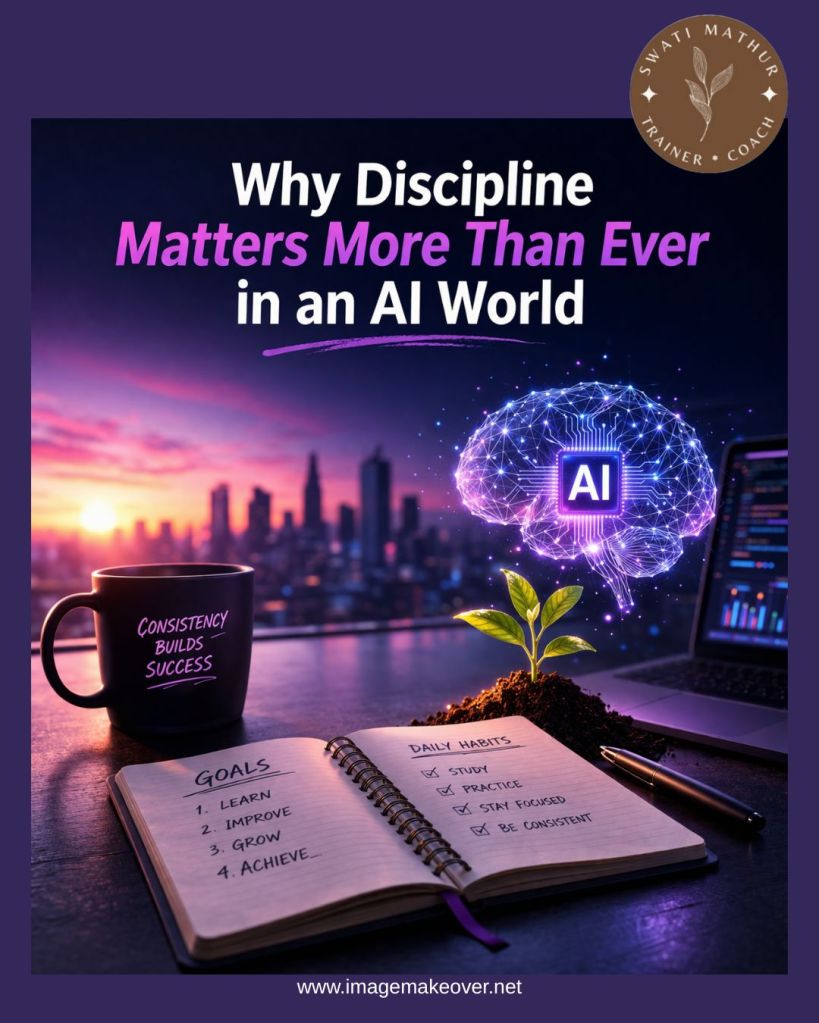
Why Discipline Matters More Than Ever in an AI World? #DisciplineMatters

While AI can accelerate success, it cannot replace one of the most powerful human traits, discipline. In fact, in an AI-driven world, discipline becomes even more important because when everything becomes faster and easier, the real challenge is not access, it’s consistency.

The Illusion of Instant Results

AI can generate content, solve problems, and automate tasks within seconds. This speed can create an illusion, that success should also be instant. For example, a student can use AI to complete an assignment in minutes. But does that mean they have truly understood the concept? Not necessarily.

Similarly, a professional can generate a presentation quickly using AI. But without refining it, practicing delivery, or understanding the content deeply, the impact remains limited.

Real growth still requires consistency where showing up every day matters, practice where repeating and improving makes things more refined, effort where one should always go beyond convenience. We need to remember this that AI can assist the process but it cannot replace discipline. It can give you a head start, but it cannot run the race for you.

Discipline is the real Human Differentiator

Today, almost everyone has access to AI tools. The difference is not who has access but who uses them well. And that difference lies in discipline.

A disciplined person will always dedicate time daily to learning new tools, cross-check and refine AI outputs and also build skills beyond automation. For instance, two employees may use AI for content creation, One copies and pastes the output directly and the other edits, adds insights, and aligns it with their audience. Over time, the second person builds expertise and credibility. The first remains dependent.

As Jim Rohn said:

AI may help you set the goal faster but discipline helps you reach it meaningfully.

Without discipline, AI can easily become a distraction rather than a tool.

It can lead to-

  • Distraction – constantly switching tools without focus
  • Over-reliance – depending on AI for even simple thinking
  • Shallow understanding – knowing answers without knowing “why”

For example, if you rely on AI to write everything, from emails to ideas then you may slowly lose your own voice. But with discipline, AI becomes a learning accelerator that will help, you understand faster , a productivity enhancer that will help you in saving time on repetitive tasks and most crucial a strategic advantage that will allow you to focus on high-value work.

The key is not how often you use AI but how intentionally you use it.Just remember small habit can have bigger impact Discipline is not about big, dramatic actions but it’s all about small, consistent habits.

In the AI era, discipline can look like spending 20–30 minutes daily exploring a new tool instead of scrolling mindlessly. Verifying AI-generated information before using it and practicing skills manually, even when AI can do it faster. A writer might use AI for structure but still write key sections independently to maintain originality. A student might use AI for explanation but still solve problems on their own. These small habits may seem insignificant daily but over time, they create deep expertise and confidence.

There are moments when using AI feels like the easiest option and it is. But I have noticed that when I rely on it too much, my thinking becomes passive. On the other hand, when I consciously choose to think first and then use AI as support, the results feel more authentic and satisfying. That’s where discipline quietly shapes growth. AI can open doors but discipline determines whether you walk through them.

It’s easy to start when tools are powerful. It’s hard to stay consistent when results are not immediate. And that’s exactly where discipline matters most. Because technology can give you opportunities but only discipline turns them into achievements.

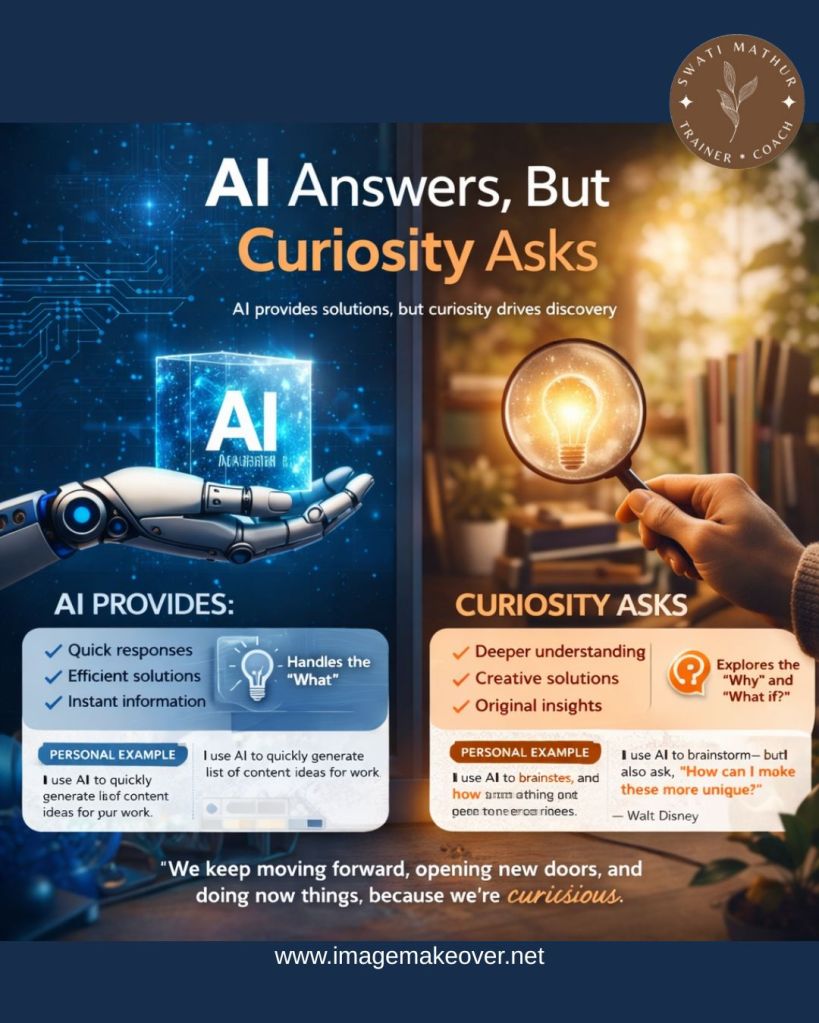
AI Answers, But Curiosity Asks #CuriosityMatters

AI is built on data but curiosity is built on wonder. It pushes us to explore, what is possible?or what can be improved? and even what lies beyond the obvious?

Without curiosity, AI becomes just another tool. With curiosity, it becomes a gateway to endless possibilities.

Think about how children interact with the world. They keep asking “why?” not because they need immediate answers, but because they want to understand. That same mindset, when applied to AI, transforms learning into discovery.

AI Needs Curious Minds

AI doesn’t ask questions on its own, it responds to human prompts. The depth of it’s output depends on the depth of your thinking. A curious person will always experiment with AI tools, will ask better questions and discover creative solutions on the other hand a passive user will only scratch the surface.

For example, two students using the same AI tool to study where one simply asks for answers to homework questions and the other asks, “Can you explain this in a simpler way?”, “Can you give real-life examples?”, or “What happens if this concept is applied differently?” Over time, the second student doesn’t just complete assignments but they actually understand the subject deeply. That’s the power of curiosity.

Learning in the Age of AI

We live in a time where answers are instantly available. But easy answers can reduce the desire to explore deeper. Curiosity ensures that we don’t just accept answers, but question them. Don’t stop at convenience, but seek understanding

For instance, while working on content or presentations, it’s easy to let AI generate everything. But when you pause and ask, “Can I make this better?” or “What’s missing here?”, you start adding originality and insight.

As Walt Disney famously said:

Curiosity vs. Comfort

AI can make life comfortable but growth rarely happens in comfort.

Curiosity pushes you to learn new skills, step out of your routine and challenge assumptions. Take a simple workplace example, some professionals stick to basics like AI usage be it emails, summaries or quick tasks, while others explore deeper like automation, creative design, data insights. Over time, the difference in growth becomes visible.The tool is the same but the curiosity is not. Curiosity doesn’t always have to be big or technical. It can be simple. Say, asking how a recommendation algorithm works instead of just scrolling, exploring a new AI tool instead of sticking to familiar ones or trying different ways to solve the same problem.

Even personally, there are moments when you start using AI for a small task and then curiosity kicks in: “What else can this do?” That single question often opens up completely new possibilities.

In a world where AI can provide information instantly, curiosity becomes even more valuable. Because those who remain curious will not just keep up with change but they will also lead it.

AI can give you answers but curiosity will help you ask the questions that truly matter.

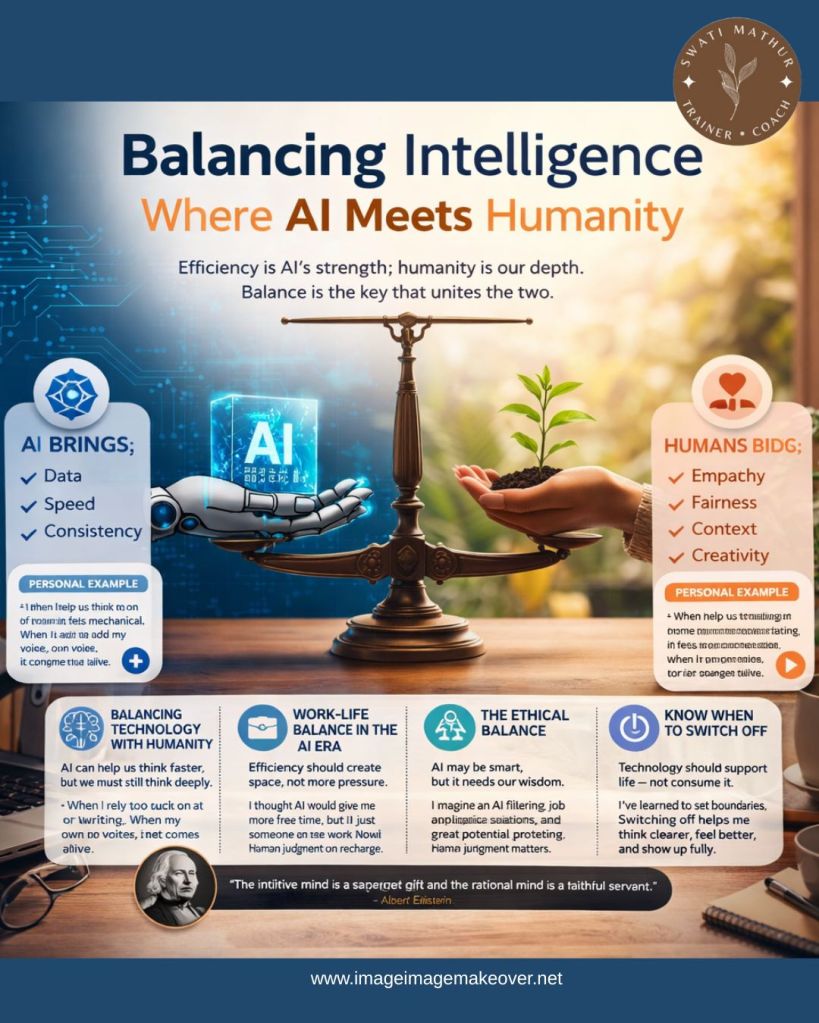
Balancing Intelligence- Where AI Meets Humanity #Balancing Matters

In the race to adopt Artificial Intelligence, many of us are running fast but not always in the right direction. We are automating, optimizing, and accelerating. But somewhere along the way, an important question arises: Are we maintaining balance?

I have experienced this personally. There have been days when I used AI tools to speed up my work be it writing, planning or even structuring ideas. While I finished tasks faster, I also noticed something surprising, I felt mentally more exhausted, not less. That’s when I realized,I was saving time, but not creating space. And that’s where balance was missing.

AI thrives on efficiency while humans thrive on meaning. And the bridge between the two is balance. Their is no doubt that AI can process information faster than any human. It can work 24/7 without fatigue and can make decisions based on vast datasets within seconds. According to global reports, organizations that effectively use AI see significant improvements in productivity and decision-making.

But here’s the challenge, when efficiency becomes the only goal, we risk losing human connection, creativity and most significantly ethical judgment.

Balancing Technology with Humanity

There’s a growing tendency to rely heavily on AI, even for thinking, writing, and decision-making. While AI is a powerful assistant, over-dependence can weaken critical thinking and originality. For instance, while writing content, creators sometimes use AI to generate ideas. But if they rely on it completely, the writing starts to feel mechanical. So it is imortant to practice to pause, reflect, and add their own voice. That small act keeps creativity alive. AI helps us start, but balance helps us finish meaningfully.

As Albert Einstein once said,

“The intuitive mind is a sacred gift and the rational mind is a faithful servant.”

AI strengthens the rational mind but balance ensures we don’t silence our intuition.

Now lets talk about Work-Life Balance in the AI Era

Ironically, while AI promises to save time, many people feel busier than ever. Why? Because efficiency often leads to higher expectations.

Balance in the AI era means-

  • Using AI to free time, not fill it
  • Prioritizing mental well-being over constant productivity
  • Knowing when to switch off

There was a time when I thought using AI would give me more free time. But instead, I started taking on more work simply because I could do it faster. My schedule became fuller, not lighter. It taught me an important lesson that efficiency should create breathing space, not more pressure. Technology should support life and not consume it.

The Ethical Balance

AI decisions can impact hiring, healthcare, finance, and more. Without human balance, these systems may unintentionally reinforce biases. Humans bring empathy fairness and context. While AI brings data, speed and consistency. Balance ensures decisions are both smart and humane.

Imagine relying on AI to shortlist candidates for a job. It might quickly filter resumes based on patterns but it may miss someone with potential just because they don’t fit the usual criteria. That’s where human judgment becomes essential. Balance ensures we don’t lose people in the process of optimizing systems.

Here The Middle Path Matters

AI is powerful but power without balance can lead to imbalance in life, work, and society. Because progress is not just about moving forward, it’s about moving forward wisely.

In The Age Of AI, Attitude Still Defines You #AttitudeMatters

We are surrounded by AI from recommendation engines that suggest what we watch, to tools that write, design, and even make decisions. According to recent studies, AI adoption in businesses has more than doubled in the last few years. It is efficient, scalable, and increasingly intelligent. But despite its growing capabilities, there is one thing AI cannot replicate in its truest form human attitude.

AI can process data. It can analyze patterns. It can even mimic emotions. But it cannot choose an attitude.

And that’s where we come in.

The Power of Attitude in an AI-Driven World

Attitude is not just about being positive or negative. It is about how we respond to change, to uncertainty, to growth. As AI reshapes industries, jobs, and daily life, our attitude determines whether we see it as a threat or an opportunity.

You may have access to the most advanced AI tools, but without the right attitude, those tools remain underutilized.

Think about it, two people using the same AI platform. One sees it as a shortcut to avoid thinking. The other sees it as a partner to enhance creativity.

The difference? Not skill. Not knowledge. Attitude.

AI Can Assist, But Attitude Leads

There’s a famous quote by Charles R. Swindoll:

This becomes even more relevant in the age of AI. AI might change how work is done, but your attitude defines:

For example, many professionals fear that AI will take away jobs. While this fear is understandable, history shows us that technology often transforms jobs rather than eliminating them entirely. The World Economic Forum has projected that while AI may displace some roles, it will also create millions of new ones.

The real question is: Will you be ready for them? Well, your attitude decides that.

The Emotional Edge Over Machines

AI lacks emotional depth. It does not feel fear, hope, ambition, or resilience. Humans do and that is our advantage.

A positive, growth-oriented attitude allows us to learn new skills faster , collaborate better with AI and most importantly stay motivated during uncertainty.

In contrast, a fixed or negative attitude can make even the simplest technological changes feel overwhelming.

Attitude Shapes the Future of AI Use

AI is a tool. A powerful one, yes but still a tool.

Just like a pen can write poetry or misinformation, AI can be used to create value or dependency. The intention behind its use comes from human attitude.

If your attitude is

Curious → You will explore AI deeply

Fearful → You will avoid it

Balanced → You will use it wisely

And that balance is where true growth lies.

A Simple Reflection

Ask yourself

  • Do I see AI as a replacement or an enhancement?
  • Am I willing to learn alongside technology?
  • Is my attitude helping me grow or holding me back?

These questions matter more than any tool you use.

The Human Factor Still Wins

As we step deeper into the AI era, it’s easy to get lost in algorithms and automation. But at the core of every technological advancement is a human being making choices.

AI may define the future of work. But attitude will define your place in that future. Because in the end, it’s not just about how intelligent the machines become but it’s about how wisely humans choose to grow alongside them.

“Aligning Hearts”- Crafting Happiness with Your Life Partner

Canva/Pexels

Radha and Mayak had been inseparable since childhood. They shared everything, from their deepest secrets to their wildest dreams. Their bond was so strong that everyone around them assumed they were destined to be together.

As they grew older, Radha and Mayak’s friendship blossomed into something more. They found comfort and solace in each other’s presence, and it wasn’t long before they realized they were in love. With their hearts full of hope and excitement, they decided to take their friendship to the next level and get married.

They had a happy and humorous first few years of marriage. Together, they traveled, followed their passions, and created an idyllic life on the outside. But as time went on, rifts in their relationship started to show.

Radha and Mayak realized that they had drifted apart. What was once an unbreakable bond now felt strained and distant. They struggled to communicate effectively, and conflicts arose more frequently than before. Despite their best efforts to reignite the spark, they found themselves caught in a cycle of misunderstandings and resentment.

Radha longed for the deep emotional connection they once shared, while Mayak felt suffocated by the weight of expectations and responsibilities. They both yearned for the simplicity and ease of their friendship but didn’t know how to bridge the growing divide between them.

As the struggles in their relationship mounted, Radha and Mayak found themselves at a crossroads. They had to confront the harsh reality that love alone couldn’t sustain their marriage. It required effort, compromise, and a willingness to confront their demons and work through their issues together.

With the help of therapy and open, honest communication, Radha and Mayak began to unravel the tangled knots that had formed between them. They learned to let go of past grievances and rediscover the qualities that had drawn them to each other in the first place.

They began to mend their relationship gradually but steadily. Once more, they sought comfort in each other’s arms and realized how deeply connected they were to one another. Radha and Mayak came to understand that genuine love involved being there for one another every day, especially in the face of adversity, rather than just making dramatic gestures or impassioned pronouncements.

Their journey wasn’t easy, but it was worth it. Through their struggles and triumphs, Radha and Mayak discovered the true meaning of love: a bond that could weather any storm, as long as they faced it together. And as they stood hand in hand, ready to face whatever the future held, they knew that their friendship-turned-love story would always be their greatest adventure.

Certainly, selecting a partner can significantly impact various aspects of your life.

A supportive and understanding partner can contribute positively to your mental well-being, whereas a toxic or unsupportive relationship can lead to stress, anxiety, and depression. A harmonious relationship can provide a sense of security and tranquility, while conflicts and unresolved issues with a partner can disrupt your peace of mind. Loving partner can enhance your ability to give and receive love, fostering a positive self-image and self-worth. On the other hand, being in an unhealthy relationship may undermine your self-esteem and capacity to love yourself. Even your partner’s dietary preferences and lifestyle choices can influence your own eating habits, leading to healthier or unhealthier patterns depending on compatibility. A partner who is supportive can encourage and empower you to pursue your career goals, while a partner who undermines your ambitions or demands excessive attention may hinder your professional growth. Remember, a partner who believes in you and provides positive reinforcement can boost your confidence, whereas criticism or lack of support may erode your self-assurance, also partner’s values, opinions, and input can shape the decisions you make in various areas of your life, from finances to lifestyle choices. A loving and fulfilling relationship can bring joy and laughter into your life, but constant conflict or dissatisfaction can diminish your happiness. The dynamics of your relationship with your partner can significantly influence how you raise your children too, impacting their upbringing, values, and emotional well-being. While a loving and supportive relationship can encourage restful sleep, relationship stress or disruptions can impair your sleep quality and cause insomnia or irregular sleep patterns. Selecting a spouse has a significant impact on many areas of your life, including daily routines, long-term objectives, and emotional health. To promote happiness and personal development, relationships must be based on respect, understanding, and support for one another.

  1. Self-awareness: Before seeking a life partner, take the time to understand yourself, your values, and your needs. Reflect on what you truly desire in a relationship and what qualities are important to you in a partner.
  2. Communication: Any effective partnership must include open and honest communication. Communicate your thoughts, feelings, and expectations to your spouse in an open and honest manner, and urge them to do the same. Stronger bonds, conflict resolution, and trust are all facilitated by effective communication.
  3. Compatibility: Seek a partner who shares your core values, interests, and life goals. While differences can add depth to a relationship, fundamental compatibility forms the foundation for long-term happiness and compatibility.
  4. Mutual Respect: Respect is the cornerstone of a healthy relationship. Treat your partner with kindness, empathy, and consideration, and expect the same in return. Respect each other’s boundaries, opinions, and autonomy.
  5. Support and Encouragement: Be each other’s biggest cheerleaders. Support your partner’s dreams and aspirations, and encourage them to pursue their passions. Celebrate their achievements and provide comfort during challenging times.
  6. Quality Time: Make time for meaningful interactions and shared experiences. Whether it’s going on dates, engaging in hobbies together, or simply having deep conversations, prioritize quality time to strengthen your connection.
  7. Compromise and Flexibility: No relationship is perfect, and conflicts are inevitable. Learn to compromise, find common ground, and work through disagreements with understanding and empathy. Be willing to adapt and grow together as individuals and as a couple.
  8. Maintain Independence: While it’s important to foster closeness and intimacy, it’s equally crucial to maintain your individual identities and interests. Allow each other space for personal growth, hobbies, and friendships outside of the relationship.
  9. Emotional Intimacy: Cultivate emotional intimacy by being vulnerable and emotionally available with your partner. Share your fears, hopes, and dreams, and create a safe space for your partner to do the same. Emotional connection deepens the bond between partners and fosters greater understanding and empathy.
  10. Continuous Effort: Lastly, remember that a happy relationship requires ongoing effort and commitment from both partners. Nurture your relationship with love, care, and dedication, and prioritize its well-being amidst life’s challenges and distractions.

Understand The Stages Of Fashion Curve (A2Z of Image Management)

Hi Everyone,

What an amazing journey from A 2 Z . Writing for #BlogchatterA2Z challenge has been amazing. In the process I have realized ,I have so much to share which I will continue as I believe sharing is caring. Kumari aka Lyrikal has rightly said “Knowledge increases by sharing and not by saving”.

Today is my 26th post , the last letter in an Alphabet ,but this post talks about Zenith in Fashion Curve…Truly wonderful. The zenith is the “highest” point on the celestial sphere and we are going to talk about highest point in fashion curve. At some time, most clothing styles pass through a fashion curve, cycle, or wave. You can observe the predictable stages a clothing style goes through during its time as a fashion trend. These stages illustrate the relative position of classics and fads, from start to finish. The average length of a fashion cycle is getting shorter due to mass media and fast fashion, lasting only three to seven years.

Before moving to fashion curve lets first understand what is classic and Fads clothing.

Continue reading “Understand The Stages Of Fashion Curve (A2Z of Image Management)”

How Do Yin and Yang in Clothing Reflects Your Personality? (A2Z of Image Management)

Hi Everyone,

Just one more post to go..yipeee!! This is my 25th Post for #BlogchatterA2Z challenge. Lets talk about Yin and Yang in clothing which is very interesting and fascinating too. The ancient Chinese concept of opposing characteristics or traits in nature is described with the terms yang and yin. The concept relates directly to dominance and subordinance, advancing and receding. Yang represents dominant, advancing, assertive traits. Yin represents subordinate, receding, receptive traits. More specifically, to the Chinese, yin means gentleness and softness—the grace of the willow tree, and the delicacy of the moon. Yang means strength and vigor— the sturdiness of the pine tree, and the force of the sun.

Importance and Functions of Yin/Yang Concept and Personal Style—Benefits
Describes opposites and classifies physical, psychological, and
clothing traits.
• Allows comparison based on similarity and differences in traits.
• Assists in discovering, developing, and refining personal style in
dress.
• Advances knowledge, awareness, understanding, acceptance, and
appreciation of the self and others.
• Becomes a tool for solving image-related problems and in creating
the type of appearance necessary to achieve goals.
• Guides the use of clothing as a means of visual communication.
• Guides the creation of powerful illusions about the individual.
• Provides a tool for adding variety and interest to your appearance.

Continue reading “How Do Yin and Yang in Clothing Reflects Your Personality? (A2Z of Image Management)”

X-factor of Smart Shopping Skills (A2Z of Image Management)

Hi Everyone,

Here I am with my 24th post for #BlogchatterA2Z challenge. Having a Smart Shopping skill may turn out to be an X-Factor in Wardrobing. So here I am talking about What is a Smart Shopping Skills and steps to follow in order to become a smart shopper.

Open your closet doors for a long look. Don’t be discouraged if the contents look skimpy. You’ve pared your wardrobe down to the bones—to what really works for you. What you need now is an accurate mental image of what’s in your closet. This mental image will give you direction for planning, shopping, and purchasing wisely—for adding new pieces that will continue to work together for you to your advantage. Think of it this way. When you buy a piece of furniture, you envision your whole house, then the room and how that piece of furniture will look and work in that room. It should be the same with your wardrobe. Just as a piece of furniture becomes part of the interior design, part of the artistic composition; a piece of clothing becomes part of your exterior design and a part of your personal artistic composition.

Continue reading “X-factor of Smart Shopping Skills (A2Z of Image Management)”

11 Wardrobe Strategies yo have attractive, affordable, appropriate and authentic closet(A2Z of Image Management)

Hi Everyone,

This is my 23rd post for #BlogchatterA2Z challenge. And today I will be taking you through some of the wardrobe strategies which can helps you to have a closet which is attractive, affordable, appropriate and authentic. When you open your closet and see it filled with clothes, yet feel you have nothing to wear, it’s likely the clothes don’t work for your life style, your personal style, or work together in ways that reflect you the way you want to be seen. The typical tendency is to go out and buy more”stuff”- to buy into the latest “must have” list. The opposite tendency is to stop buying anything, assuming that what you want is not available or cost too much. In either case, seize the moment and overcome the fear of fashion. Look at yourself and your clothes in the light of What all wardrobe strategies you need to adopt?

Rely on clothing as a resource, a tool that can control and use to help you meet your needs and achieve your goals.

A resource is anything available to use to your advantage, as an aid to meet a need or achieve a goal. Time, money, property, energy, food, and clothing qualify as resources.

As a resource, your clothing becomes a tool for meeting needs and achieving goals, takes you where you need to go.
Virtually everyone can afford some clothing of value as a resource.
Carefully selected, this resource can have positive effects on the wearer.
Prepared with clothing as a resource, you/we feel more confident, capable, and credible.

Continue reading “11 Wardrobe Strategies yo have attractive, affordable, appropriate and authentic closet(A2Z of Image Management)”