Is Learning Still Important in the Age of AI? #LearningMatters

In a world where Artificial Intelligence can answer almost anything instantly, one might assume that learning has become easier than ever. And in many ways, it has. But at the same time, it has also become more fragile. Because when answers are instant, the temptation to stop learning becomes stronger. AI can give you solutions.But learning is what gives you understanding. As the philosopher Confucius once said:

And in the age of AI, this balance between learning and thinking is more important than ever. Traditionally, learning required effort. You had to read, research, struggle, and spend time understanding concepts. That effort, although challenging, built depth and clarity.

Today, AI has reduced that friction. You can ask a question and get an answer instantly, can get summaries instead of reading full texts and even solve problems without fully understanding them. While this makes learning faster, it also creates a hidden risk and that is superficial learning. For example, a student preparing for exams can use AI to quickly generate answers. But if they skip the process of thinking and understanding, they may perform well in the short term but struggle in real-world application. Learning is not just about getting answers but it is about building the ability to think. One of the biggest differences in the AI era is how people engage with information.

A passive learner,

  • Reads AI-generated content without questioning
  • Accepts answers without understanding
  • Moves quickly from one topic to another

An active learner,

  • Asks follow-up questions
  • Tries to explain concepts in their own words
  • Applies what they learn in real situations

The difference may seem small, but over time, it creates a huge gap. AI can support both but only one leads to real growth. When used correctly, AI can transform learning in powerful ways. It can break down complex concepts into simple explanations, it can also provide real-life examples, even offer multiple perspectives ans act as a practice partner. For instance, instead of just asking for an answer, a learner can ask:

  • “Explain this like I’m a beginner”
  • “Give me a real-world example”
  • “Test my understanding with questions”

This turns AI into an interactive learning companion rather than just a solution provider.In a world where AI can do so much for you, choosing to learn becomes a matter of discipline.

It means: taking time to understand, even when shortcuts are available , practicing skills, even when AI can do it faster and staying curious, even when answers are easily accessible

For example, a professional might use AI to draft emails or reports. But someone committed to learning will review, refine, and understand the structure—improving their own communication skills over time.

Learning requires effort beyond convenience. The more you learn, the less dependent you become. When you truly understand something you can apply it without assistance, can adapt it in new situations and think independently. But when you rely only on AI too much you hesitate without it also struggle in unfamiliar situations and lack confidence in your own thinking Learning gives you ownership of your knowledge. So ask yourself am I learning or just getting answers? Can I explain what I know without using AI? ans Am I using AI to grow or to avoid effort? These questions define whether you are evolving or just keeping up. AI can give you speed but learning gives you depth.

This post is part of Blogchatter A2Z challenge 2026
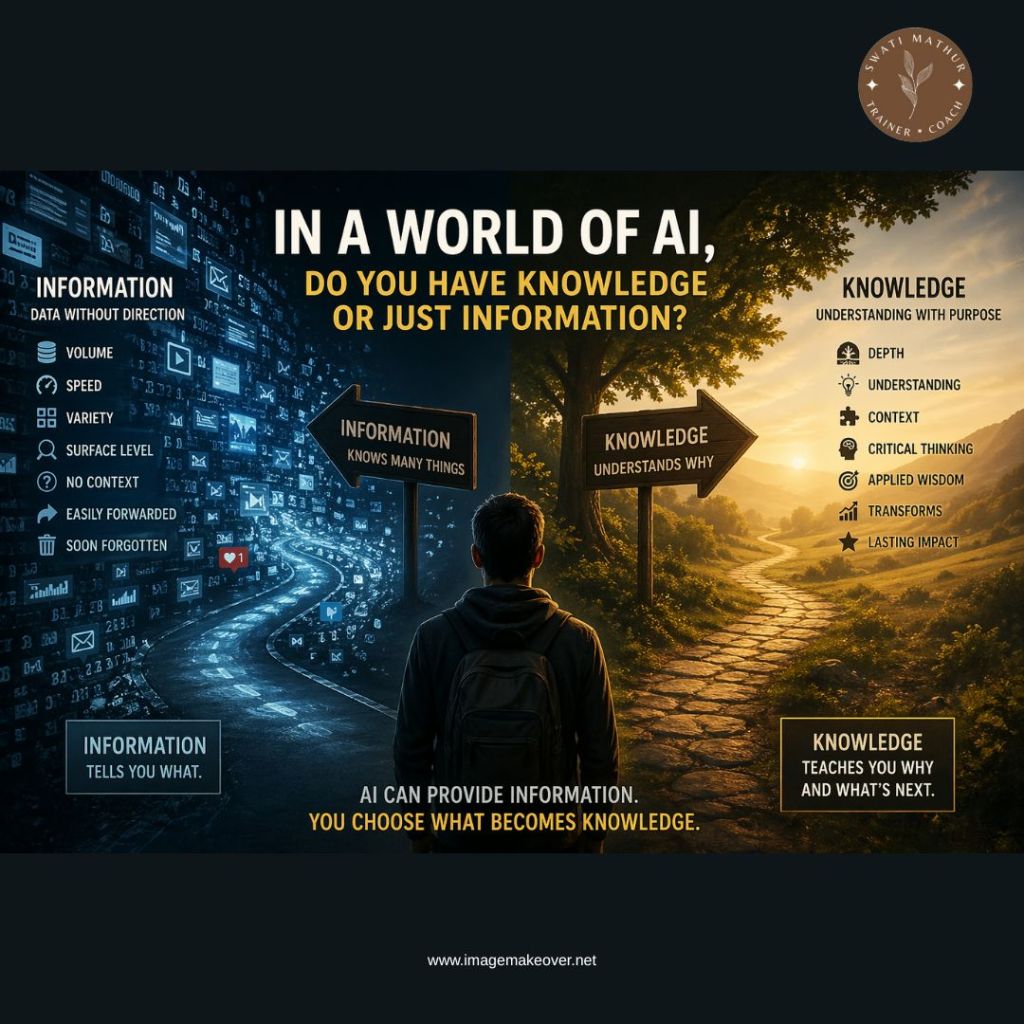
In a World of AI, Do You Have Knowledge or Just Information? #KnowledgeMatters

In a world powered by Artificial Intelligence, information is everywhere but knowledge is still rare. AI can give you answers in seconds. It can summarize books, explain concepts, and generate ideas instantly. But having access to information is not the same as having knowledge. And that distinction is what truly sets people apart.

As Albert Einstein once said:

And in the age of AI, this difference matters more than ever. Today, you can ask AI anything and get an answer immediately. But the real question is—do you understand it?

Information is quick, accessible and temporary and knowledge is deep, applied and lasting. For example, a student can use AI to get answers to questions instantly. But unless they take the time to understand the concept, question it, and apply it, that information remains surface-level.This is where many people get stuck. They confuse speed with learning. AI is an incredibly powerful tool for learning—but only when used actively.

It can explain complex ideas in simple ways, provide examples and analogies and help you explore multiple perspectives. But knowledge is built when you reflect on what you learn apply it in real situations and connect it with your own understanding Consider two learners one asks AI for answers and moves on and the other asks why, how, and what if. Over time, the second person develops knowledge. The first only collects information.

One of the biggest risks in the AI era is passive consumption. When everything is available instantly, it becomes easy to read without thinking copy without understanding, agree without questioning and this creates an illusion of knowledge.

For instance, you may feel confident after reading an AI-generated explanation. But when asked to explain it in your own words or apply it in a new situation, the gaps become visible. That’s because knowledge requires engagement, not just exposure.

To truly benefit from AI, you need to shift from passive use to active learning.

A simple approach: should be,

  • Don’t just ask for answers—ask for explanations
  • Don’t stop at understanding—try applying it
  • Don’t accept everything—question and verify

For example, instead of asking, give me an answer you should ask explain this concept with a real-life example and test me on it. This small shift transforms AI from a shortcut into a learning partner. True knowledge gives you something AI cannot—confidence without dependency. When you understand something deeply you can explain it clearly, can apply it creatively and you can adapt it in new situations. But when you rely only on AI you hesitate without it, you struggle to think independently and most importantly you lack clarity. Knowledge gives you ownership.

A Simple Reflection

Ask yourself,

  • Am I just consuming information or building knowledge?
  • Can I explain what I learn without using AI?
  • Am I using AI to think or to avoid thinking?

Your answers will reveal where you stand. AI can give you access to unlimited information.
But only you can turn that information into knowledge. Because knowledge is not what you read it is what you understand, apply, and remember.

How to Teach Judgment Skills to Students in the Age of Artificial Intelligence #JudgementMatters

In today’s AI-driven world, where Artificial Intelligence (AI) can generate answers in seconds, the real challenge is no longer finding information, it is deciding what to do with it. As a soft skills trainer and a blogger, I often emphasize that success today is not about speed, but about sound decision-making.

Judgment, therefore, becomes the defining skill. It is the bridge between information and action, knowledge and wisdom. Without it, even the best tools can lead you in the wrong direction. It is not just about making decisions but about making thoughtful, responsible, and context-aware decisions. In a world full of automated outputs, judgment helps you pause, evaluate, and choose wisely. It is very important to critically evaluate every information instead of just blindly accepting it. At the same time having clarity of purpose and awareness regarding consequences is equally important before taking any decision. When you develop judgment, you move from being a passive user of AI to an active thinker.

AI today can do anything from writing essays and reports to suggest career paths or provide business ideas and even offer solutions instantly. But what it cannot do is fully understand your personal context, emotions, and long-term goals. That gap is where judgment plays its role. Without judgment you may follow advice that doesn’t suit you, you may lose your originality or you may become dependent on tools. But with judgment you filter what truly matters, adapt ideas to your reality and make decisions aligned with your values.

In the AI age, not everything that sounds right is actually right. AI often presents information confidently, which can create an illusion of correctness.

Strong judgment begins when you start questioning:

  • Is this accurate?
  • Is this relevant to my situation?
  • What might be missing here?

For example, when a student receives a ready-made answer, instead of copying it, they should analyze whether they truly understand it.

AI works on general patterns, but your life is unique. What works for others may not work for you.

Good judgment requires you to:

  • Understand your strengths and limitations
  • Consider your environment and goals
  • Customize AI suggestions accordingly

For instance, a productivity method suggested by AI may not suit your learning style. Judgment helps you adapt it instead of blindly applying it. One-size solutions don’t work in real life therefore personalization is the key to effectiveness.

One of the biggest risks in the AI era is the temptation to take shortcuts. It is easy to generate assignments, projects, or answers without effort. But judgment asks a deeper question, Is this helping me grow? Ethical judgment helps you to maintain integrity, build trust and focus on long-term success instead of short-term gains. As I often tell students AI can help you finish tasks, but only honesty will help you build a future.

AI can give you multiple options, but it cannot take responsibility for your choices. That responsibility lies with you. Strong judgment means, evaluating pros and cons, accepting uncertainty and taking ownership of decisions. For example choosing a career path, making a business decision, or handling relationships, AI can guide, but you must decide and stand by it. Remember every decision has consequences and every choice shapes your future.

Judgment is not something you are born with, it is something you build over time.After every decision, take a moment to reflect what worked well, what could I improve and what did I learn? This habit strengthens your thinking and prepares you for better decisions in the future.

We are living in a time where intelligence is easily accessible.
But what will truly set you apart is not how much you know but it is how wisely you choose.

From Artificial Intelligence to Intentional Intelligence: The New Intelligence in AI Age #Intentional Intelligence Matters

In a world where Artificial Intelligence (AI) can think, write, analyze, and even create, the definition of intelligence has fundamentally changed. Earlier, intelligence was about what you know, today, it is about how consciously and purposefully you use what is available to you. This is where the concept of Intentional Intelligence becomes critical.

Intentional Intelligence is not just about being smart but it is about being aware, mindful, and purposeful in how you think, learn, and act, especially when powerful tools like AI are at your fingertips. Without intention, AI can make you faster but not necessarily better. In the age of AI, one of the biggest mistakes people make is jumping to tools without clarity. They open AI platforms, type random prompts, and expect meaningful results. But AI is like a mirror, it reflects the quality of your thinking. Before you use AI, pause and define your intention clearly,

  • What exactly am I trying to achieve?
  • What problem am I solving?
  • What kind of output do I really need?

When you operate with clarity, AI becomes a powerful assistant. Without it, it becomes a source of distraction and confusion. For example, a student who asks, “Explain this chapter so I can understand it deeply” will gain far more than someone who simply says, “Give me answers.” The difference is not in AI but it is in intention.

AI gives fast answers but high performers don’t accept them blindly. They engage, challenge, and refine. In fact, one of the most important skills in the AI age is learning how to question. Whenever you receive an output, train yourself to think,

  • Is this accurate and relevant?
  • What perspective is missing?
  • Can I improve or expand this idea?

This habit builds critical thinking, which is something AI cannot replace. For instance, if AI generates a business idea, an average user may accept it. But a high performer will always question like, “Is this practical in my context?”, “What are the risks?”, and “How can I make it unique?” This is where real intelligence begins not in receiving answers, but in refining them.

Most people use AI to consume, read, copy, paste, and move on. But high performers use AI to create. The goal is not to depend on AI for output, but to use it as a thinking partner. You can use AI to brainstorm ideas, to build your own frameworks from AI suggestions or combine your originality with AI efficiency. When you shift from consumption to creation, your value increases. For example, instead of copying an AI-generated assignment, a student can understand the structure, add personal insights and present a unique perspective. Now this transforms them from a user into a creator.

One of the most underrated habits in the AI age is reflection. When everything is instant, people rarely stop to think about what they actually learned. But learning does not come from access, it comes from processing. After using AI, take a moment to reflect, what new idea did I understand today? Did this improve my thinking or just save time? How can I apply this knowledge? Reflection converts information into deep intelligence.

For example, after completing a task using AI, instead of immediately moving on, a learner who reflects will retain more, think better, and grow faster.

AI is powerful but it can also make you lazy if used without discipline. Over-dependence reduces your ability to think independently. That’s why intentional users build boundaries. They decide when to use AI and when to think on their own. They avoid using AI for everything instead challenge themselves before seeking assistance. Discipline ensures that AI remains a tool and not a replacement. For instance, a student might first attempt solving a problem independently, and only then use AI to check or improve their answer. This builds confidence and capability.

In the age of AI, the gap is no longer between those who have access and those who don’t. The gap is between those who use AI passively and those who use it intentionally. Two people can use the same tool, but their outcomes will be completely different.

Which category you fall into?

Focus in the Age of AI-The Real Productivity Skill #FocusMatters

In a world full of notifications, tools, and endless information, the real challenge is no longer access actually it is focus. We are surrounded by possibilities, powered by Artificial Intelligence that can generate ideas, automate tasks, and provide instant solutions. Yet, despite having more resources than ever before, many of us struggle to complete meaningful work. The reason is simple, AI gives us options, but focus helps us choose what truly matters.

As the author Cal Newport wisely said,

There is an interesting paradox that comes with the rise of AI. While it offers countless tools for writing, designing, coding, and learning, it also creates an environment of constant distraction. What begins as a productive intention often turns into scattered activity. For instance, you may start using one AI tool to write an article, then switch to another for better phrasing, explore a third for visuals, and eventually end up watching tutorials on the “best AI tools available.” Hours pass, yet the actual task remains incomplete. This is not productivity, it is attention being pulled in multiple directions. Psychologists describe this as decision fatigue, where too many choices reduce our ability to act effectively. In fact, research suggests that professionals spend a significant portion of their time switching between tasks rather than completing them, which reduces both efficiency and quality of work.

At its core, focus is not merely about avoiding distractions but it is about directing your energy with intention. It means doing one thing at a time and doing it well. Although multitasking is often celebrated, studies have shown that it can reduce productivity and increase errors. When you try to write, check messages, and use AI tools simultaneously, your thinking becomes fragmented. On the other hand, when you dedicate uninterrupted time to a single task, your work gains clarity and depth. Focus also requires giving your full attention to what you are doing. AI can generate output quickly, but it cannot replace your judgment, creativity, or understanding. For example, you may generate content in seconds using AI, but without thoughtful review and refinement, it may remain generic and uninspiring. It is your attention that transforms that output into something meaningful.

Another essential aspect of focus is the ability to complete what you start. One of the biggest productivity challenges today is the habit of leaving tasks unfinished. Constant notifications, easy access to multiple tools, and the temptation to switch tasks create mental clutter. You might begin working on a report, get distracted by a message, check an AI suggestion, and return later with reduced clarity. This cycle not only delays completion but also drains mental energy. In contrast, completing a task before moving on creates a sense of progress and builds momentum.

As Steve Jobs once said,

Using AI effectively requires a focused approach. Instead of jumping between multiple tools, it is far more beneficial to understand and master one or two tools deeply. Mastery brings efficiency, confidence, and better results, whereas constant switching leads to surface-level knowledge. Similarly, having a clear goal before using AI makes a significant difference. Without clarity, AI becomes a source of random exploration rather than purposeful action. A focused approach to AI can be as simple as,

  • Using one or two tools consistently instead of experimenting endlessly
  • Setting a clear intention before starting a task
  • Allocating separate time for learning and exploration
  • Asking clear, structured questions instead of multiple vague ones

These small shifts can dramatically improve both productivity and quality of work.

The quality of your interaction with AI also depends on the clarity of your thinking. Asking multiple vague questions often leads to scattered answers, while asking one well-structured question produces precise and meaningful results. This reflects an important truth: AI responds to the quality of human input. A focused mind naturally asks better questions and therefore receives better answers.

If you reflect on your daily routine, you may notice how often your attention shifts—between apps, tasks, and ideas. This is not a lack of ability but a lack of sustained focus. Even a small change, such as dedicating uninterrupted time to a single task, can significantly improve both productivity and satisfaction. Focus allows you to move from being busy to being effective.

In the end, AI expands your possibilities, but focus sharpens your direction. AI can give you speed, but focus gives you depth. AI can help you begin, but only focus ensures that you finish with purpose and quality. So yes, F is for AI. But more importantly, F is for Focus. Because in a world where everything demands your attention, the ability to concentrate on what truly matters is what will set you apart.

Human First, AI Next “The Role of Empathy” Because #EmpathyMatters

In a world driven by algorithms and automation, one human quality stands out more than ever is empathy.

AI can analyze behavior, predict preferences, and even simulate conversations. It can detect sentiment in text, recommend products based on past choices, and respond instantly. But it cannot truly feel. It does not understand pain, joy, struggle, or hope in the way humans do. And that is where empathy becomes our greatest strength.

Empathy: Beyond Data

On one hand AI works on data and on other hand empathy works on understanding.

Data can tell you what is happening while empathy helps you understand why it really matters. For instance, an AI system may detect that a customer has made multiple complaints. It flags the case as “high priority.” But a human, listening to the tone of the customer, may realize that the frustration is not just about the issue but about feeling unheard. That difference changes the response. AI may prioritize speed but a human adds care, patience, and reassurance. This is why empathy creates connection, not just resolution.

A well-known quote by Maya Angelou captures this beautifully:

Let’s understand this better with the example. An AI chatbot responds instantly “We apologize for the inconvenience. Your request is being processed.” But a human representative says: “I completely understand how frustrating this must be. Let me personally make sure this gets resolved for you.”

Both responses may solve the problem but only one builds trust.

According to studies in customer experience, over 70% of customers say they stay loyal to brands that show understanding and empathy. Speed matters but emotional connection matters more.

Empathy Matters More Today

As AI takes over repetitive and technical tasks, human roles are evolving.

We are moving from-

  • Task-based work to a Relationship-based work
  • Execution to Interaction
  • Information to Understanding

Empathy helps us in many ways be it-

🔹 Building Meaningful Connections

In a digital-first world, genuine human connection is becoming rare and therefore more valuable. For example a teacher using AI tools to prepare lessons can deliver information efficiently. But a teacher who understands a student’s fear, hesitation, or lack of confidence can truly impact their learning journey. Empathy turns communication into connection.

🔹 Communicate Effectively

Effective communication is not just about clarity, it’s about sensitivity.

For instance, a manager delivering feedback without empathy may sound critical. The same feedback, delivered with empathy, becomes constructive and motivating.

Empathy helps you choose, the right words, right tone and right timing.

🔹 Lead with Understanding

Leadership in the AI era is not just about making decisions, it’s about making humane decisions.

For example, an AI system may recommend layoffs based purely on efficiency metrics but a leader will always do with empathy by considering the human impact, alternative solutions and by long-term morale. Empathy ensures decisions are not just smart, but also responsible.

As Satya Nadella (CEO of Microsoft) once said

Empathy in Everyday Use of AI

Even when using AI, empathy quietly shapes the outcome. When you are creating a content AI can generate it quickly but empathy ensures it resonates. For example, If you’re writing for students, empathy helps you to simplify language, address their confusion and make content more relatable. Without empathy, content may be correct but not impactful. When you are Teaching or Explaining AI can provide explanations, but empathy helps tailor them. For example a curious learner may need depth on the other hand a struggling learner may need simplicity and encouragement. Empathy allows you to adjust and not just deliver. While making decisions AI often reduces people to data points numbers, patterns or probabilities.But humans are more than data. For example a hiring algorithm may reject a candidate due to lack of keywords but a human may recognize potential, passion, and adaptability. Empathy ensures we don’t lose human value in data-driven decision.

Think about a time when someone truly understood you when they listened without interrupting, responded without judging, and supported without conditions.That experience stays with you forever. Now imagine a world where every interaction is efficient but emotionally empty. That’s the gap empathy fills. AI may improve efficiency, process information, stimulate responses and can process information but empathy improves relationships and create meanings. Empathy builds trust because in a world of smart machines, being human is your greatest strength.