
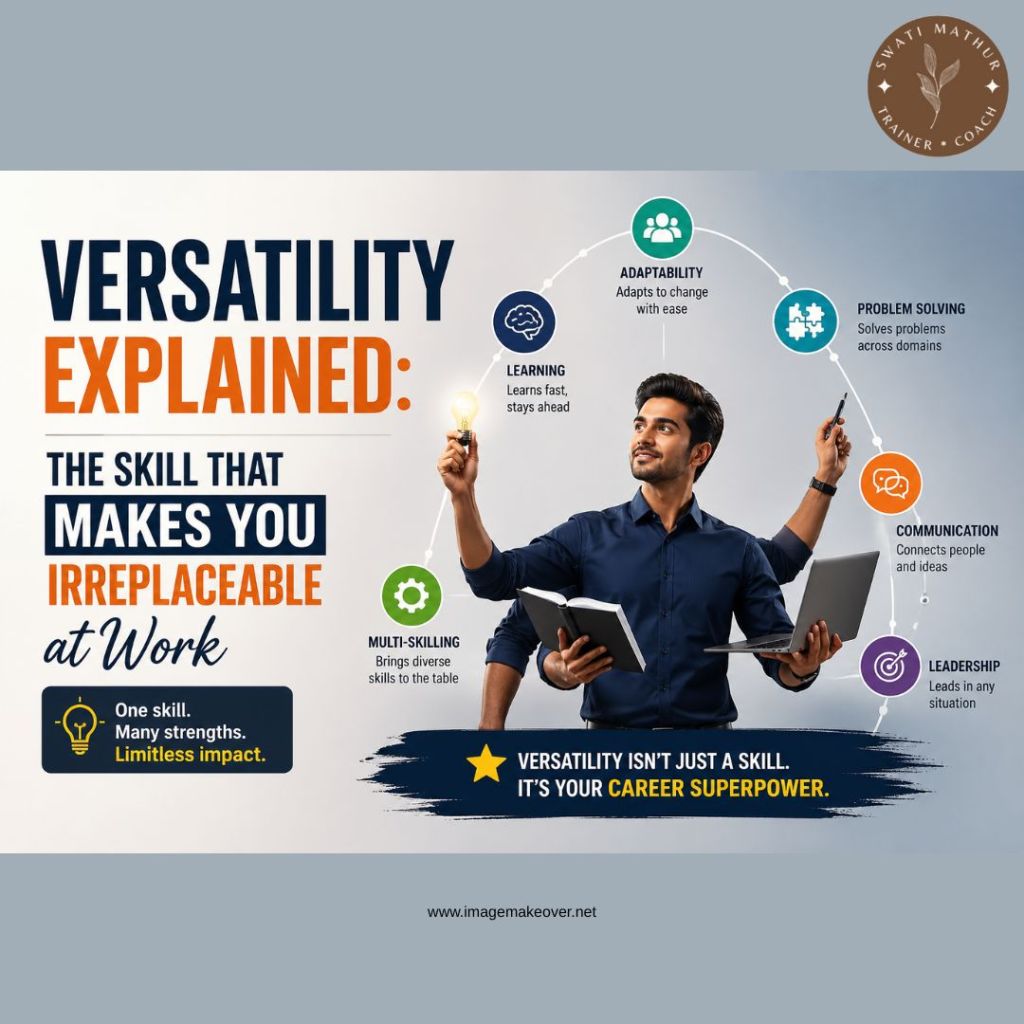
In the past, success was often defined by specialization being known for one skill, one role, one domain. But in today’s AI-driven world, that definition is shifting. Success now depends on versatility that is your ability to adapt, learn, and contribute across different roles, tools, and situations. Versatility is not just a skill. It is a mindset of flexibility, agility, and openness to change.
Artificial Intelligence is not replacing humans entirely, it is reshaping the nature of work. Tasks are being automated, workflows are evolving, and job roles are becoming more fluid.
Earlier, roles were clearly defined:
- A marketer did marketing
- A developer wrote code
- A trainer delivered sessions
Today, boundaries are blurring. A marketer uses AI tools and analytics, a developer collaborates with design and product teams and a trainer integrates technology, storytelling, and data insights. This is why rigid roles are fading, and dynamic skill sets are rising What Versatility Looks Like in Practice, let’s break down the expectations of modern professionals.
1. Learning New Tools Quickly
In the AI era, tools are constantly evolving. What you learned last year may already be outdated. Versatility means you are not attached to one tool, you focus on understanding how tools work, not just how to use one tool and you can quickly adapt when a new platform or technology is introduced. For example, someone versatile doesn’t struggle when switching from one AI tool to another but they adapt because they understand the logic behind them.
2. Shifting Between Tasks and Responsibilities
Earlier, people stayed within fixed job descriptions. Today, professionals are expected to wear multiple hats. Here versatility helps in moving from execution to strategy when needed, handle both individual tasks and team responsibilities and take ownership beyond your defined role. Instead of saying, “This is not my job,” a versatile person asks, “How can I contribute here?”
3. Collaborating Across Domains
Work today is highly interconnected. You rarely work in isolation. In this scenario versatility enables you to understand perspectives from different functions, communicate effectively with diverse teams and also bridge gaps between departments. For instance, when a technical person understands basic business needs, or a non-technical person understands technology, collaboration becomes smoother and more impactful.
4. Thinking Both Technically and Creatively
AI handles logic, data, and speed but humans bring creativity, intuition, and context. Versatility is the ability to balance analytical thinking with creative problem-solving also use data to inform ideas, but not limit imagination and combine structure with innovation. This blend is what makes professionals truly valuable in modern workplaces.
One common misconception is that versatility means being average at everything. That’s not true. Versatility is not about losing depth, it’s about expanding your range without losing your core strength. Think of it as a “T-shaped professional”:
- The vertical line (|) represents your deep expertise in one area
- The horizontal line (—) represents your ability to understand and work across multiple areas
For example a trainer may specialize in soft skills (depth) but also understand AI tools, content creation, and facilitation techniques (breadth). This combination makes you adaptable and valuable across situations.
Versatility is not something you are born with but it is something you consciously develop.
1. Keep Learning Continuously
The half-life of skills is shrinking. What you know today may not be enough tomorrow. Continuous learning means staying curious, exploring new tools, ideas, and trends and not waiting for change— instead anticipating it. Learning is no longer a phase now it is a lifelong habit.
2. Step Out of Your Comfort Zone
Growth never happens in familiar spaces. When you take on new roles, try unfamiliar tasks or accept challenging projects, you expand your capabilities and confidence. Discomfort is not a sign of failure but it is a sign of growth in progress.
3. Collaborate Across Teams
Exposure creates adaptability. Working with different people expands your thinking and improves your communication too. It also helps you understand different approaches to the same problem. The more diverse your experiences is the more versatile you become.
4. Be Open to Change
Resistance to change is the biggest barrier to versatility. Instead of asking, “Why is this changing?” Start asking, “What can I learn from this change?” When you shift your mindset change stops feeling like a threat and it starts becoming an opportunity. In an unpredictable, AI-driven world, job roles will change, tools will evolve, and industries will transform. The question is not whether change will happen the question is how ready you are for it. Because the safest skill today is not specialization , it is adaptability through versatility.
When you are versatile you don’t fear change, you don’t resist new roles and you don’t even get stuck in one identity. Instead, you grow, evolve, and stay relevant. Because in the end, it’s not what you know that secures your future but it’s how well you can adapt when what you know changes.
As Charles Darwin is often paraphrased:
“It is not the strongest or the most intelligent who survive, but the one most adaptable to change.”
This post is part of Blogchatter A2Z challenge 2026

