
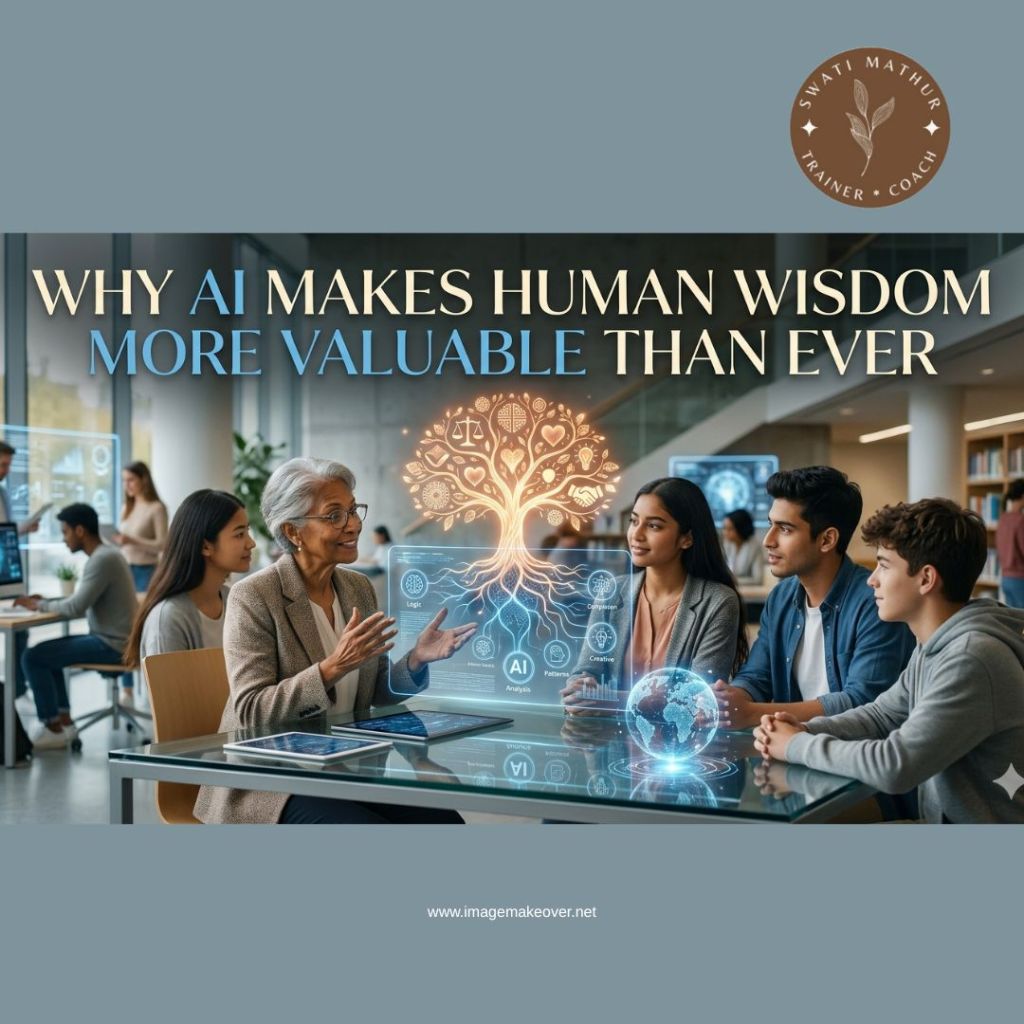
In today’s world, Artificial Intelligence can process information faster than ever before. It can analyze patterns, generate insights, and even recommend decisions. But despite all this advancement, one quality remains uniquely human and deeply valuable is wisdom.
Wisdom goes beyond knowledge and intelligence. It is the ability to apply what you know with judgment, ethics, empathy, and long-term thinking. And in the AI era, knowing yourself and understanding the impact of your decisions matters more than ever. Some people mistake intelligence for but they are fundamentally different. Intelligence is about acquiring knowledge, solving problems, and processing information, on other hand Wisdom is about using that knowledge in the right way, at the right time, for the right reasons. AI excels at intelligence while humans must excel at wisdom. Let’s understand this with an example, AI can suggest the fastest solution but wisdom asks: Is this the right solution? Is it ethical? What are the consequences?
As T.S. Eliot reflected:
“Where is the wisdom we have lost in knowledge? Where is the knowledge we have lost in information?”
This gap between information and meaningful action is where wisdom plays a critical role. As AI becomes more powerful, decisions are becoming more and more complex and impactful. Technology can amplify both good and bad outcomes. But wisdom ensures that decisions are not just efficient, but responsible, actions consider human impact, not just results and short-term gains do not harm long-term outcomes. Without wisdom, even the smartest tools can lead to poor decisions.
1. Making Ethical Decisions
AI can provide options, but it does not have a moral compass. Wisdom will help you choose what is right, not just what is easy, it will consider fairness, responsibility, and integrity and think about the consequences of your actions on others. For instance, just because something can be automated doesn’t mean it should be and here wisdom helps you draw that line.
2. Understanding Human Impact
Data can show trends, but it cannot fully capture human emotions, struggles, and experiences. Wisdom allows you to balance logic with empathy, consider how decisions affect people, not just outcomes and build trust and respect in relationships. In leadership and teamwork, this becomes a critical differentiator.
3. Thinking Long-Term
AI often optimizes for efficiency and speed. Wisdom, however, looks beyond the immediate. It helps you ask what will this decision look like a year from now? or what are the long-term consequences? or are we solving the right problem or just the urgent one?So, wisdom shifts focus from quick wins to meaningful impact.
4. Balancing Logic with Intuition
AI operates on logic and data but humans bring intuition shaped by experience. Wisdom is the ability to use data without being controlled by it, it also trust your judgment when data is incomplete and combine rational thinking with human insight. This balance leads to better and more holistic decisions.
Wisdom is not something you gain instantly but it develops over time through experience, reflection, and conscious effort. Every experience, success or failure has a lesson. Reflection turns experience into insight. Wisdom grows when you listen to others and understand different viewpoints and also challenge your own thinking. Exposure to diverse perspectives deepens your understanding. Wisdom requires slowing down. Not every decision needs to be immediate. Taking time to think often leads to better outcomes.
True wisdom is reflected in consistent behavior. When your actions align with your values you build credibility, earn trust and make decisions with clarity.
In the AI-driven world where information is everywhere, intelligence is accessible and tools are powerful but still wisdom remains rare and that is what makes it valuable. Intelligence can tell you what to do while wisdom tells you whether you should do it
In a world full of answers, wisdom is knowing which ones truly matter.
This post is part of Blogchatter A2Z challenge 2026

