
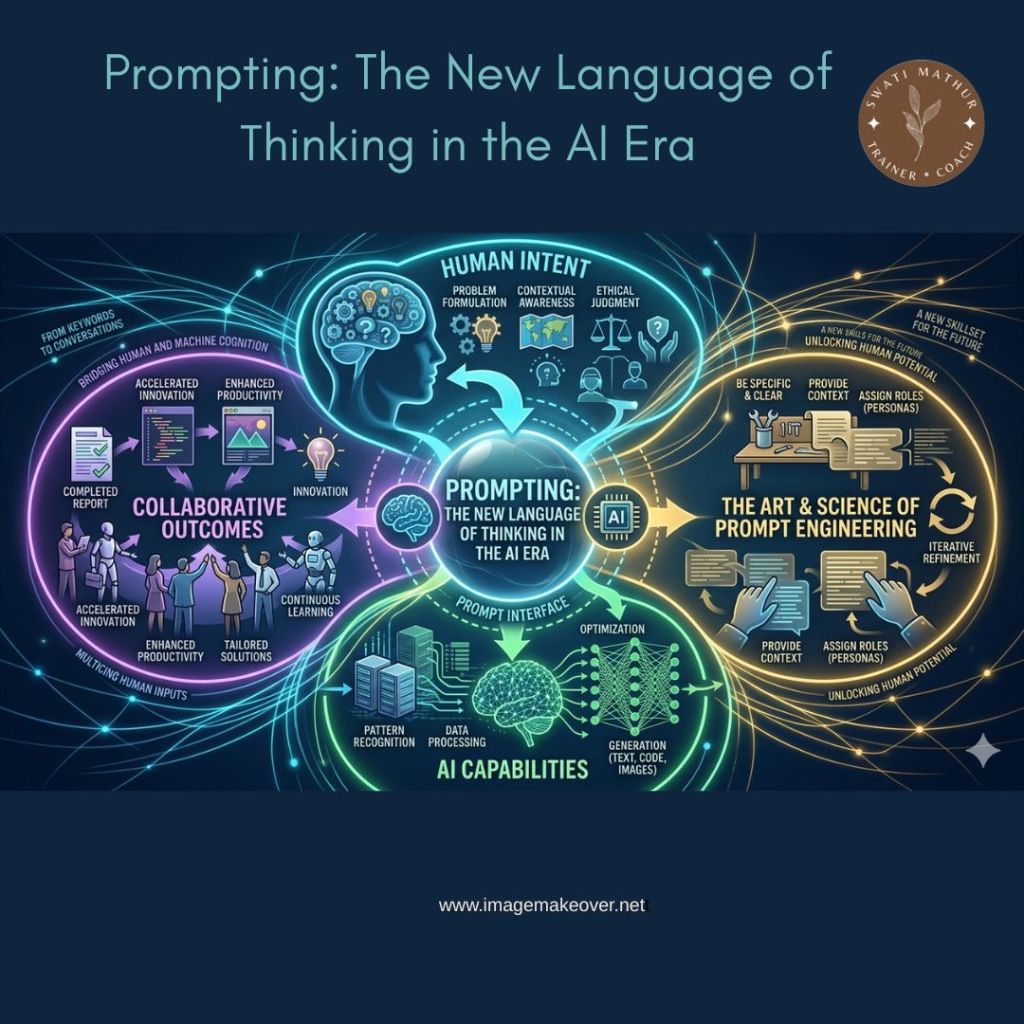
“Prompting “the New Communication Skill in the Age of AI.”
In a world where AI can generate ideas, content, and solutions instantly, the real differentiator is not access to AI, but how effectively you communicate with it. Prompting is no longer just a technical input, it is a reflection of your clarity of thought, your ability to structure ideas, and your skill in giving precise instructions. In many ways, prompting is an extension of soft skills like communication, critical thinking, and problem framing.
“If you can’t explain it clearly, you don’t understand it well enough.” — Albert Einstein
Prompting teaches you to think before you ask. It forces you to define the goal, provide context, and set expectations. For example, a vague prompt like “Give me a training activity” will give you a generic answer. But a structured prompt like “Create a 15-minute group activity to improve active listening skills for first-year college students, including step-by-step instructions and debrief questions” will produce a far more useful and targeted result. The difference lies in clarity, intent, and detail that is the core elements of strong communication.
What is Prompt Engineering?
Prompt Engineering is the skill of designing inputs in a way that guides AI to produce accurate, relevant, and high-quality outputs. It is not about coding, it is about thinking and communicating effectively.
It involves:
- Giving clear instructions
- Providing context
- Defining the audience
- Specifying format and tone
- Iterating and refining responses
In simple terms, Prompting is asking. Prompt engineering is asking intelligently.
Types of Prompts
Basic Prompt
“Explain communication skills.” Here the output will be general, broad and not very useful.
Structured Prompt
“Explain communication skills for college students in simple language with 3 real-life examples.” Here the output will be more relevant and usable.
Advanced Prompt
“Act as a soft skills trainer. Design a 20-minute interactive session on communication skills for college students. Include: icebreaker, activity, examples, and reflection questions. Here the output will be more practical, structured and training-ready content.
Iterative Prompting
Step 1: Generate activity
Step 2: “Make it more engaging”
Step 3: “Add debrief questions and expected outcomes” This shows how prompting is a process and not a one-time action. Lets see how prompting connects to soft skills
Clarity in Communication : You learn to express exactly what you need and useful in giving instructions, presentations, and training
Critical Thinking: You break down problems before asking.and helps in decision-making and problem-solving.
Empathy & Audience Awareness: You define who the response is for and makes communication more relevant and impactful.
Structured Thinking: You organize ideas logically and improves teaching, coaching, and leadership. AI plus Prompting results in powerful combination. AI provides speed and possibilities while prompting provides direction and quality. Without good prompting, AI is underutilized. and with good prompting, AI becomes a powerful assistant. The art of asking the right question is the key to unlocking meaningful answers.” In the age of AI, knowing answers is no longer enough but knowing how to ask is everything. Prompting transforms communication into a skill of precision, intention, and clarity. It teaches you to think better, express better, and ultimately lead better. Because in both AI and human interaction, the quality of your outcome is deeply connected to the quality of your input.
This post is part of Blogchatter A2Z challenge 2026

