
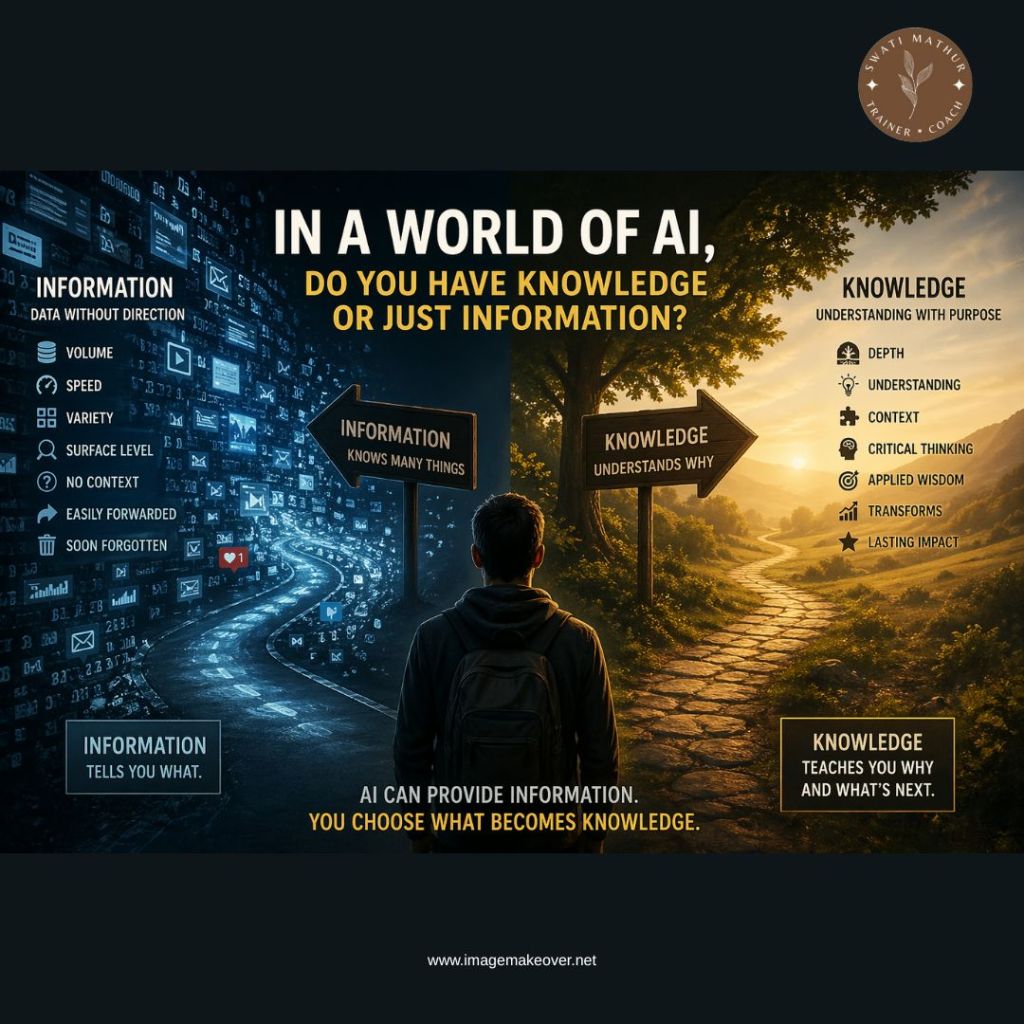
In a world powered by Artificial Intelligence, information is everywhere but knowledge is still rare. AI can give you answers in seconds. It can summarize books, explain concepts, and generate ideas instantly. But having access to information is not the same as having knowledge. And that distinction is what truly sets people apart.
As Albert Einstein once said:
“Information is not knowledge. The only source of knowledge is experience.”
And in the age of AI, this difference matters more than ever. Today, you can ask AI anything and get an answer immediately. But the real question is—do you understand it?
Information is quick, accessible and temporary and knowledge is deep, applied and lasting. For example, a student can use AI to get answers to questions instantly. But unless they take the time to understand the concept, question it, and apply it, that information remains surface-level.This is where many people get stuck. They confuse speed with learning. AI is an incredibly powerful tool for learning—but only when used actively.
It can explain complex ideas in simple ways, provide examples and analogies and help you explore multiple perspectives. But knowledge is built when you reflect on what you learn apply it in real situations and connect it with your own understanding Consider two learners one asks AI for answers and moves on and the other asks why, how, and what if. Over time, the second person develops knowledge. The first only collects information.
One of the biggest risks in the AI era is passive consumption. When everything is available instantly, it becomes easy to read without thinking copy without understanding, agree without questioning and this creates an illusion of knowledge.
For instance, you may feel confident after reading an AI-generated explanation. But when asked to explain it in your own words or apply it in a new situation, the gaps become visible. That’s because knowledge requires engagement, not just exposure.
To truly benefit from AI, you need to shift from passive use to active learning.
A simple approach: should be,
- Don’t just ask for answers—ask for explanations
- Don’t stop at understanding—try applying it
- Don’t accept everything—question and verify
For example, instead of asking, give me an answer you should ask explain this concept with a real-life example and test me on it. This small shift transforms AI from a shortcut into a learning partner. True knowledge gives you something AI cannot—confidence without dependency. When you understand something deeply you can explain it clearly, can apply it creatively and you can adapt it in new situations. But when you rely only on AI you hesitate without it, you struggle to think independently and most importantly you lack clarity. Knowledge gives you ownership.
A Simple Reflection
Ask yourself,
- Am I just consuming information or building knowledge?
- Can I explain what I learn without using AI?
- Am I using AI to think or to avoid thinking?
Your answers will reveal where you stand. AI can give you access to unlimited information.
But only you can turn that information into knowledge. Because knowledge is not what you read it is what you understand, apply, and remember.
This post is part of Blogchatter A2Z challenge 2026

