Learn How Embracing A Growth Mindset Fosters Continuous Learning, Self-improvement, and Personal Growth

Canva/ pexels

“Every failure and disappointment teaches you something”. People say ‘why me,’ but I say ‘why not.’ You should think you are the chosen one who can have better learning, as each experience teaches you to be a better version of yourself.” Instead of viewing challenges as setbacks, seeing them as opportunities allows individuals to confront difficulties head-on. For instance, if someone faces rejection in a job interview, they could choose to see it as an opportunity to reflect on their skills and improve for future interviews. Each failure or disappointment can serve as a building block for resilience. When facing obstacles, individuals can choose to adapt and grow stronger rather than succumb to despair. Let’s say, a student who fails a test can use that experience to develop better study habits and resilience for future academic challenges. Every setback provides valuable lessons that contribute to personal development. Whether it’s a failed project at work or a broken relationship, there are insights to be gained from analyzing what went wrong and how to do better next time. Someone who experiences a business venture failure might learn valuable lessons about market research, financial management, or team dynamics. Instead of dwelling on self-pity or feeling like a victim of circumstances, adopting the mindset of “why not me?” can foster a sense of empowerment. This perspective shifts the focus from feeling singled out by adversity to believing in one’s ability to overcome it. An athlete who faces a career-threatening injury might use the experience to develop mental resilience and come back even stronger.

Recognizing that failure is not a final destination but rather a stepping stone toward growth enables individuals to embrace a continuous journey of self-improvement. Each setback becomes an opportunity to refine skills, broaden perspectives, and evolve into a better version of oneself. An entrepreneur whose startup fails can use that experience to refine their business model, identify areas for improvement, and ultimately achieve success in future endeavors. By reframing failures and disappointments as opportunities for growth and learning, individuals can harness their experiences to become more resilient, adaptable, and ultimately, better versions of themselves.

A growth mindset is a psychological concept developed by psychologist Carol Dweck, which describes the belief that abilities, intelligence, and talents can be developed through dedication and hard work. People with a growth mindset see challenges, setbacks, and criticism as opportunities for growth and learning, rather than as indicators of their fixed abilities.

  1. Belief in Potential: Individuals with a growth mindset believe that their abilities and intelligence can be developed over time. They understand that with effort, perseverance, and effective strategies, they can improve and achieve their goals.
  2. Embracing Challenges: Instead of avoiding challenges or giving up when faced with obstacles, those with a growth mindset see challenges as opportunities to learn and grow. They approach difficult tasks with enthusiasm and are willing to put in the effort to overcome them.
  3. Persistence and Resilience: People with a growth mindset are resilient in the face of setbacks. They understand that failure is a natural part of the learning process and use setbacks as opportunities to gain valuable insights and adjust their approach.
  4. Viewing Effort as Path to Mastery: A growth mindset values effort and hard work as essential components of success. Rather than relying solely on innate talent or intelligence, individuals with a growth mindset understand that consistent effort and practice are necessary to achieve mastery in any endeavor.
  5. Learning from Feedback: Feedback, whether positive or negative, is seen as valuable information for growth and improvement. Instead of feeling threatened or discouraged by criticism, those with a growth mindset use feedback to identify areas for development and refine their skills.
  6. Celebrating Others’ Success: Rather than feeling envious or threatened by others’ achievements, people with a growth mindset celebrate the success of others. They see others’ accomplishments as inspiration and evidence that with effort and dedication, they too can achieve their goals.
  7. Continual Learning and Improvement: A growth mindset is characterized by a commitment to lifelong learning and development. Individuals with this mindset are always seeking new challenges, acquiring new skills, and expanding their knowledge base.

Transitioning from a fixed mindset to a growth mindset requires intentional effort and the implementation of strategies aimed at changing ingrained beliefs and behaviors.

  1. Self-awareness: Recognize when you’re exhibiting fixed mindset beliefs or behaviors. Pay attention to your inner dialogue and the language you use when faced with challenges or setbacks. Are you attributing failures solely to lack of ability, or are you viewing them as opportunities for learning and growth?
  2. Challenge fixed beliefs: Challenge the beliefs that contribute to a fixed mindset by questioning their validity. Ask yourself whether there is evidence to support the belief that abilities are fixed and cannot be changed. Consider alternative perspectives and examples of people who have achieved success through effort and perseverance.
  3. Learn from failures: Instead of viewing failures as evidence of incompetence, see them as opportunities for growth and learning. Reflect on what went wrong, what you can learn from the experience, and how you can improve in the future. Embrace the idea that setbacks are a natural part of the learning process and provide valuable feedback for improvement.
  4. Set learning goals: Shift your focus from performance goals to learning goals. Instead of solely focusing on achieving specific outcomes, prioritize acquiring new skills, expanding your knowledge, and developing expertise in areas of interest. Celebrate progress and effort, regardless of the outcome.
  5. Embrace challenges: Seek out opportunities to challenge yourself and step outside of your comfort zone. Embrace challenges as opportunities for growth and development, rather than avoiding them out of fear of failure. Recognize that facing challenges head-on is essential for building resilience and developing new skills.
  6. Cultivate a growth-oriented environment: Surround yourself with individuals who have a growth mindset and support your efforts to cultivate one as well. Engage in discussions about learning, development, and personal growth. Seek out mentors and role models who embody a growth mindset and can provide guidance and encouragement.
  7. Practice self-compassion: Be kind to yourself and recognize that transitioning from a fixed mindset to a growth mindset is a gradual process that takes time and effort. Acknowledge and accept your limitations, but also believe in your capacity to learn and improve. Treat yourself with the same kindness and understanding that you would offer to a friend facing similar challenges.
  8. Celebrate effort and progress: Acknowledge and celebrate your efforts and progress, regardless of the outcome. Recognize that growth and development are ongoing processes, and every step forward, no matter how small, is worth celebrating. Focus on the journey of self-improvement rather than solely on the destination.

By implementing these strategies consistently and intentionally, you can gradually shift your mindset from fixed to growth-oriented, unlocking your full potential and achieving greater success and fulfillment in various aspects of your life.

Let me explain you the concept of growth mindset with an inspiring stories of Ramya who have turned setbacks and obstacles into catalysts for growth and success through her resilient mindset.

How Can You Empower Young People To Use Their Latent Potential?

Pic courtesy/Edit: KnowledgeWroks / Canva

Do you know out of 13 million people who join India’s workforce each year, only one in four management professionals, one in five engineers and one in ten graduates are employable? This is definitely a hard-hitting fact but brutally true.

Empowering young people to utilize their latent potential involves a multifaceted approach that addresses various aspects of their personal, academic, and professional development. Here are some effective strategies that one can adopt:

  1. Provide Mentorship and Guidance: Pair young people with mentors who can offer support, guidance, and encouragement as they navigate their personal and professional journeys. Mentors can share their experiences, provide valuable advice, and help young people set and achieve their goals by holding them accountable. There are many companies that want to build employees skills often create mentoring programs that create high quality and productive workforce.
  2. Promote Self-Discovery and Exploration: Self-Discovery is a powerful tool for personal growth and development. By understanding ourselves better one can better decisions, build stronger relationships and can live a full filling life. Therefore, encourage young people to explore their interests, passions, and strengths through experiential learning opportunities such as internships, volunteer work, and extracurricular activities. Help them discover their talents and potential career paths by exposing them to a variety of experiences.
  3. Encourage a Growth Mindset: Growth mindsets understand the importance of determination and persistence. By changing the way you think , can change the way you learn. Knowing your strengths and abilities allows you to explore, experience and achieve more in life. Teach young people the value of a growth mindset, emphasizing the belief that abilities and intelligence can be developed through dedication and effort. Encourage them to embrace challenges, learn from failures, and persist in the face of obstacles.
  4. Provide Access to Education and Resources: Easy access to education and resources can lead to better quality, social mobility, economic development and ensure brighter future for individuals. It allows you to gain a more comprehensive understanding considering different perspectives and interpretations. Ensure that young people have access to quality education, including formal schooling, vocational training, and online learning resources. Provide scholarships, grants, and other forms of financial assistance to support their educational pursuits.
  5. Build Confidence and Resilience: We are often told that” you are stronger than you think”. Confidence is believing in ones abilities and beliefs. This deep self-belief becomes resilience. That resilience will never make you feel disappointed if things don’t work out or feel scared of anything. That is part of the beautiful emotional spectrum of human nature. What confidence and resilience do together is to keep you feeling hopeful. Help young people build self-confidence and resilience by acknowledging their accomplishments, encouraging them to step out of their comfort zones, and teaching them coping strategies for dealing with adversity and setbacks.
  6. Encourage Goal-Setting and Planning: One of the most effective way to feel motivated and to accept change is to set specific goals and plan ahead of time. It focuses your acquisition of knowledge, and helps you to organize your time and your resources so that you can make the most of your life. Guide young people in setting realistic, achievable goals and developing action plans to accomplish them. Teach them the importance of setting both short-term and long-term goals and provide tools and resources to help them track their progress.
  7. Promote Leadership and Advocacy Skills: Advocacy is all about taking action and being accountable for oneself in creating a better life on the other hand leadership is the ability to empower others to achieve a collective set of goals for a progressive future. These are the skills that can be acquired through experience and not given from birth. The creation of a strong foundation starts with the family, education, peers, and other experiences to develop those necessary skills.  The goal in all of these is to develop the child’s own strong capacity to self-advocate and to become a leader, based upon their own experiences. Encourage young people to take on leadership roles in their schools, communities, and extracurricular activities. Provide opportunities for them to develop leadership skills, such as public speaking, teamwork, and decision-making, and support their efforts to advocate for causes they believe in.
  8. Promote a Supportive Environment: Foster a supportive and inclusive environment where young people feel valued, respected, and empowered to express themselves. Create safe spaces for them to share their ideas, opinions, and concerns without fear of judgment or criticism. This will keep them motivated and more focused at the same time.
  9. Celebrate Diversity and Inclusion: Embrace and celebrate the diversity of young people’s backgrounds, experiences, and perspectives. Create opportunities for them to learn from each other, collaborate on projects, and build connections across cultural, ethnic, and socioeconomic lines. Diversity and inclusion leads to innovation as they don’t have a fixed mind set like, “We have always done it this way”, it create an environment where people can be themselves without any judgment and probably that is the reason they are more fearless and ready to take risks.
  10. Lead by Example: Be a positive role model for young people by demonstrating qualities such as integrity, perseverance, and compassion. Share your own experiences and challenges to inspire and motivate them to pursue their goals with determination and resilience. I feel the mark of the great achiever lies in their ability to “Walk the Talk”. Lead by example is very important as it boosts the people’s morale especially those who are following you, it builds respect and trust and create positive work culture that lead to increased productivity.

I am sure it really makes sense now as investing in youth empowerment directly leads to not just economic growth but greater innovations. By giving the quality education, vocational training and supportive environment we are equipping them with the skills and knowledge that will contribute to the workforce effectively.

Personality Development- Need Of The Hour

Oh! What a personality, I am sure you must have heard this n number of times from people around you or you must have said it yourself many a times. But what exactly does personality means? It’s a collection of traits, behaviors and attitudes that define a person. The word personality comes from the Latin word ‘persona’ which refers to a theatrical mask worn by performers for different roles. But today it means much more than that, attributes that can make a person more especial and unique.

In today’s competitive world, educational qualification is not enough if you want to leave a mark on people’s mind. Therefore, developing personality which is powerful and lead you to the success path is need of the hour.

There are no two individual that are same, they may look the same or have similar experiences but their environment, temperament and character makes them unique. There are different aspects that can develop one’s personality be it social, emotional, physical, spiritual, moral or mental. These various aspects provide us a different view into the process by which an individual’s personality is developed.

The first and the foremost criteria to develop personality is self-awareness. Only when you know who you are and what your capabilities are, you can work on it. According to psychological theory of self-awareness, we are not the sum of our emotions, reactions, and hormones, though these elements have a lot of influence over us. Rather, we are the level of consciousness that observes those things. Being self aware help us know more clearly about our own strengths and weaknesses, our values, our trigger points, our motivational level and our habits. Knowing about all these things helps you to stay positive, encourages growth mindset, boosts self confidences that leads to higher self belief and one can be higher at their emotional quotient.

Strategies to improve Self-Awareness

  • Meditation
  • Selective disclosure so that nothing can go against you
  • Taking feedback from people around you that can help in strengthening your core strengths
  • Journaling, a way of talking to your inner self

Ones a person is self aware and discovered the hidden aspects of themselves then comes working on making your personality distinguishable. Most of the time it’s our inner self that we need to work upon. Self-motivation is the key in developing ones personality.

How To Make Your Personality Vibrant- Tell Yourself

  • You are Unique: As I said earlier no two persons can be same. Do not compare yourself with others. When you compare you lower your self esteem and doesn’t allow yourself to blossom. The creator has created each one of us with a touch of uniqueness and originality. Then why we human waste our time and energy in comparing ourself with others. Accept the way you are.
  • Be Zealous: There will be a situation in life that will not be in our control. There will be times when your expectations will not be met. But despite all the adversities in life. one must never give up their enthusiasm.
  • Be a communicator: Effective communication is the key to success especially in today’s time. Words have a power to make or break relationships. A skillful communicator can win over people and adverse situations. Try to bring clarity in your communication.
  • Stay calm and composed: When a person stays calm and composed, it brings clarity and you can take better decisions. Being decisive is one of the top most quality of any successful person be it in personal or professional live.
  • Learn to let go things:  Letting go is empowering. In doing so, you demonstrate to yourself that you are competent, can make positive decisions, and have your own best interests at heart. Your Personal Productivity Will Skyrocket.
  • Be spontaneous: A person who is impulsive can ever take good decisions and that can lead to disaster. There try to be focused in the present moments as spontaneity is the key to success.
  • Embrace imperfection: People and situation do not always fit into your definition of perfection. Often that makes a person agitated, angry and frustrated, eventually diminishing the strength of their personality. So, learn to find peace amidst the world’s flaws even as you strive to make a change.
  • Stay Positive: Positive people not only happy but they spread happiness too. Tune into this part of yourself again and again with the help of meditation. When you develop a positive attitude, you will start feeling better about yourself. You will treat yourself with more respect and love, and this in turn will boost your confidence levels and inner strength. You will take on new challenges and come out of your self-limiting beliefs
  • Be Approachable: We all like people with whom we can easily get connected and with or whom we can easily talk to. One needs to be warm and friendly and be ready to share and help. Remember when your are helping other, indirectly you are helping yourself, and good deeds always pay off.
  • Develop your own style in work: Each one of us have a certain style in dressing as well the way we carry our tasks. Doing things with style adds zing to your personality and if people can relate to your style it’s like icing on a cake. Remember the secret of doing things with style lies in working with passion and a relaxed mind. So while working on something try not to get distracted.
  • Be assertive: Always speak your mind without hurting other person’s feelings. Don’t give into pressure and face every challenge confidently. Either you will overcome adversity of learn something valuable.

Work on all these factors as strong and attractive personality helps you gain recognition and acceptance from the society as well as people around. Will write about most important personality traits that will bring success in your life in my next post, so stay tuned…………

Four Types of Employee Training Programs #CampusToCorporate

When a company invest in employees training programs, they are actually investing in their own success. We all are living in an era where technology advances are common and to survive in this ever-changing world every employee demands their companies to facilitate them with continuous training programs to keep them abreast with the latest technologies, trends and different industrial processes. Now these training methods are designed not just to enhance employees skills but help in improving their performance and productivity, develop efficiency in their job, and avoid violations of laws and regulations and prepare them for the future.

Benefits of training programs

These ongoing training programs brings out positive culture and environment that facilitates employees in becoming

  • More adaptive: An employee who is more adaptive in nature will never fear a change. They would challenge themselves by being more innovative. Adaptability increases their chances of succeeding, as they will find themself trying out different job.
  • More productive: As every employee will be familiar with their roles and responsibilities it will help them to give their 100% and be more productive and efficient.
  • Improve morale: Employee training sharpens the skills and knowledge of employees, which results in a boost of their morale and adds a sense of job satisfaction as well as security. A satisfied and motivated employee is a great asset for organizational success.
  • Improve retention: Every company want an efficient employee and every employee want an opportunity to grow. A company with a culture of continuous learning and development leads to  higher retention rates. This is why prioritizing training inspires top talent to stick around for a long time.
  • Reduce error: Workplace training makes employees more proficient and reduces the chances of them committing errors on the job. It strengthens the functioning and abilities of the employees.
  • Identifying weaknesses: Employee training program will make organization aware about their weaknesses and allows to strengthen the skills that each employee needs to improve.

Four different types of training programs

Orientation Training

Orientation training program is generally conducted by the HR department of any company to train and make them aware about their roles and company policies. The orientation program benefits both employee and employer as both get to learn about each other which is must for their success.

Onboarding training

Onboarding training helps new employees to speed up their understanding of their responsibilities and organizational culture in becoming productive team members quickly. Onboarding is responsible for truly integrating an employee within an organization. This training includes functional training where in employee has been given overview of the company and their roles and goals.

Compliance Training

This is one of the mandatory training that every organization needs to provide. It educates employees on the laws and regulations applicable to their job function or industry. Some of the examples of compliance trainings are anti-harassment, diversity, cybersecurity and business ethics. Undergoing this training will help in minimizing the risks and provide better and safe workplace environment for employees.

Soft Skills Training

Soft skills training is very crucial for every organization as employees trained in soft skills will help organization in maintaining good customer relationships, gaining new clients and building stronger team dynamics. Soft skills training includes communication skills, negotiation skills, conflict management skills, leadership skills, sales and customer service ready and team building. These skills are not only necessary for their individual career growth but for the overall development of the organization.

Things to remember

Identifying and implementing right training program for your organization enables you to create rich learning opportunities that can truly empower your employees to grow with the organization.

Make sure that these training programs are interactive. Interactive training engages each individual and connects them personally and focuses on learner’s engagement which leads to higher productivity and performance.

Every training program should have a purpose and a goal as it puts them in the right direction for creating and setting realistic employee training goals and objectives. Your organization’s training goals should be SMART so that they know what is expected to achieve by the end of a training program. 

‘This blog post is part of the blog challenge ‘Blogaberry Dazzle’ hosted by Cindy D’Silva and Noor Anand Chawla.’

How Higher Self-Efficacy Helps In Better Mental Health? #Mental Health #CauseAChatter #CampusToCorporate

Pexels /Canva

According to Albert Bandura, a social cognitive psychologist, self-efficacy is defined as:

The belief in one’s capabilities to organize and execute the courses of action required to manage prospective situations.

Self-efficacy is about your belief in your abilities in dealing with different situations. It is very important to understand how self-efficacy impacts the mental health of a student, in specific. It plays a vital role in your life, as it not just affects the way you feel about yourself but also how successful you will be in your personal and professional life. It has a huge impact on your psychological state, behavior as well as on motivational level.

Continue reading “How Higher Self-Efficacy Helps In Better Mental Health? #Mental Health #CauseAChatter #CampusToCorporate”

10 Ways to Implement Your Learning #CampusToCorporate #SkillDevelopment #LearningProcess

Canva

Learning is an on going process and as professionals we are constantly learning be it something you are passionate about or need of an hour. But how many of you are putting what you have learned into practice? Or you are just absorbing information? That’s the real question. Whether you are learning formally like enrolling yourself to any course, or participating in a workshop or seminar or informally through reading an article or conducting research, in both the given settings you should implement your learning if you are looking for any tangible result.

Without putting your learning into practice, the training you’ve received will go to waste, so it’s important to have a strategy for implementing your learning.

So how to translate what you’ve learned into your everyday routine. Here are the different ways:

Continue reading “10 Ways to Implement Your Learning #CampusToCorporate #SkillDevelopment #LearningProcess”

6 Most Innovative Future Jobs #CampusToCorporateSeries

Embracing Unknown Future will reduce the anxiety. And if I say so I may not be wrong. Tomorrow’s graduates will be entering into the professional unknown as they will be taking up jobs which doesn’t exist now. But there is nothing to fear as it’s rightly said “Change is the only constant thing” and fearing that change will only cause you stress, so if one wants to increase their probability of success, accept the change, be the change and be proactive in the approach.

The fourth Industrial revolution is here and has brought opportunities that unfolds many stages of development. We all are standing at the edge of technological revolutions that will change the way we live, work and relate with one another. The transformation and scale of this revolution will be such that humankind have not experienced it before. As I said we don’t know how it will unfold, but it is surely going to be integrated and comprehensive as there will be fusion of technologies which will fade away the line between physical, digital and biological spheres and wherein public sector, private sectors, academia and civil society all will be part of it.

The 21stcentury has witnessed rapid change and many new jobs are the result of experimentation and complementary rather than replacing existing jobs. Lets see how and what future jobs are going to look like.

Wearable Technology Personalized Therapist

Wearable technology is something that you can wear, be it smart watches, fitness trackers which are mostly personalized. Today people are not just going through physical health issues but emotional health concerns too which has increased the demand for personalized therapist. These therapists will use AI and research to monitor the emotional health of their patients and give personalized therapies. The required skills would be High EQ and SQ, creative thinking , technical aptitude and analytical skills.

Memory Creators

Recreating spaces for people who want to relive beautiful memories of past. Here a creator needs to do historical research and combine it with interior design skills to recreate the space which are the reflection of their favorite time of life. Basically they will develop virtual reality experience to help them to cherish those memories which will bring happiness and love in their lives.

Robot Police

As in real life , technology also comes with lot of ethical problems that emerges with the design, operation or use of robots in real life. For example using drones are still not legal in many countries, so to keep a track of their movements and tasks we require a profession that requires strong analytical and risk assessment skills in order to proactively assess the danger these machines can bring and how to control them by using specific action.

Best Out of Waste Creators

As we know India generates 62 million tonnes of waste each year. About 43 million tonnes (70%) are collected of which about 12 million tonnes are treated and 31 million tonnes are dumped in landfill sites. Now Best out of waste creators will help in creating ways to reuse these waste by helping individual toat individual level. They will be responsible for creating new ideas and sharing it with general public, so that waste can be reused at the source itself and this can help in reduction in the volume of waste generation. This future job would help us to live in a more environment friendly way. The creator should have creative skills, engineering skills and good interpersonal skills so that they not just create innovative ideas but letting those ideas be acceptable by the people too.

Criminal Psychology Tapper

The crime rate in India is increasing year after year. No law or rule could create fear in these criminal minds. These criminal psychology tappers will not just have neurological understanding but emotional and analytical skills which will help them to understand how criminal mind works. Research conducted by Dustin Pardini, PhD, of the University of Pittsburgh, 26-year-old men with lower amygdala volumes are three times more likely to be aggressive, violent and to show psychopathic traits than the same age men with normal-sized amygdala, independent of factors including history of violence and social background. With the help of AI and neurological research, criminal psychology tapper will ensure to balance amygdala volume to balance the emotions and this may help in reduction in crime rate.

Farming Big Data Analyst

We know that a farmer is a person who works as an agriculturist and produces a wide variety of food products and to get better yield he also manipulates the environment by using, pesticides, fertilizers, crop rotation etc. Similarly farming big data analyst grows data from computer models and manipulates it , this can help them predict new trends for developing new and innovative products and services, regulate commerce and environment strategies. They do this with the help of simulation model where they work on algorithm and estimate things by assuming variables for their advantage.

As I said earlier, future jobs are going to be an unknown territory, nobody knows how it is going to be but one thing we are sure that technologies like Al, big data, block chain will be integrated with traditional way or working to give absolutely new and innovative working style. So prepare yourself working in diffuse mode of brain where-in you have to think out of the box. Most of these futuristic jobs are going to be fusion of different skills but the foundation will remain techno innovation with Al.

“Innovation is taking two things that already exist and putting them together in a new way” – Tom Freston

This blog post is part of the blog challenge ‘Blogaberry Dazzle’ hosted by Cindy D’Silva andNoor Anand Chawla in collaboration with RRE Studios and ShowCase Events.

What is Skill Mapping and Ways To Develop Skill Matrix?#CampusToCorporateSeries

In my previous post I have talked about How to develop job oriented skillset. In order to develop any skill it is imperative to understand the skills one needs to develop and for that very purpose we need to do skill mapping.

Skill mapping is similar to competency mapping the only difference is competency mapping is more in depth which includes things beyond skills, like behaviour. Skill mapping is a visual representation of the skills needed to perform well in any given role and comparing that with the existing skills. This comparison will allow to identify the gaps. Skills maps can provide a view of the entire team by showing the contributions and skills of each individual in the teams.

Need of Skill Mapping

Skill mapping will not only show the strength and weakness of a team but will benefit the company as a whole. Organizations and companies do this in order to get better clarity and insight about their employee’s skillset.

  • Skills mapping identifies which tasks and skills are crucial to the organization as only few employees can actually perform a certain task to a required level.
  • It helps in recommending what kind of training employee needs.
  • It can find the substitute candidate in case of emergency.
  • It allows tracking the progress of each team and individual.

Skill mapping benefits the team as the organization would know the skills required by the team before a project begins. It benefits the employee as they could identify their strengths and weaknesses and accordingly can train themselves. It benefits the company, as they know what skill sets they require and accordingly hire people. While doing skills mapping they could clearly see available skills and missing skills and empower their employees with required skills or hire people with skills which are needed to reach company’s goal. A team that is aware about their strengths and weaknesses can work on upgrading their skills and in turn company gets the benefits so the company benefits mean good news to the clients.

Skill Matrix

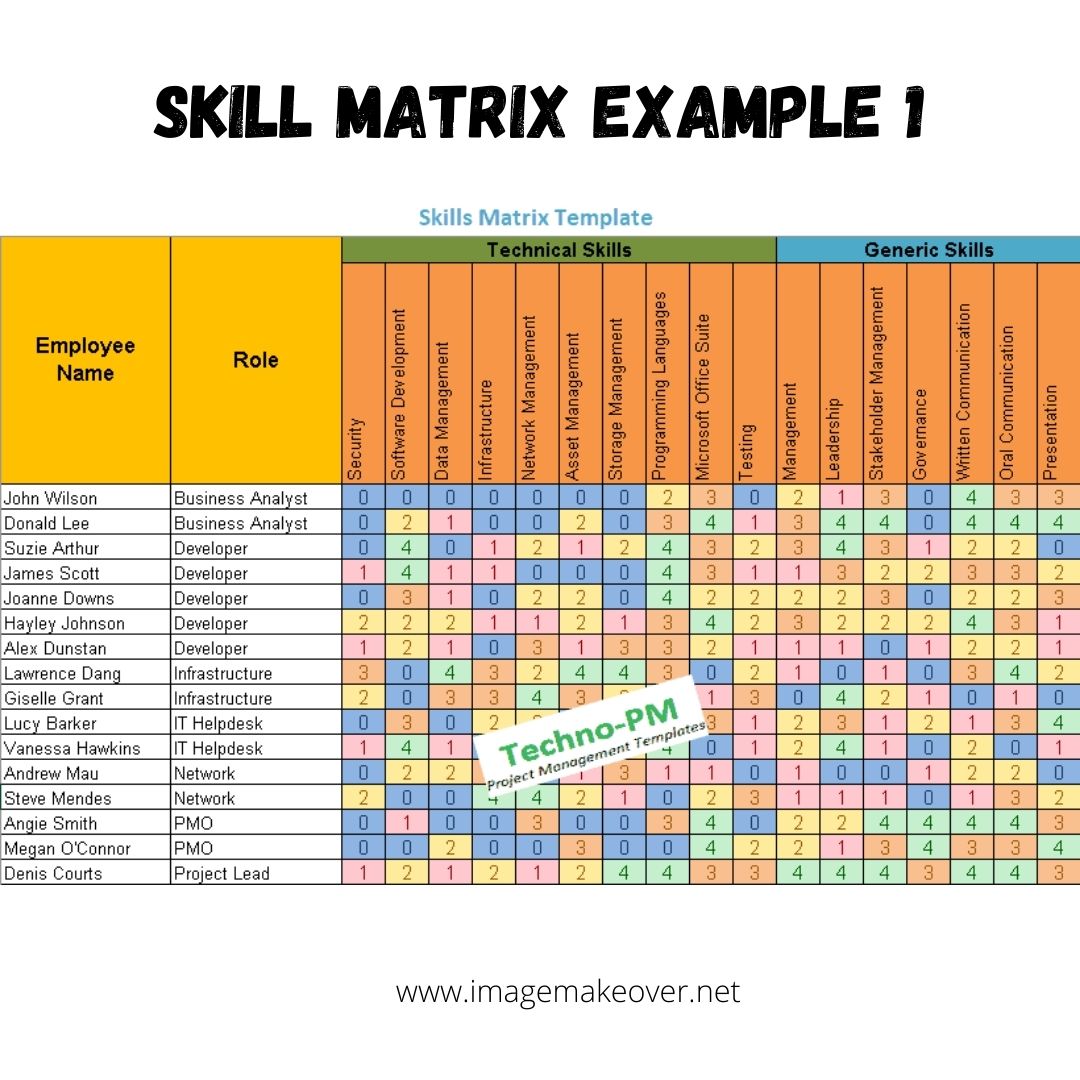
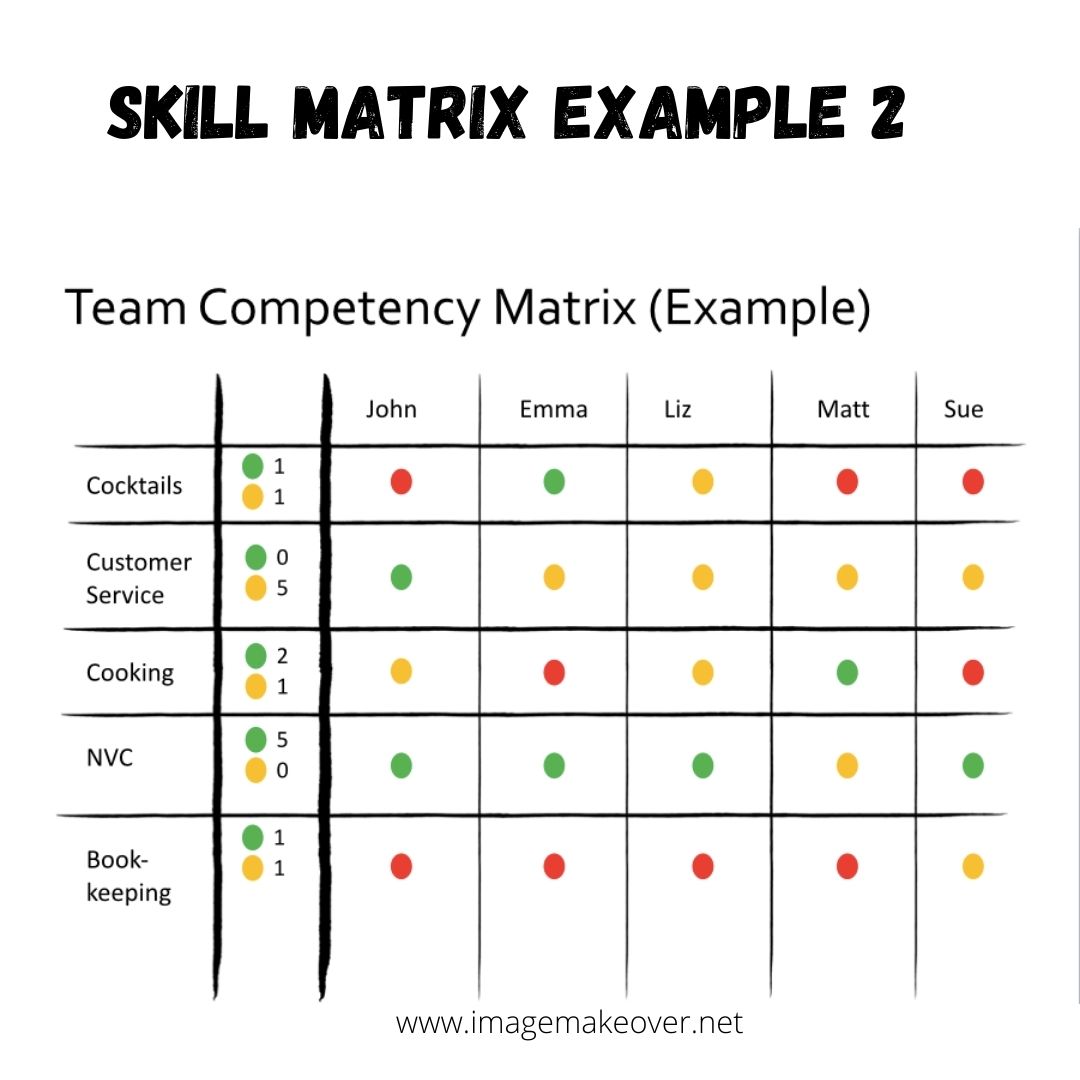
Skill mapping provides immense benefits and the best way to visualize proficiency level is by using the tool called Skill Matrix. A skill matrix is a snapshot of all the employees skills laid out in matrix form.

How to make Skill Matrix?

Create one skill matrix for each department or a team. List down names of all the employees and their role down the left hand column and all their skills across the top row. Then enter the proficiency levels for each employee for each skill until the matrix is filled. Measuring proficiency varies from organization to organization.

Firstly, it is important to determine what kind of skills are required for a particular project. This input will list down the competencies that you’ll assess the team members on.

Secondly, assess the team member on their current skill level.

Some organizations divides their capabilities in 4 group

  • No capability
  • Basic level of capability
  • Intermediate level of capability
  • Advanced level of capability

Some organization uses 5 point scale, to determine knowledge and experience of their employees

  1. No experience or knowledge
  2. Little experience or knowledge
  3. Reasonable experience or knowledge
  4. Considerable experience or knowledge
  5. Expert experience or knowledge

Thirdly, the skills matrix may show that you have someone competent at a crucial task – but if the person is unwilling to perform the task, you will still hit a dead end. For each person, you’d want to know whether they have:

  1. No interest in applying this skill or knowledge
  2. Interested in applying this skill or knowledge

Lastly, incorporate all the information in the matrix and analyze.

You can find different types of skill matrix, so use what suits you the best or create one which works for you. Please find some of the examples below

For any project to be a successful it is important to make sure you have the right people and the right skills to start quickly and finish the job successfully. In such scenario the skills matrix, or competency matrix, is your best friend.

@ Swati Mathur

‘This blog post is part of the blog challenge ‘Blogaberry Dazzle’ hosted by Cindy D’Silva andNoor Anand Chawla.’

How to Develop Job Oriented Skillsets #CampusToCorporateSeries

Today, people are no longer sticking to same kind of job throughout their life, therefore, career for life is no longer an option. Most people work under variety of employers and move across different industries. And how do they do this? They work on their job oriented skillsets.

What is a skill? A skill is an ability to perform an activity in a competent manner. The skill can be classified as transferable, based on personality traits and knowledge based skills.

What is a skillset? A skillset is a combination of abilities, qualities and experience you can apply to perform any task. Each person will have different skillset according to their interest, natural abilities, personal qualities and technical skills.

As an employability coach, I define employability as a set of skills that includes skills, understanding and personal attributes. A fresher is called to be employable if they posess all of these , that will lead to success in their chosen profession. These set of achievements will benefit themselves, the workplace, the community and the economy.

Most of the people are not just worried about getting the job but how can they be successful throughout their working life. This can only be achieved if they broaden their skill sets and attributes to fit into anything and everything by being more adaptable.

According to The American Society for Training and Development (ASTD), employees should own 6 skill sets

  • Basic Competency Skills: includes reading, writing, computation skills
  • Communication Skills: includes listening and speaking skills
  • Adaptability Skills: includes problem solving and creative skills
  • Development Skills: includes goal setting, motivation, career planning skills
  • Group Effectiveness Skills: includes team work, negotiation and interpersonal skills
  • Influencing Skills: leadership and understanding organizational culture skills
Continue reading “How to Develop Job Oriented Skillsets #CampusToCorporateSeries”

How Inclusion Can Help In Employee Well-Being? #CauseAChatter

Mental health and diversity and inclusion are closely related. You cannot ignore the effect of racism and racial trauma on mental health at the same time the disparity in access to mental health care across various communities cannot be ignored. The inequality and lack of cultural competency in mental health treatment cannot be ignored. Employees from diverse backgrounds can face lack of representation, unconscious bias, and other stressors that impact their mental health and psychological safety at work. Nothing can be ignored as they all are deep rooted, but we do see a ray of hope.

Today the modern workplace is consists of people of different religion, ages, gender and ethnicity. And one of the reasons for this outcome is economic globalization. Many organizations have realized that diversity at workplace can bring lot of material as well as intangible benefits. However, diversity has their own challenges like discrimination, harassment. disrespect, indifferent attitude and many more which can lead to a nasty consequence. Hiring a diverse workforce is great but this is not enough if people don’t feel wanted and accepted. Diversity is one part of the equation, to balance this equation companies need to work on inclusion.

Therefore, many companies have adopted diversity and inclusion programs. Inclusion in the workplace is extremely important for any organization looking to build a strong sense of connections and belonging and an engaging culture. Inclusive workplace is where all the employees irrespective of their differences and disabilities feel welcomed and valued for their contribution.

Here we need to understand without inclusion, diversity effort will not succeed. Some of the important traits of inclusions are

Every employee should feel that they have a voice and will be heard.

Every employee should feel the sense of ownership. The feeling that you’re a part of an organization that knows and values you. 

Every employee should be given an environment for learning and development which makes them feel that companies care about their growth and aspirations.

Every employee should have access to resources which will aid them in their work.

Every employee should be provided with collaborative environment regardless of their role and department.

Ways to create inclusive culture

Firstly it is important to educate employees and leaders.

Secondly creating an environment for open communication where listening should be given priority.

Third and the most important is embracing employees to their full authentic self. As we all know we are at our best when we are our own authentic selves. Give employee freedom to explore their true potential.

Benefits of inclusive workplace

  • People are more committed towards their work.
  • People are more engaged with their work as they enjoy working.
  • People will have better wellbeing in their lives.
  • Reduction in attrition rate and people will stay with the company for a longer duration.
  • People will be more likely to recommend their company as a best working place.
  • Increase in productivity and sales.
  • Improved participation and decision making.
  • Reduce conflicts and miscommunication.
  • Brings out favorable work cultural and happy and satisfy employees.
  • Leads to increase in self- esteem and self- confidence.
  • Better ideas that leads to inflation of profits.

According to Deloitte’s article on diversity and inclusion, it states, “A growing body of research indicates that diverse and inclusive teams outperform their peers. Companies with inclusive talent practices in hiring, promotion, development, leadership, and team management generate up to 30 percent higher revenue per employee and greater profitability than their competitors. Without a strong culture of inclusion and flexibility, the team-centric model comprising diverse individuals may not perform well.”

Therefore, diversity with inclusiveness leads to positive growth not just for the employee but for the organization. It is time that each and every company should adopt this for the overall growth of our country and for better mental health of our employee.

This post is part of the Blogchatter’s #CauseAChatter campaign.

Pic Courtesy : Pexels/Google/Canva