
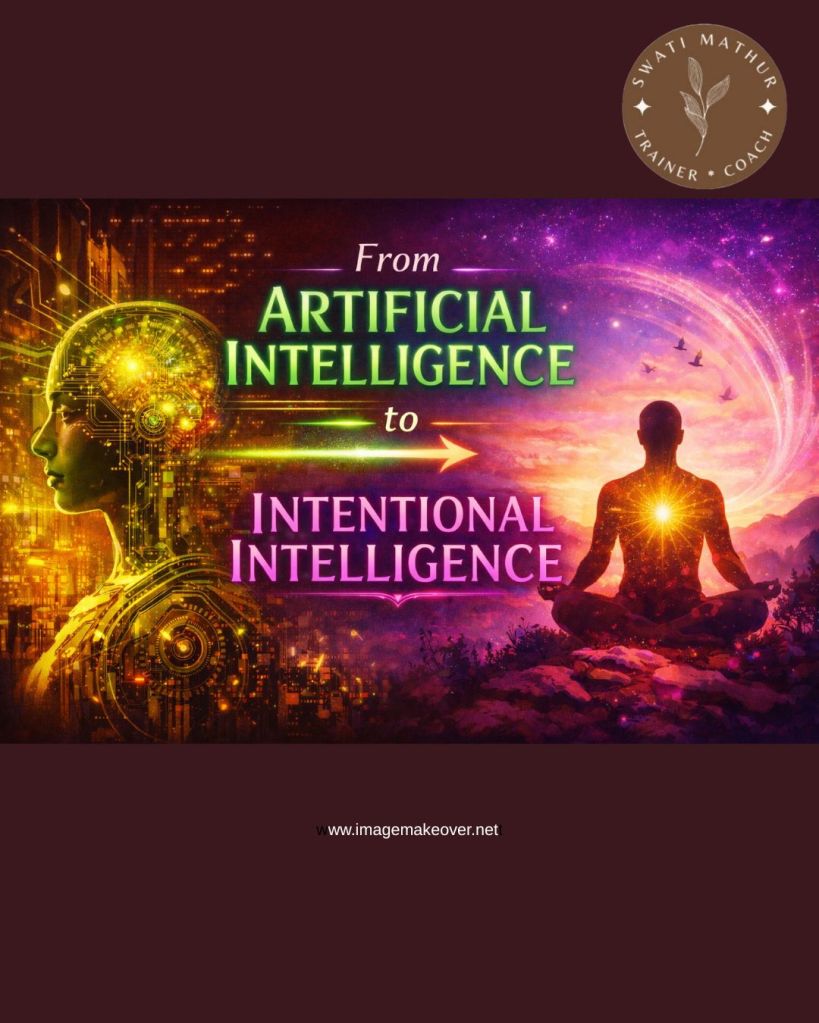
“Don’t let AI think for you; let it think with you.”
In a world where Artificial Intelligence (AI) can think, write, analyze, and even create, the definition of intelligence has fundamentally changed. Earlier, intelligence was about what you know, today, it is about how consciously and purposefully you use what is available to you. This is where the concept of Intentional Intelligence becomes critical.
Intentional Intelligence is not just about being smart but it is about being aware, mindful, and purposeful in how you think, learn, and act, especially when powerful tools like AI are at your fingertips. Without intention, AI can make you faster but not necessarily better. In the age of AI, one of the biggest mistakes people make is jumping to tools without clarity. They open AI platforms, type random prompts, and expect meaningful results. But AI is like a mirror, it reflects the quality of your thinking. Before you use AI, pause and define your intention clearly,
- What exactly am I trying to achieve?
- What problem am I solving?
- What kind of output do I really need?
When you operate with clarity, AI becomes a powerful assistant. Without it, it becomes a source of distraction and confusion. For example, a student who asks, “Explain this chapter so I can understand it deeply” will gain far more than someone who simply says, “Give me answers.” The difference is not in AI but it is in intention.
AI gives fast answers but high performers don’t accept them blindly. They engage, challenge, and refine. In fact, one of the most important skills in the AI age is learning how to question. Whenever you receive an output, train yourself to think,
- Is this accurate and relevant?
- What perspective is missing?
- Can I improve or expand this idea?
This habit builds critical thinking, which is something AI cannot replace. For instance, if AI generates a business idea, an average user may accept it. But a high performer will always question like, “Is this practical in my context?”, “What are the risks?”, and “How can I make it unique?” This is where real intelligence begins not in receiving answers, but in refining them.
Most people use AI to consume, read, copy, paste, and move on. But high performers use AI to create. The goal is not to depend on AI for output, but to use it as a thinking partner. You can use AI to brainstorm ideas, to build your own frameworks from AI suggestions or combine your originality with AI efficiency. When you shift from consumption to creation, your value increases. For example, instead of copying an AI-generated assignment, a student can understand the structure, add personal insights and present a unique perspective. Now this transforms them from a user into a creator.
One of the most underrated habits in the AI age is reflection. When everything is instant, people rarely stop to think about what they actually learned. But learning does not come from access, it comes from processing. After using AI, take a moment to reflect, what new idea did I understand today? Did this improve my thinking or just save time? How can I apply this knowledge? Reflection converts information into deep intelligence.
For example, after completing a task using AI, instead of immediately moving on, a learner who reflects will retain more, think better, and grow faster.
AI is powerful but it can also make you lazy if used without discipline. Over-dependence reduces your ability to think independently. That’s why intentional users build boundaries. They decide when to use AI and when to think on their own. They avoid using AI for everything instead challenge themselves before seeking assistance. Discipline ensures that AI remains a tool and not a replacement. For instance, a student might first attempt solving a problem independently, and only then use AI to check or improve their answer. This builds confidence and capability.
In the age of AI, the gap is no longer between those who have access and those who don’t. The gap is between those who use AI passively and those who use it intentionally. Two people can use the same tool, but their outcomes will be completely different.
Which category you fall into?
This post is part of Blogchatter A2Z challenge 2026
 Imagemakeover