
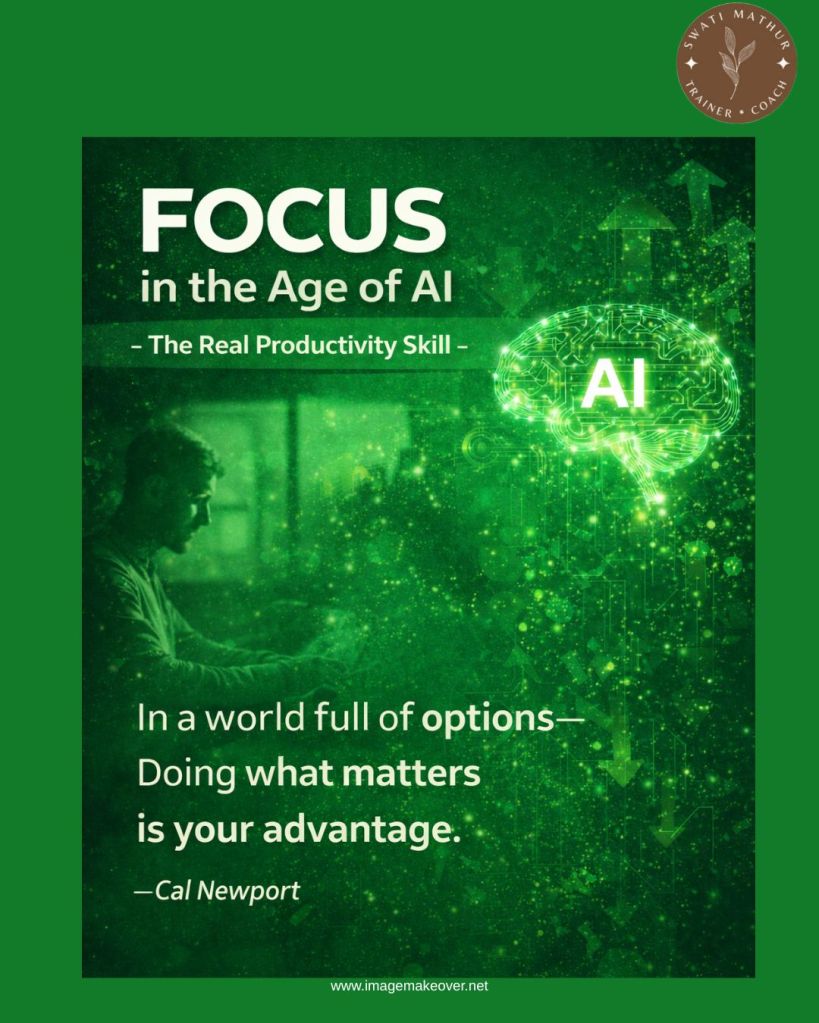
In a world full of notifications, tools, and endless information, the real challenge is no longer access actually it is focus. We are surrounded by possibilities, powered by Artificial Intelligence that can generate ideas, automate tasks, and provide instant solutions. Yet, despite having more resources than ever before, many of us struggle to complete meaningful work. The reason is simple, AI gives us options, but focus helps us choose what truly matters.
As the author Cal Newport wisely said,
“Clarity about what matters provides clarity about what does not.”
There is an interesting paradox that comes with the rise of AI. While it offers countless tools for writing, designing, coding, and learning, it also creates an environment of constant distraction. What begins as a productive intention often turns into scattered activity. For instance, you may start using one AI tool to write an article, then switch to another for better phrasing, explore a third for visuals, and eventually end up watching tutorials on the “best AI tools available.” Hours pass, yet the actual task remains incomplete. This is not productivity, it is attention being pulled in multiple directions. Psychologists describe this as decision fatigue, where too many choices reduce our ability to act effectively. In fact, research suggests that professionals spend a significant portion of their time switching between tasks rather than completing them, which reduces both efficiency and quality of work.
At its core, focus is not merely about avoiding distractions but it is about directing your energy with intention. It means doing one thing at a time and doing it well. Although multitasking is often celebrated, studies have shown that it can reduce productivity and increase errors. When you try to write, check messages, and use AI tools simultaneously, your thinking becomes fragmented. On the other hand, when you dedicate uninterrupted time to a single task, your work gains clarity and depth. Focus also requires giving your full attention to what you are doing. AI can generate output quickly, but it cannot replace your judgment, creativity, or understanding. For example, you may generate content in seconds using AI, but without thoughtful review and refinement, it may remain generic and uninspiring. It is your attention that transforms that output into something meaningful.
Another essential aspect of focus is the ability to complete what you start. One of the biggest productivity challenges today is the habit of leaving tasks unfinished. Constant notifications, easy access to multiple tools, and the temptation to switch tasks create mental clutter. You might begin working on a report, get distracted by a message, check an AI suggestion, and return later with reduced clarity. This cycle not only delays completion but also drains mental energy. In contrast, completing a task before moving on creates a sense of progress and builds momentum.
As Steve Jobs once said,
“Focus is about saying no,” and in today’s context, it often means saying no to distractions disguised as opportunities.
Using AI effectively requires a focused approach. Instead of jumping between multiple tools, it is far more beneficial to understand and master one or two tools deeply. Mastery brings efficiency, confidence, and better results, whereas constant switching leads to surface-level knowledge. Similarly, having a clear goal before using AI makes a significant difference. Without clarity, AI becomes a source of random exploration rather than purposeful action. A focused approach to AI can be as simple as,
- Using one or two tools consistently instead of experimenting endlessly
- Setting a clear intention before starting a task
- Allocating separate time for learning and exploration
- Asking clear, structured questions instead of multiple vague ones
These small shifts can dramatically improve both productivity and quality of work.
The quality of your interaction with AI also depends on the clarity of your thinking. Asking multiple vague questions often leads to scattered answers, while asking one well-structured question produces precise and meaningful results. This reflects an important truth: AI responds to the quality of human input. A focused mind naturally asks better questions and therefore receives better answers.
If you reflect on your daily routine, you may notice how often your attention shifts—between apps, tasks, and ideas. This is not a lack of ability but a lack of sustained focus. Even a small change, such as dedicating uninterrupted time to a single task, can significantly improve both productivity and satisfaction. Focus allows you to move from being busy to being effective.
In the end, AI expands your possibilities, but focus sharpens your direction. AI can give you speed, but focus gives you depth. AI can help you begin, but only focus ensures that you finish with purpose and quality. So yes, F is for AI. But more importantly, F is for Focus. Because in a world where everything demands your attention, the ability to concentrate on what truly matters is what will set you apart.
This post is part of Blogchatter A2Z challenge 2026
 Imagemakeover