
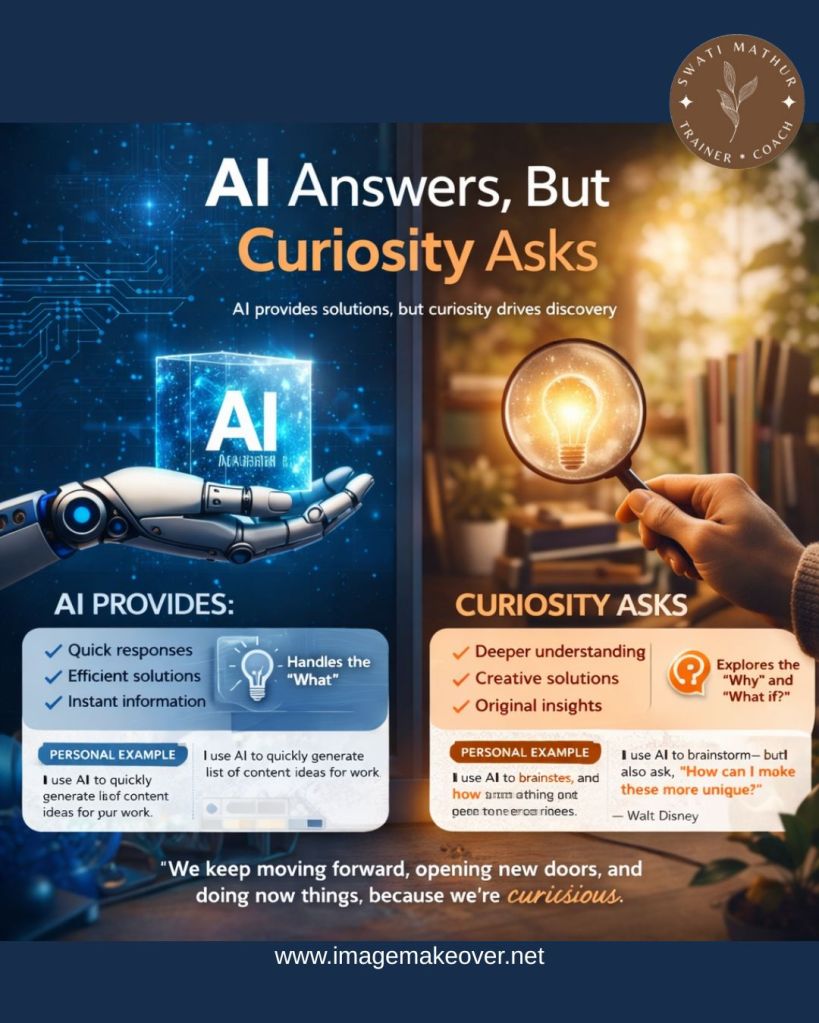
AI is built on data but curiosity is built on wonder. It pushes us to explore, what is possible?or what can be improved? and even what lies beyond the obvious?
Without curiosity, AI becomes just another tool. With curiosity, it becomes a gateway to endless possibilities.
Think about how children interact with the world. They keep asking “why?” not because they need immediate answers, but because they want to understand. That same mindset, when applied to AI, transforms learning into discovery.
AI Needs Curious Minds
AI doesn’t ask questions on its own, it responds to human prompts. The depth of it’s output depends on the depth of your thinking. A curious person will always experiment with AI tools, will ask better questions and discover creative solutions on the other hand a passive user will only scratch the surface.
For example, two students using the same AI tool to study where one simply asks for answers to homework questions and the other asks, “Can you explain this in a simpler way?”, “Can you give real-life examples?”, or “What happens if this concept is applied differently?” Over time, the second student doesn’t just complete assignments but they actually understand the subject deeply. That’s the power of curiosity.
Learning in the Age of AI
We live in a time where answers are instantly available. But easy answers can reduce the desire to explore deeper. Curiosity ensures that we don’t just accept answers, but question them. Don’t stop at convenience, but seek understanding
For instance, while working on content or presentations, it’s easy to let AI generate everything. But when you pause and ask, “Can I make this better?” or “What’s missing here?”, you start adding originality and insight.
As Walt Disney famously said:
“We keep moving forward, opening new doors, and doing new things, because we’re curious.”
Curiosity vs. Comfort
AI can make life comfortable but growth rarely happens in comfort.
Curiosity pushes you to learn new skills, step out of your routine and challenge assumptions. Take a simple workplace example, some professionals stick to basics like AI usage be it emails, summaries or quick tasks, while others explore deeper like automation, creative design, data insights. Over time, the difference in growth becomes visible.The tool is the same but the curiosity is not. Curiosity doesn’t always have to be big or technical. It can be simple. Say, asking how a recommendation algorithm works instead of just scrolling, exploring a new AI tool instead of sticking to familiar ones or trying different ways to solve the same problem.
Even personally, there are moments when you start using AI for a small task and then curiosity kicks in: “What else can this do?” That single question often opens up completely new possibilities.
In a world where AI can provide information instantly, curiosity becomes even more valuable. Because those who remain curious will not just keep up with change but they will also lead it.
AI can give you answers but curiosity will help you ask the questions that truly matter.
This post is part of Blogchatter A2Z challenge 2026
 Imagemakeover