
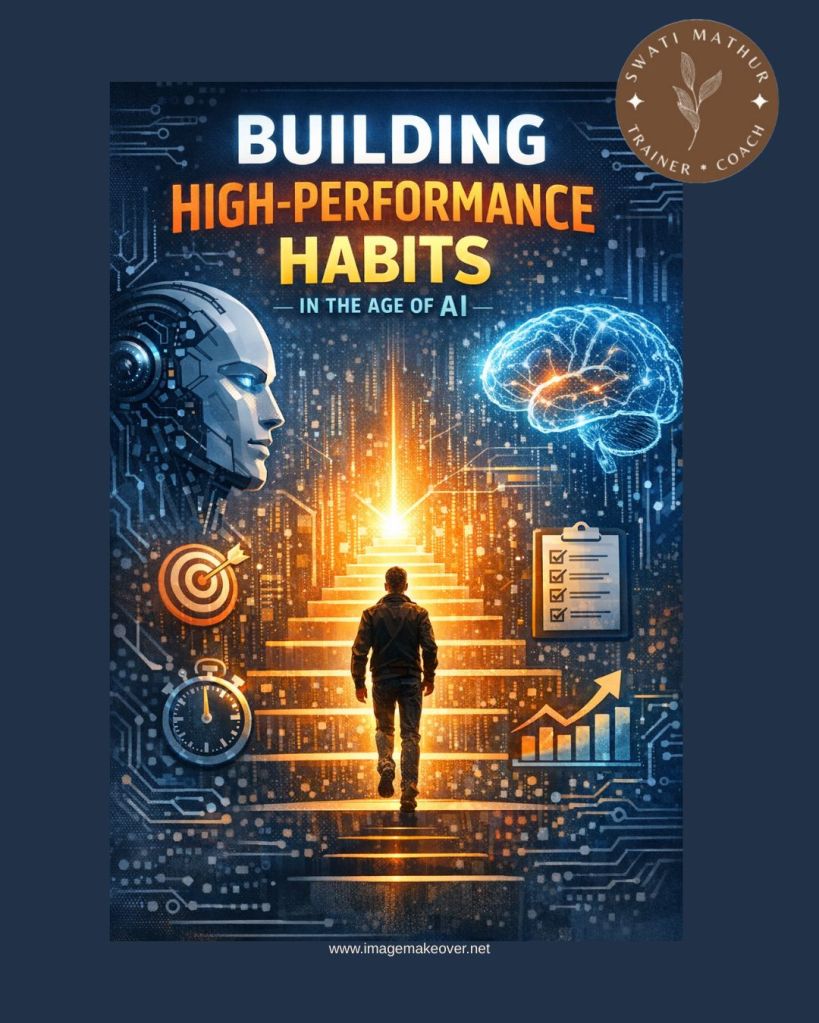
In the age of AI, your habits is not just your intelligence but it will define your success.
We often believe that intelligence, talent, or access to the right tools gives people an edge. But today, with Artificial Intelligence making knowledge accessible to everyone, the playing field has changed.
The real differentiator is no longer what you know, but what you repeatedly do. AI can not only give you answers in seconds or can simplify complex problems but it can even think alongside you. But there is one thing it cannot do and that is, it cannot build your habits. And that is exactly where your future is decide.
There was a time when information was limited. People who had knowledge had power but today, information is unlimited. Anyone with a smartphone can learn anything. So what matters now?
- Consistency over intensity
- Discipline over motivation
- Execution over intention
You don’t need to know everything, but what you really need is the habit of learning continuously. Imagine two students, one who studies only before exams, using AI to quickly prepare. and another one studies a little every day, using AI to understand deeply. The difference is not intelligence. The difference is habit. We need to remember success is not a one-time event, it is a system. and habits are that system. They operate quietly in the background, shaping your skills, thinking patterns, your confidence and your Identity. You don’t wake up one day confident instead you become confident by repeatedly doing things that build confidence.
Similarly, in the AI era, you don’t become future-ready overnight instead you build it through daily habits of learning, adapting, and applying.
AI has made life faster, but it has also made distractions stronger and patience weaker. This creates two kinds of people:
1. The Reactive User
- Uses AI for quick answers
- Avoids effort
- Seeks shortcuts
- Feels productive but isn’t growing
2. The Intentional Learner
- Uses AI to explore deeper
- Asks better questions
- Practices and reflects
- Builds long-term capability
The difference lies in one thing: habitual behavior. We often underestimate small actions because they don’t show immediate results. But transformation is never instant, it is accumulated. Consider these simple but powerful habits:
- Writing or journaling for 10 minutes daily
- Learning one new concept every day using AI
- Practicing speaking or communication regularly
- Asking “why” and “how” instead of just accepting answers
Individually, these feel small but collectively, they create exponential growth.
One of the most powerful ideas that I have come across is that “You don’t rise to your goals. You fall to your habits.” how beautiful and true. Your habits are constantly answering on every important question and that is “Who am I becoming?” If you practice daily, you will become disciplined, ff you avoid effort, you will become dependent and if you think deeply, you will become insightful. In the AI age, identity matters more than ever because tools are common but mindsets are not.
AI is powerful but how you use it depends on your habits. Use AI to learn, and not just to finish any tasks. It is extremely imperative to cross-check and validate information also learn to apply what you learn in real situations and also build original thinking alongside AI. Apart from empowering us there are certain things that we need to be cautious about, like not blindly trusting AI outputs, not to copy-past without understanding, not making enough effort because AI makes things easy and also not to become mentally passive.
Remember, If you don’t control your habits, your habits will control your future. Habits don’t show results immediately which is why people quit early. But over time, they create a powerful effect. For example 1% improvement daily leads to massive growth in a year and 1% neglect daily leads to gradual decline. A student who practices communication for just 10 minutes daily may not see change in a week. But in 6 months, their confidence can completely transform. Similarly, someone who avoids effort daily may not fail immediately but slowly loses competence.
In the age of AI, tools are available to everyone but discipline is not. And discipline is built through habits.
This post is part of Blogchatter A2Z challenge 2026
 Imagemakeover