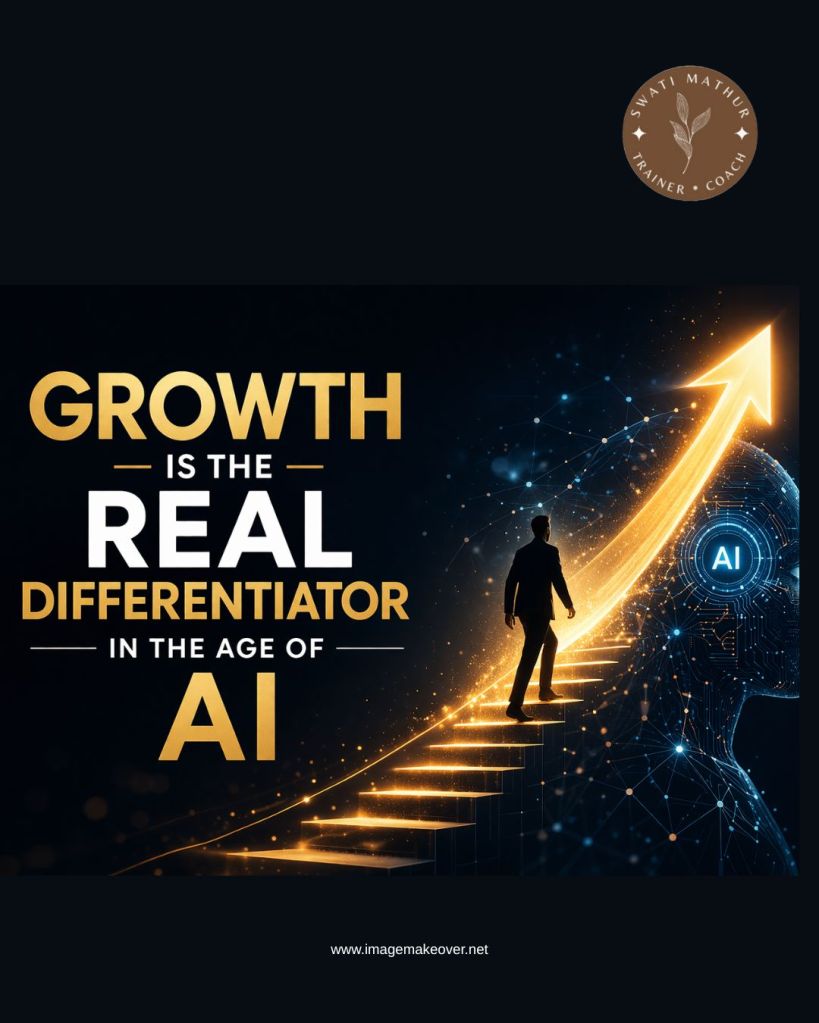
Growth Is The Real Differentiator In The Age Of AI #GrowthMatters

In a world where Artificial Intelligence is evolving every single day, the real question is not whether technology is growing but it is whether you are growing with it.

AI is not just changing industries, it is reshaping the way we learn, think, and adapt. But one thing that we all are aware that growth, unlike technology is not automatic. It is a conscious choice one that requires effort, awareness, and intention.

As John C. Maxwell wisely said,

And in the age of AI, this truth has never been more relevant. We often assume that having access to advanced tools will automatically leads to progress. But access does not guarantee growth but intentional effort definitely does. Today, almost everyone has access to AI, yet not everyone grows equally.

Consider this example, where, One person uses AI to complete tasks quickly and another uses AI to understand deeply, question ideas, and improve thinking. here both are using the same tool but only one is truly growing. This highlights an important reality that, access gives you opportunity where as effort turns it into growth. Therefore, without effort, AI becomes a shortcut. but, with effort, it becomes a learning accelerator.

AI has the potential to become one of the most powerful tools for personal and professional growth but only if you use it actively, and not passively. It can

  • Help you learn new skills faster
  • Provide instant explanations and feedback
  • Expose you to diverse perspectives
  • Encourage experimentation without fear

For example, a student preparing for exams can simply ask for answers or can go deeper by asking “Can you explain this in a simpler way?”, “Can you give real-life examples?” or “What are alternative ways to solve this?” This shift from answer-seeking to understanding transforms learning completely.

Similarly, a professional can use AI to,

  • Refine presentations
  • Improve communication
  • Brainstorm creative ideas

But growth only happens when you engage with the process and not when you depend entirely on the output. One of the biggest risks in the AI era is confusing convenience with growth. AI makes things easier and that is its strength but growth often happens when things are challenges.

If you always choose the easiest path your thinking becomes passive, your skills stop developing and your confidence becomes tool-dependent On the other hand, when you try solving problems yourself first and use AI to validate or refine this will reflect on what you have actually learned and that when you build real capability. Let’s understand this by simple example.
A person learning writing may use AI to generate content instantly. But someone focused on growth will write, edit, fail, improve, and then use AI to refine their work. Over time, the second person develops a strong voice, while the first remains dependent.

That difference is not talent it is effort and mindset.

At the heart of growth in the AI era lies one critical factor and that is mindset.

A fixed mindset believes that abilities are limited. It avoids challenges, fears failure, and often depends on shortcuts. In the context of AI, a fixed mindset might say, “Why should I try? AI can do it better anyway.” Over time, this thinking creates dependency, reduces confidence, and limits real progress.

On the other hand, a growth mindset believes that abilities can be developed with effort and learning. It embraces challenges, learns from mistakes, and uses tools like AI as support and not replacement. A growth mindset says, “AI can help me—but I will still think, learn, and improve. This difference may seem subtle, but it defines everything.

As a soft skills trainer, this is something I emphasize repeatedly to students. I often tell them that AI is not here to replace their intelligence but it is here to test their mindset. The real question is not how advanced the technology is, but how willing they are to grow alongside it.

In my sessions, I share a simple thought with students, If you use AI only to finish tasks, you may get quick results but if you use AI to learn, question, and improve, you build a future. I remind them that skills may become outdated, tools may change, but a growth mindset stays relevant forever. It is what helps you adapt, evolve, and stay confident even in uncertainty. Because in the end, success in the AI era will not belong to those who know the most tools but to those who are willing to keep learning.

Growth does not happen in comfort, it happens when you stretch yourself beyond what feels easy. AI can make life comfortable, but comfort can quietly limit progress.

Growth demands-

  • Asking deeper questions
  • Trying unfamiliar tools
  • Making mistakes and learning from them
  • Staying consistent even when results are slow

This is where mindset plays a crucial role.

As Carol Dweck said:

When you see challenges as opportunities, AI becomes a partner in exploration and not just a tool for convenience.

Adaptability is the Core of Growth

In the AI era, adaptability is no longer optional, it is essential. Technology will continue to evolve, and those who grow are those who stay open to learning.

Remember, AI will keep evolving with or without you. The real advantage lies in choosing to grow alongside it. Because growth is not about keeping up it is about becoming better than you were yesterday.

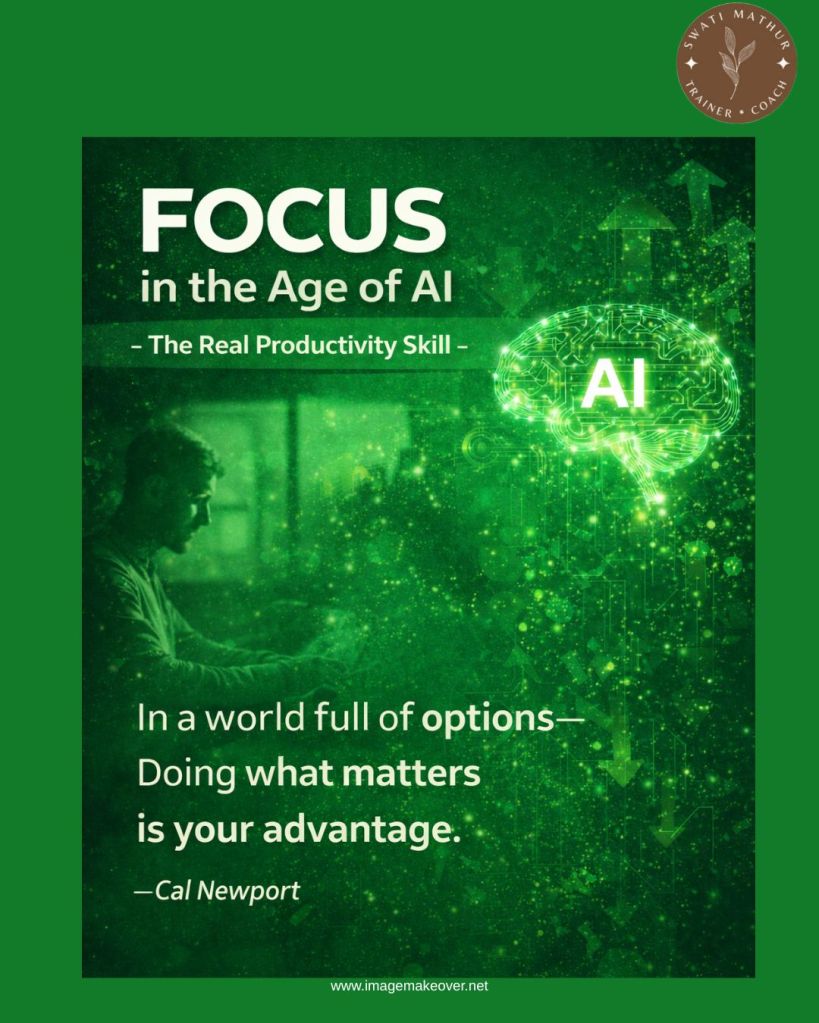
Focus in the Age of AI-The Real Productivity Skill #FocusMatters

In a world full of notifications, tools, and endless information, the real challenge is no longer access actually it is focus. We are surrounded by possibilities, powered by Artificial Intelligence that can generate ideas, automate tasks, and provide instant solutions. Yet, despite having more resources than ever before, many of us struggle to complete meaningful work. The reason is simple, AI gives us options, but focus helps us choose what truly matters.

As the author Cal Newport wisely said,

There is an interesting paradox that comes with the rise of AI. While it offers countless tools for writing, designing, coding, and learning, it also creates an environment of constant distraction. What begins as a productive intention often turns into scattered activity. For instance, you may start using one AI tool to write an article, then switch to another for better phrasing, explore a third for visuals, and eventually end up watching tutorials on the “best AI tools available.” Hours pass, yet the actual task remains incomplete. This is not productivity, it is attention being pulled in multiple directions. Psychologists describe this as decision fatigue, where too many choices reduce our ability to act effectively. In fact, research suggests that professionals spend a significant portion of their time switching between tasks rather than completing them, which reduces both efficiency and quality of work.

At its core, focus is not merely about avoiding distractions but it is about directing your energy with intention. It means doing one thing at a time and doing it well. Although multitasking is often celebrated, studies have shown that it can reduce productivity and increase errors. When you try to write, check messages, and use AI tools simultaneously, your thinking becomes fragmented. On the other hand, when you dedicate uninterrupted time to a single task, your work gains clarity and depth. Focus also requires giving your full attention to what you are doing. AI can generate output quickly, but it cannot replace your judgment, creativity, or understanding. For example, you may generate content in seconds using AI, but without thoughtful review and refinement, it may remain generic and uninspiring. It is your attention that transforms that output into something meaningful.

Another essential aspect of focus is the ability to complete what you start. One of the biggest productivity challenges today is the habit of leaving tasks unfinished. Constant notifications, easy access to multiple tools, and the temptation to switch tasks create mental clutter. You might begin working on a report, get distracted by a message, check an AI suggestion, and return later with reduced clarity. This cycle not only delays completion but also drains mental energy. In contrast, completing a task before moving on creates a sense of progress and builds momentum.

As Steve Jobs once said,

Using AI effectively requires a focused approach. Instead of jumping between multiple tools, it is far more beneficial to understand and master one or two tools deeply. Mastery brings efficiency, confidence, and better results, whereas constant switching leads to surface-level knowledge. Similarly, having a clear goal before using AI makes a significant difference. Without clarity, AI becomes a source of random exploration rather than purposeful action. A focused approach to AI can be as simple as,

  • Using one or two tools consistently instead of experimenting endlessly
  • Setting a clear intention before starting a task
  • Allocating separate time for learning and exploration
  • Asking clear, structured questions instead of multiple vague ones

These small shifts can dramatically improve both productivity and quality of work.

The quality of your interaction with AI also depends on the clarity of your thinking. Asking multiple vague questions often leads to scattered answers, while asking one well-structured question produces precise and meaningful results. This reflects an important truth: AI responds to the quality of human input. A focused mind naturally asks better questions and therefore receives better answers.

If you reflect on your daily routine, you may notice how often your attention shifts—between apps, tasks, and ideas. This is not a lack of ability but a lack of sustained focus. Even a small change, such as dedicating uninterrupted time to a single task, can significantly improve both productivity and satisfaction. Focus allows you to move from being busy to being effective.

In the end, AI expands your possibilities, but focus sharpens your direction. AI can give you speed, but focus gives you depth. AI can help you begin, but only focus ensures that you finish with purpose and quality. So yes, F is for AI. But more importantly, F is for Focus. Because in a world where everything demands your attention, the ability to concentrate on what truly matters is what will set you apart.

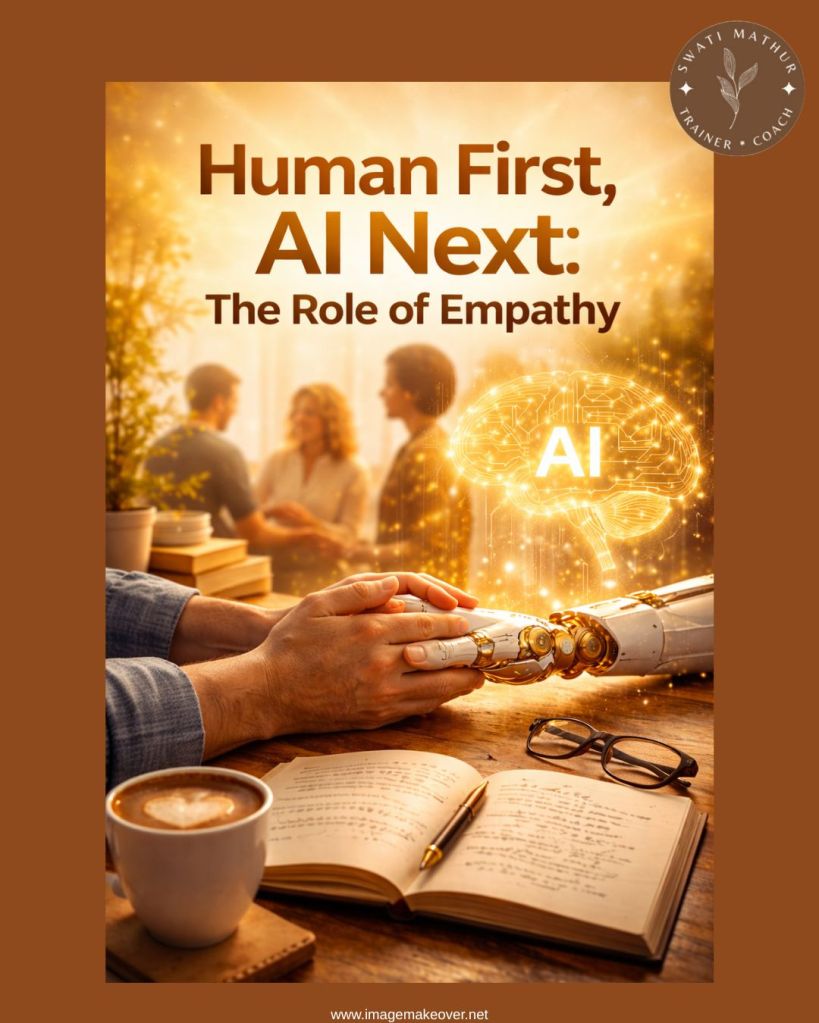
Human First, AI Next “The Role of Empathy” Because #EmpathyMatters

In a world driven by algorithms and automation, one human quality stands out more than ever is empathy.

AI can analyze behavior, predict preferences, and even simulate conversations. It can detect sentiment in text, recommend products based on past choices, and respond instantly. But it cannot truly feel. It does not understand pain, joy, struggle, or hope in the way humans do. And that is where empathy becomes our greatest strength.

Empathy: Beyond Data

On one hand AI works on data and on other hand empathy works on understanding.

Data can tell you what is happening while empathy helps you understand why it really matters. For instance, an AI system may detect that a customer has made multiple complaints. It flags the case as “high priority.” But a human, listening to the tone of the customer, may realize that the frustration is not just about the issue but about feeling unheard. That difference changes the response. AI may prioritize speed but a human adds care, patience, and reassurance. This is why empathy creates connection, not just resolution.

A well-known quote by Maya Angelou captures this beautifully:

Let’s understand this better with the example. An AI chatbot responds instantly “We apologize for the inconvenience. Your request is being processed.” But a human representative says: “I completely understand how frustrating this must be. Let me personally make sure this gets resolved for you.”

Both responses may solve the problem but only one builds trust.

According to studies in customer experience, over 70% of customers say they stay loyal to brands that show understanding and empathy. Speed matters but emotional connection matters more.

Empathy Matters More Today

As AI takes over repetitive and technical tasks, human roles are evolving.

We are moving from-

  • Task-based work to a Relationship-based work
  • Execution to Interaction
  • Information to Understanding

Empathy helps us in many ways be it-

🔹 Building Meaningful Connections

In a digital-first world, genuine human connection is becoming rare and therefore more valuable. For example a teacher using AI tools to prepare lessons can deliver information efficiently. But a teacher who understands a student’s fear, hesitation, or lack of confidence can truly impact their learning journey. Empathy turns communication into connection.

🔹 Communicate Effectively

Effective communication is not just about clarity, it’s about sensitivity.

For instance, a manager delivering feedback without empathy may sound critical. The same feedback, delivered with empathy, becomes constructive and motivating.

Empathy helps you choose, the right words, right tone and right timing.

🔹 Lead with Understanding

Leadership in the AI era is not just about making decisions, it’s about making humane decisions.

For example, an AI system may recommend layoffs based purely on efficiency metrics but a leader will always do with empathy by considering the human impact, alternative solutions and by long-term morale. Empathy ensures decisions are not just smart, but also responsible.

As Satya Nadella (CEO of Microsoft) once said

Empathy in Everyday Use of AI

Even when using AI, empathy quietly shapes the outcome. When you are creating a content AI can generate it quickly but empathy ensures it resonates. For example, If you’re writing for students, empathy helps you to simplify language, address their confusion and make content more relatable. Without empathy, content may be correct but not impactful. When you are Teaching or Explaining AI can provide explanations, but empathy helps tailor them. For example a curious learner may need depth on the other hand a struggling learner may need simplicity and encouragement. Empathy allows you to adjust and not just deliver. While making decisions AI often reduces people to data points numbers, patterns or probabilities.But humans are more than data. For example a hiring algorithm may reject a candidate due to lack of keywords but a human may recognize potential, passion, and adaptability. Empathy ensures we don’t lose human value in data-driven decision.

Think about a time when someone truly understood you when they listened without interrupting, responded without judging, and supported without conditions.That experience stays with you forever. Now imagine a world where every interaction is efficient but emotionally empty. That’s the gap empathy fills. AI may improve efficiency, process information, stimulate responses and can process information but empathy improves relationships and create meanings. Empathy builds trust because in a world of smart machines, being human is your greatest strength.

Staying Ahead in Today’s Fast-Paced World: The Key to Success

In an era where change is the only constant, staying ahead requires agility, adaptability, and a forward-thinking mindset. The rapid evolution of technology has presented both opportunities and challenges, making it imperative for professionals to equip themselves with the right tools and skills. Among the many factors influencing success, three crucial elements stand out: Artificial Intelligence (AI), Soft Skills, and the Willingness to Embrace New Tools.

AI has redefined the way industries operate, transforming everything from business processes to customer interactions. What was once the subject of sci-fi fantasies is now an everyday reality, with AI-powered tools seamlessly integrating into our personal and professional lives.

For instance, global giants like Amazon and Netflix leverage AI-driven recommendation systems to enhance user experiences, while tools like Grammarly and Hemingway Editor assist writers in refining their content. Similarly, AI-powered chatbots streamline customer service, predictive analytics aid in decision-making, and automation tools help businesses enhance efficiency.

Understanding AI and its applications is no longer optional—it’s essential. Professionals who embrace AI can automate mundane tasks, improve productivity, and gain data-driven insights that drive smarter decision-making. Staying informed about emerging AI trends and developing AI literacy can give individuals a competitive edge in today’s job market.

While hard skills provide the technical expertise necessary to perform specific job functions, soft skills are what set professionals apart in the modern workplace. As automation and AI take over repetitive tasks, the importance of human-centric skills has never been greater. Soft Skills—such as emotional intelligence, adaptability, communication, and leadership—are now recognized as key differentiators in professional success.

In workplaces driven by collaboration, professionals with strong interpersonal skills can effectively manage teams, navigate conflicts, and build lasting relationships with colleagues and clients. Creativity and critical thinking also play a pivotal role, allowing individuals to solve complex problems and contribute innovative ideas in an increasingly automated world.

Nothing can replace hard skills, as they form the foundation of any professional expertise. However, possessing strong soft skills enhances one’s ability to apply technical knowledge effectively. Investing in Soft Skills is just as crucial as staying updated on technical advancements. Developing leadership abilities, honing communication skills, and practicing empathy can enhance one’s career prospects and foster a more inclusive and effective work environment.

Technology is evolving at an unprecedented pace, and professionals who resist change risk falling behind. To stay ahead, embracing new tools and acquiring relevant skills is essential.

For instance, marketers must stay updated on emerging social media platforms and digital marketing tools to engage audiences effectively. Similarly, software developers need to learn new programming languages and frameworks to remain competitive in the industry. Even traditional sectors like finance and healthcare are adopting tech-driven solutions, making digital literacy a must-have skill.

Continuous learning and upskilling help professionals remain relevant, enhance productivity, and drive innovation. Those who proactively seek out new tools and technologies are better equipped to adapt to industry shifts and capitalize on emerging opportunities.

Success in today’s fast-paced world requires a dynamic and proactive approach. By focusing on Artificial Intelligence, Soft Skills, and Embracing New Tools, professionals can future-proof their careers and thrive in an evolving landscape. Lifelong learning, adaptability, and curiosity will be the defining factors of success. As industries continue to transform, those who embrace change, harness technology, and prioritize human connections will unlock new opportunities and drive meaningful innovation. The key to staying ahead lies in continuous growth and an unwavering commitment to evolution.